11 min read Alle Artikel auf Deutsch Tous les articles en français Todos os artigos em português
Meaning of Negotiation: Definition, BATNA
The short answer
Negotiation is a back-and-forth exchange between two or more parties who share some interests and compete on others. The goal is an agreement each side prefers to walking away. Each party works out its BATNA (best alternative to a negotiated agreement) and sets a walk-away point from it. Then the parties trade concessions across several terms, such as price, scope and timing. A deal happens when an offer falls inside both sides' limits. If no offer does, someone walks.
In this article
- What is the meaning of negotiation?
- How does a negotiation actually work?
- What is BATNA in negotiation?
- What are the 7 stages of negotiation?
- What does "negotiable" mean, and what's a better word for negotiation?
- Where do negotiations go wrong?
- Where does a B2B negotiation start?
- Related sales terms people look up
- Questions people ask
What is the meaning of negotiation?
Negotiation means two or more parties discussing terms back and forth until they reach an agreement that none of them could settle alone. It only happens when the parties share some interests and compete on others. A buyer and a seller both want the deal but disagree on price, scope or timing, and if no offer beats what each side can do without the deal, there's no agreement.
Merriam-Webster and Cambridge Dictionary, the sources Google's AI overview cites for this search (as of November 2026), both define negotiation as discussion aimed at reaching an agreement. The overview adds the condition about shared and competing interests. If the parties share nothing, there's nothing to agree on. If nothing competes, there's nothing to negotiate, and you just say yes.
Different fields stress different parts of that meaning. The definitions ranking for this search fall roughly into these groups:
| Context | What negotiation means there | What it's usually about |
|---|---|---|
| Everyday or dictionary sense | Discussion between parties aimed at reaching an agreement | Anything: a deadline, a household decision, a schedule |
| Legal sense (as USLegal phrases it) | A communication process meant to reach a compromise or agreement that satisfies both parties | Settlements and disputes, before or instead of going to court |
| Procurement sense | The buyer and supplier agreeing price, terms and conditions before a contract or order is placed | Price, payment terms, delivery and liability |
| B2B sales sense | The stage between a verbal yes and a signed contract | Discounts, contract length, scope and start date |
Here's a concrete case. A buyer likes a software vendor's product but wants a lower price. The vendor won't move on price, but it offers a two-year term with a fixed start date. The buyer gets predictable costs and the vendor gets a longer commitment. Neither side got what it first asked for, and each took something it preferred to walking away. That's a negotiation, not just a haggle over price.

How does a negotiation actually work?
Under the small talk, every negotiation runs on the same four parts:
- Positions: what each side says it wants, such as "a lower price" or "a three-year contract".
- Interests: why it wants that, such as budget certainty, fear of lock-in or a quarter-end target. Trades happen at the level of interests, not positions.
- BATNA: what each side will do if the talks fail. This sets how much pressure each party is really under.
- Reservation point: the worst deal a side will accept, worked out from its BATNA. The range where both sides' reservation points overlap is often called the ZOPA (zone of possible agreement).
When the two sides' limits don't overlap, there's no deal, however skilled the negotiators are. When they do overlap, the bargaining decides where in that range the deal lands. Negotiating several terms at once (price, payment timing, scope, support level, contract length) lets each side trade concessions that cost it little for ones the other side values. If you negotiate price alone, every concession is a straight loss for one side.
What is BATNA in negotiation?
BATNA stands for Best Alternative To a Negotiated Agreement. Roger Fisher and William Ury introduced the term in their book Getting to Yes. It's the course of action you'd actually take if this negotiation produced nothing. For a buyer, that might be staying with the current supplier, building in-house or choosing the runner-up vendor. For a seller, it might be another deal in the pipeline, or holding the price and losing this one.
Your BATNA tells you when to stop. Refuse any offer that's worse than your BATNA, because walking away leaves you better off. Two mistakes come up again and again. The first is overrating your BATNA, for example assuming a competitor will offer the same terms without checking. The second is having no BATNA at all, which makes every concession feel compulsory. Improving your BATNA before the talks start, say by getting a second quote, changes the negotiation more than any tactic used during it.
A worked example from a software renewal: the procurement lead holds the incumbent's renewal quote and a written quote from a second supplier, plus a note from IT on what switching would involve. That second quote plus the switching effort is the BATNA. The incumbent's sales rep, meanwhile, knows the account is up for renewal in the same quarter as two new deals. The rep's BATNA is weaker if those new deals are uncertain. Neither side sees the other's BATNA directly, so both spend the information-exchange stage testing it with questions like "what happens if this doesn't go ahead?"

What are the 7 stages of negotiation?
There's no single official list. Training programmes divide the process into different numbers of stages, and seven is just one common way to split it. This seven-stage version matches how B2B deals move in practice:
- Preparation: define your goals, your BATNA, your reservation point and the terms you can trade.
- Relationship building: find out who decides, who influences and how each side prefers to communicate.
- Information exchange: ask about interests and constraints before anyone names a number.
- Opening: one side makes the first offer, ideally with the reasoning behind it.
- Bargaining: trade concessions on several terms and attach a condition to each one ("if you sign for two years, we can…").
- Closing: confirm every agreed term in writing, including the dull ones like the start date and notice period.
- Implementation: deliver what was agreed. A deal that fails here gets renegotiated, usually on worse terms.
Stages get skipped all the time, and skipping stage three causes the most trouble. A team that jumps straight to an opening offer has to guess which terms the other side values.
What does "negotiable" mean, and what's a better word for negotiation?
"Negotiable" means open to discussion and change rather than fixed. "Salary negotiable" in a job ad means the figure shown is a starting point. The word also has a narrower finance sense: a negotiable instrument, such as a cheque, can be transferred to someone else. "Non-negotiable" is the opposite and describes a fixed condition. Say early on which terms are non-negotiable, so the other side doesn't waste effort on them.
Synonyms can't always be swapped in. Each one shifts the meaning a little:
- Bargaining: close to negotiation, but it suggests a focus on price.
- Haggling: informal, and it suggests small stakes and lots of back-and-forth over one number.
- Talks: neutral and common in news coverage ("trade talks").
- Deliberation: discussion to reach a decision, often within one side rather than between two.
- Mediation: not a synonym. A neutral third party helps the parties negotiate but doesn't decide for them.
- Arbitration: also not a synonym. A third party makes a decision the parties have agreed to accept.

Where do negotiations go wrong?
Most negotiations fail for a reason you could name in advance:
- No BATNA prepared: one side can't judge whether an offer is good, so it accepts or refuses on instinct.
- Single-issue talks: when only price is on the table, every move is a win for one side and a loss for the other, so talks stall.
- Concessions with no condition: giving a discount without asking for anything back teaches the other side to wait for the next one.
- Splitting the difference by reflex: it rewards whoever opened with the more extreme number.
- Agreeing to things you can't deliver: promising scope or dates the team can't meet to close the deal just moves the conflict into implementation.
- Verbal-only agreement: if nobody writes the terms down, each side remembers them differently.
Promising more than the team can deliver is common enough to have its own idiom, explained in our piece on over promise and under deliver meaning. When the other side pushes back on price or timing, treat it as an objection and work through it, as our guide to sales objection handling steps and replies describes.
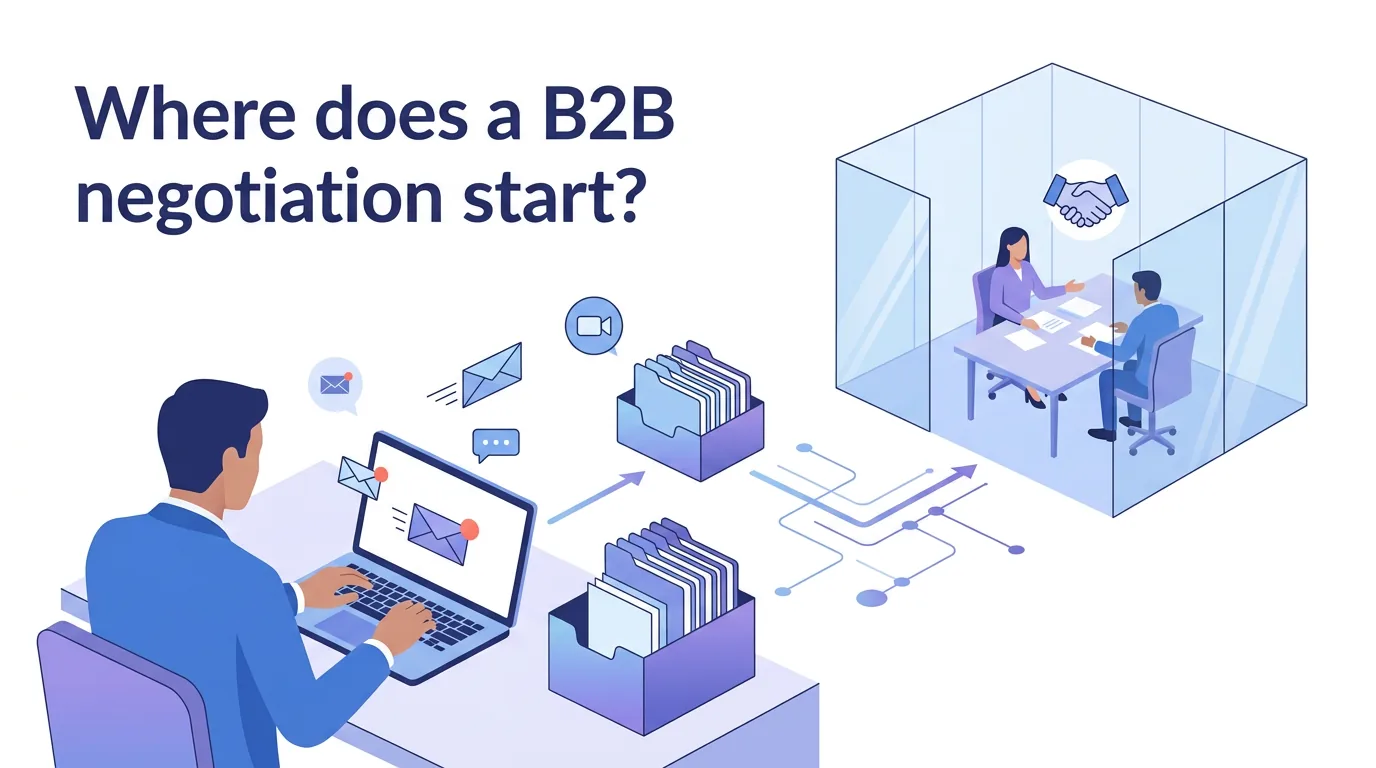
Where does a B2B negotiation start?
In B2B sales, negotiating over terms usually comes late. Before that, someone had to agree to a first conversation, and that conversation often starts with a cold email. Negotiating by email has one practical advantage: every offer and concession is written down in a thread that both sides can check later. Replies only stay in one thread if the mail client links them through the reply headers, as our explainer on email thread meaning and how threading works shows. The downside of email is that tone gets lost, which is why some sellers put a face to the first contact.
That's where EmailFlow OS comes in. It's an EmailFlow OS product for personalised AI video email in B2B cold outreach. You record one video and upload it, connect your own Brevo account and sending domain, and import your prospect list into EmailFlow OS. EmailFlow OS then creates a personalised version of that recording for each recipient, not one per company. Each version goes out from your own inbox, through your Brevo account and your sending domain, never through a shared platform sender. Your domain, your DNS records and your Brevo account stay under your control. Whether a reply turns into a negotiation still depends on your offer. The setup is described on the EmailFlow OS personalised video email home page.
Related sales terms people look up
These terms come up in the same deals and email threads as negotiation. Each row stands on its own:
| Term | Meaning | Where it touches a negotiation |
|---|---|---|
| Camera shy meaning | Feeling uncomfortable or reluctant about being photographed or filmed | Camera-shy sellers often avoid video calls and video email, which leaves early rapport-building to text alone |
| Camera-shy meaning (hyphenated) | Same meaning as camera shy. The hyphen is used when the word comes before a noun, as in "a camera-shy founder" | Same as above. The hyphen is a spelling convention, not a different meaning |
| EOD meaning | End of day, a deadline at the close of the working day. In other contexts it can mean explosive ordnance disposal | An "EOD" deadline on an offer is unclear across time zones, so give the date, time and zone in writing |
| Blast email meaning | One identical message sent to a whole list at once, with nothing tailored to each recipient | Blasts suit announcements. A negotiation needs one-to-one messages that refer to what was agreed |
| ACV sales meaning | Annual contract value: the contract's value converted to a one-year figure. Definitions differ on whether one-off fees count | Multi-year discounts change ACV and total contract value differently, so agree which figure you're negotiating |
For more detail, see camera shy meaning and a one-take video fix, EOD meaning and deadline uses, what an email blast is and its limits, and the ACV in sales formula with examples.
Questions people ask
- What is the meaning of negotiation in simple words?
- Negotiation is talking with someone to agree on terms that neither of you can set alone. Merriam-Webster and Cambridge Dictionary, the sources Google's AI overview cites for the term (as of November 2026), define it as discussion aimed at agreement. Example: a supplier keeps its price but adds a fixed delivery date, and the buyer accepts because the date matters more to it than a discount.
- Is negotiation the same as bargaining?
- Not quite. Bargaining usually means haggling over one quantity, most often price, where one side's gain is the other's loss. Negotiation is the wider term. It can cover several issues at once, such as price, scope, timing and support, so each side can trade concessions the two sides value differently. Every bargain is a negotiation, but many negotiations involve no haggling at all.
- What does negotiable mean?
- Negotiable means open to discussion and change rather than fixed, as in "salary negotiable", where the stated figure is a starting point. In finance, a negotiable instrument such as a cheque is one that can be transferred to another person. The opposite, non-negotiable, marks a condition that won't change. Naming non-negotiable terms early stops the other side spending effort on them.
- What is the difference between negotiation and mediation?
- In a negotiation, the parties reach agreement themselves. In mediation, a neutral third party guides the discussion, helps each side state its interests and suggests options, but has no power to decide. If mediation fails, the parties go back to negotiating alone or move to arbitration, where a third party's decision binds them because they agreed to that in advance.
- Can you negotiate a B2B deal by email?
- Yes. Many terms get settled that way because email leaves a written record of every offer. Its limits are tone and speed: a blunt counter-offer reads harsher in text than it would sound on a call. Keep each issue in one thread, restate agreed terms in full instead of writing "as discussed", and switch to a call when the talks stall on one point.
- What is a reservation point in negotiation?
- A reservation point is the least favourable deal you'll accept before you walk away. You work it out from your BATNA: if your alternative is a competitor's offer, your reservation point is the set of terms that makes this deal exactly as good as that one. It's different from your target, which is what you're aiming for. Keep it private, because revealing it sets the price.
