10 min read Diesen Artikel auf Deutsch lesen Lire cet article en français Ler este artigo em português
Challenger Sales Model: Steps and Follow-Ups
The short answer
In the Challenger sales model, reps teach, tailor and take control. They give the buyer an insight that changes how the buyer sees their own problem. They adapt that insight for each stakeholder. Then they push toward a concrete next step instead of waiting. The model comes from Dixon and Adamson's 2011 book The Challenger Sale. In email, that means every follow-up carries one reframing point, is written for one person and ends with one specific ask.
In this article
- What is the Challenger sales model?
- How does a Challenger sales conversation run, step by step?
- Challenger vs SPIN, Solution Selling, MEDDIC and Sandler: which fits?
- Is Challenger sales still relevant?
- Follow-up sales emails written the Challenger way
- What should a follow-up sales email do?
- Follow-up email after a sales call
- Follow-up sales email format
- Follow-up sales email template
- Follow-up sales email sample for a second stakeholder
- Follow-up email templates for sales: one per stage
- Why your follow-ups need your own sending domain
- How EmailFlow OS sends a tailored video follow-up
- Questions people ask
What is the Challenger sales model?
The Challenger sales model is a B2B selling method. Matthew Dixon and Brent Adamson set it out in their 2011 book The Challenger Sale, which Google's AI overview for this search also gives as the model's origin. The book sorts sales reps into five profiles: the Hard Worker, the Relationship Builder, the Lone Wolf, the Reactive Problem Solver and the Challenger. The authors argue that the Challenger wins complex deals by changing how the buyer thinks about a problem, not by being the most likeable person in the room.
The method rests on three behaviours. Teach: bring an insight the buyer doesn't have yet, usually about a cost or a risk they underestimate. Tailor: adapt that insight for each stakeholder, so finance hears about cost exposure and operations hears about workload. Take control: talk openly about money and next steps, and don't let a deal stall just to avoid an awkward conversation. To see how the Challenger compares with the other four rep types, read our article on types of salespeople, which covers each profile.
Here's an example. A rep selling invoice automation doesn't open with features. They open with this point: the buyer's month-end close slips because approvals pile up in one inbox, and hiring more people won't fix a routing problem. The product only comes up after the buyer accepts that framing.
How does a Challenger sales conversation run, step by step?
The book calls its teaching sequence the commercial teaching choreography. It has six steps, and the order matters because the product only appears in the last one:
- Warmer: show you understand the buyer's situation by naming problems that similar companies face, and let the buyer confirm or correct you.
- Reframe: present the insight that changes the picture. For example, the real problem isn't the one they budgeted for.
- Rational drowning: back the reframe with data or a worked calculation, so it's more than an opinion.
- Emotional impact: show what the problem looks like in their own team's working day, so an abstract number becomes something they recognise.
- A new way: describe what solving the problem would take, still without naming your product.
- Your solution: show how your offer delivers that new way, and nothing beyond it.
Here's where it goes wrong. If you skip the warmer, the reframe sounds presumptuous. If the reframe isn't true for this buyer, the rational drowning step collapses at the first question. And if you mention the product early, the buyer hears the whole conversation as a pitch, and the teaching loses its credibility.
Challenger vs SPIN, Solution Selling, MEDDIC and Sandler: which fits?
When people ask for the top five sales methodologies, they usually mean these five. They don't all solve the same problem. Challenger and SPIN shape the conversation itself, while MEDDIC is mainly a qualification checklist, so many teams use one of each. Our comparison of sales methodologies covers more frameworks in the same format.
| Methodology | Core idea | What the rep mainly does | Fits best | Where it stops |
|---|---|---|---|---|
| Challenger | Teach, tailor, take control | Brings a reframing insight and steers toward the next step | Complex B2B deals with several stakeholders and a status quo to break | Needs real, defensible insight; without it, reps just sound pushy |
| SPIN Selling (Neil Rackham) | Situation, Problem, Implication, Need-payoff questions | Asks questions so the buyer works out the cost of the problem themselves | Consultative sales where the buyer already senses a problem | Slow if the buyer doesn't recognise any problem yet |
| Solution Selling | Sell a solution to a diagnosed pain, not a product | Diagnoses pain and maps the offer onto it | Buyers who know their pain and are looking for a fix | Depends on the buyer's own diagnosis being right |
| MEDDIC / MEDDPICC | Qualify on metrics, economic buyer, decision criteria and process, pain, champion | Checks whether a deal is real and who decides | Forecasting and long enterprise cycles | Tells you whether to pursue, not what to say |
| Sandler | Mutual agreement on agenda, pain and budget before presenting | Sets up-front contracts and qualifies out early | Teams that lose time on prospects who were never going to buy | Can feel scripted to buyers who expect a peer conversation |
Is Challenger sales still relevant?
Yes, as long as your offer changes something the buyer currently does wrong or can't see. It's a poor fit when the buyer already knows exactly what they want and is comparing quotes. In that situation, teaching them about their own business only slows the deal down. It also struggles in small, transactional sales, where nobody can justify a six-step conversation.
Most failures come from how teams apply the model, not from the model itself:
- Taking control turns into pressure. The book means controlling the agenda and the next step, not overriding the buyer's objections.
- The insight is generic. A reframe that could apply to any company reads like a template, and buyers notice.
- There's no tailoring. Sending the same message unchanged to the CFO and the team lead ignores the second behaviour entirely.
- Relationship work gets dropped. The book doesn't say relationships don't matter, only that they don't win a deal on their own.
When a buyer pushes back on your reframe, treat it as an objection, not a debate to win. The steps in our guide to sales objection handling apply here too: ask what's behind the pushback before you answer it.
Follow-up sales emails written the Challenger way
What should a follow-up sales email do?
In a Challenger cadence, a follow-up email isn't a reminder. Each one carries a single piece of teaching: a number, a comparison or a consequence the buyer hasn't thought about. It's written for the one person who receives it and ends with one concrete ask. A follow-up that only says you're checking in adds nothing. Send it as a reply in the existing thread so the earlier context stays visible.
Follow-up email after a sales call
After a call, write down the reframe the buyer agreed with, in their own words if you can. Add the one piece of evidence you promised, then propose a dated next step with named attendees. That's the take-control behaviour in writing. Our article on the follow-up email after a sales call has more templates for each call outcome.
Follow-up sales email format
- Subject: keep the original subject and send the email as a reply in the same thread.
- Line 1: what you agreed on, in one sentence.
- Lines 2–3: one new insight, tailored to this reader's role.
- Line 4: one ask, with a date or a specific choice.
- Signature: your name, role and company domain, matching the sending address.
Follow-up sales email template
Hi [First name], on [day of call] you said approvals are what hold up month-end. One thing we didn't cover: when every approval goes through one inbox, a single absence stops the whole queue. Hiring more people won't change that. Could we go through your approval routing with [Finance lead] on [option A] or [option B]?
Follow-up sales email sample for a second stakeholder
Hi [First name], [Colleague] and I talked about month-end delays. From the finance side, the issue is less about speed and more about exposure: invoices approved late miss their payment terms. Would a short overview of where your approvals get stuck be useful before the review on [date]?
Follow-up email templates for sales: one per stage
- No reply to first contact: restate the reframe in one sentence from a different angle and ask a yes/no question.
- After a demo: name the one capability that answered their stated problem and propose the stakeholder meeting.
- Stalled deal: spell out what waiting costs them, as they described it, and offer two dated options.
- Closing the loop: say you'll stop writing and leave the insight with them, so they can come back to it.
Our sales follow-up email template collection has the full wording for each of these stages.
Why your follow-ups need your own sending domain
A Challenger follow-up only works if the buyer sees it as coming from the rep they spoke to. That means sending from your own address on your own domain, with SPF, DKIM and DMARC published in that domain's DNS. SPF is a TXT record that lists the servers allowed to send for the domain. DKIM signs each message with a private key, and the receiver checks the signature against the public key published in your DNS. DMARC tells receivers whether those checks have to align with the domain in the From address, and what to do with mail that fails. If DKIM signs with a different domain than the one in the From address, DMARC alignment fails even when the signature itself is valid. Our guide to DKIM, DMARC and SPF for cold email senders walks through the records step by step.
The receiving server decides where each message is filed, and correct records don't take that decision away from it. What they do is give the receiver a sender it can verify. They also tie the sending history of your follow-ups to your own domain, not to an address shared with other senders.
How EmailFlow OS sends a tailored video follow-up
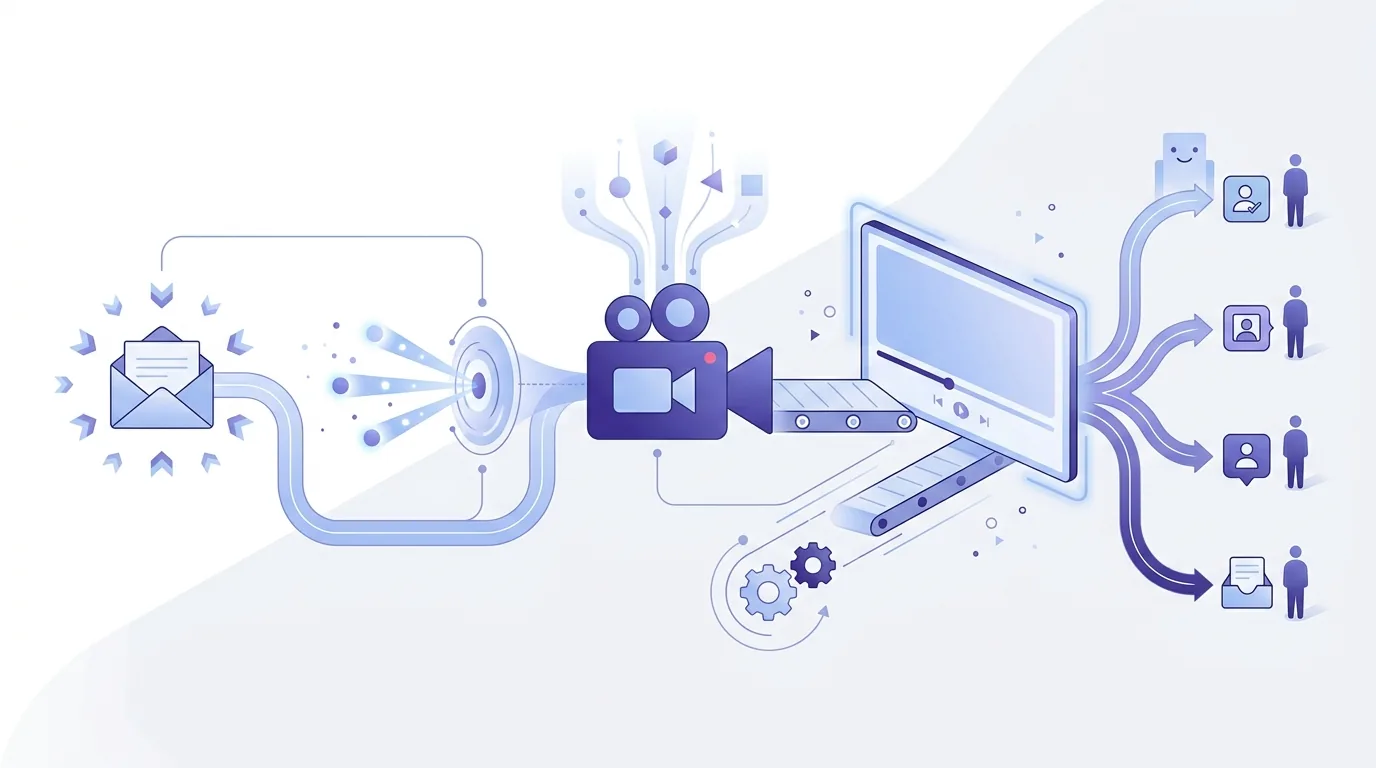
This section describes our own product, a EmailFlow OS product. You record one video that walks through your reframe and upload it to EmailFlow OS. You also import your prospect list, which stays in EmailFlow OS. EmailFlow OS then personalises that single recording for each recipient, not each company, so two stakeholders at the same account each get their own version. Every version goes out from your own inbox, through your own Brevo account and your own sending domain, which you connect and stay in control of. Nothing is sent through a shared platform sender. The DNS records, the Brevo account and the domain stay with you. The EmailFlow OS home page explains the setup.
What it doesn't do is write your insight. If the reframe in the recording is generic, every personalised version carries the same generic point. You still decide how to tailor the content for finance or operations, both when you record and when you build your list. Our article on the personalized video message for cold email covers per-recipient video in more detail.
Questions people ask
- What is the 3-3-3 rule in sales?
- There's no standard definition. It's a mnemonic, and the versions in circulation differ. Most describe a quick research habit: find three facts about the prospect within a few minutes before you reach out, so your first message refers to something specific. It isn't part of The Challenger Sale. Unlike Challenger's teach, tailor and take control, it tells you how to prepare, not how to steer the conversation.
- What are the 5 C's in sales?
- The 5 C's is a list that different trainers fill in differently. Common versions include clarity, confidence, credibility, connection and commitment. It's a checklist of rep qualities, not a methodology with steps. Challenger, by comparison, defines a rep profile and a six-step teaching sequence, while MEDDIC defines qualification criteria for a single deal.
- Can the Challenger sales model work in cold email?
- Partly. A cold email can handle the warmer and the reframe: one sentence showing you know the buyer's situation and one claim that challenges it. Rational drowning and emotional impact need more room, so they belong in the call or a follow-up. In cold email, taking control means one specific ask, not pressure. A five-paragraph teaching email usually goes unread.
- What's the difference between Challenger and SPIN selling?
- Challenger tells the buyer something new and backs it with evidence. SPIN uses Situation, Problem, Implication and Need-payoff questions so the buyer reaches the conclusion themselves. Challenger suits buyers who don't yet see the problem. SPIN suits buyers who sense the problem but haven't measured what it costs them.
