13 min read Alle Artikel auf Deutsch Tous les articles en français Todos os artigos em português
MEDDIC Sales: Letters, Versions, Follow-Ups
The short answer
MEDDIC is a B2B qualification framework. For each deal you record Metrics, Economic Buyer, Decision Criteria, Decision Process, Identify Pain and Champion, and any letter left blank counts as an open risk. MEDDICC adds Competition, and MEDDPICC adds Paper Process. Store each letter as a field on the opportunity in your CRM. Then use each follow-up email to close one specific gap: one question per letter, sent to the person who can answer it.
In this article
- What does MEDDIC stand for in sales?
- MEDDIC example: one deal, scored letter by letter
- MEDDIC, MEDDICC or MEDDPICC: which version should you run?
- When is MEDDIC the wrong framework?
- Which tools track MEDDIC fields?
- Follow-up sales emails that fill MEDDIC gaps
- What should a follow up sales email do?
- Follow up email format for sales
- Follow up sales email template
- Follow up email templates for sales, by MEDDIC letter
- Follow up sales email example
- Follow up sales email sample: two people at one account
- Sending MEDDIC follow-ups from your own domain
- Video follow-ups per recipient: a EmailFlow OS product
- Questions people ask
What does MEDDIC stand for in sales?
MEDDIC sales is a qualification framework for complex B2B deals. For every opportunity the rep collects evidence on six points: Metrics, Economic Buyer, Decision Criteria, Decision Process, Identify Pain and Champion. A deal only counts as qualified when each letter is backed by something the buyer said or did, not by the rep's impression. Google's AI overview for this search (citing salesforce.com and meddicc.com, as of November 2026) traces the framework to PTC in the 1990s, where it was built to make forecasts more accurate.
The six letters aren't stages you move through in order. They're six facts you either have evidence for or don't. A rep who thinks a deal is qualified but can't fill in the Economic Buyer field with a name and a meeting date is working from a guess.
| Letter | Question it answers | Evidence that counts | What a blank means |
|---|---|---|---|
| Metrics | What measurable gain does the buyer expect? | A number the buyer stated, e.g. hours saved or cost avoided, in their words | You can't build a business case, and the price looks arbitrary |
| Economic Buyer | Who can approve the spend? | A named person you have spoken to or written to directly | The deal can stall at the last step with no warning |
| Decision Criteria | What will they judge options on? | A written or stated list: technical, commercial, legal | You get compared on criteria someone else set |
| Decision Process | Which steps, people and dates lead to a yes? | A sequence with owners and dates, confirmed by the buyer | Your close date is your own invention |
| Identify Pain | What problem costs them enough to act now? | A consequence the buyer described, not a feature they liked | No urgency, so 'not this quarter' wins |
| Champion | Who inside sells for you when you're not in the room? | Someone who has done something: shared internal info, set up a meeting | You have a friendly contact, not an advocate |
The usual mistake is filling a field because a contact sounded positive. "Champion: Sarah, very keen" isn't evidence. "Champion: Sarah, forwarded our proposal to the CFO and booked the review" is. If you need help wording the questions behind each letter, the qualifying questions sales examples by stage map well onto the six fields.

MEDDIC example: one deal, scored letter by letter
Here's an illustrative deal, not a customer: a vendor of reconciliation software is talking to the finance team of a mid-sized company after one discovery call. The record below shows what's filled, what isn't, and what the blank tells the rep to do next. The same deal runs through the follow-up examples further down.
| Letter | What's recorded after call one | Status |
|---|---|---|
| Metrics | Buyer said the team loses two days each month to manual matching | Filled, in the buyer's words |
| Economic Buyer | CFO named by the contact; no direct conversation yet | Partial: name only, no contact |
| Decision Criteria | Must connect to the existing ERP; no written list yet | Partial |
| Decision Process | Nothing recorded | Blank: close date is a guess |
| Identify Pain | Month-end close slips, which delays board reporting | Filled |
| Champion | Finance manager, friendly but hasn't acted yet | Not yet: no action taken on the vendor's behalf |
Read it as a to-do list. The next email should ask about the Decision Process, because without it the forecast date means nothing. The one after should test the champion by offering something they can pass to the CFO. If they forward it, Champion and Economic Buyer both move forward.
MEDDIC, MEDDICC or MEDDPICC: which version should you run?
MEDDICC adds a second C for Competition: who else is being evaluated, and that includes doing nothing or building it in-house. MEDDPICC also adds P for Paper Process, meaning the steps from verbal yes to signed contract: procurement, legal review, security questionnaires, vendor onboarding and who signs. In the MEDDPICC sales process, Paper Process is its own item because it runs on different people and timelines from the Decision Process. A business sponsor can say yes in a week, and procurement can still take its own time after that.
- Run MEDDIC when deals involve a handful of people and contracts are standard. Six fields are easier to keep honest than eight.
- Run MEDDICC when you regularly lose to a named alternative or to the status quo and nobody records it until the loss review.
- Run MEDDPICC when deals slip after verbal approval because of procurement or legal, which is common in enterprise and public-sector sales.
Whichever version you pick, every rep should use the same one. Mixed versions in one CRM give you fields that are empty for some deals by design and empty for others by neglect, and nobody can tell which is which. The enterprise sales process and its tools cover how paper process steps show up in longer cycles.
When is MEDDIC the wrong framework?
MEDDIC was built for deals with several stakeholders, a budget approval step and a long cycle. It goes wrong in predictable ways:
- Transactional or self-serve deals: when one person decides and pays by card, Economic Buyer and Decision Process collapse into the same contact, and the fields add admin without adding information.
- First-touch cold outreach: a prospect who hasn't replied can't give you Metrics or a Decision Process. Scoring MEDDIC before a conversation produces invented data.
- Box-ticking: when managers inspect whether fields are filled rather than what is in them, reps write placeholders and the forecast gets worse, not better.
- Interrogation calls: asking all six areas in order on a first call reads like a questionnaire. Most letters fill over several conversations and emails.
For earlier-stage qualification, BANT or CHAMP are lighter. The sales lead qualification steps and frameworks article compares them, and the overview of sales methodologies with 10 frameworks compared sets MEDDIC against SPIN, Challenger and others. Challenger is a selling approach rather than a qualification checklist, so teams often pair it with MEDDIC. The Challenger sales model steps show where the two overlap.
Which tools track MEDDIC fields?
MEDDIC lives wherever your opportunities live. Each tool below is measured on the same three points: where the letters are stored, how gaps become visible, and where the tool stops. Cost depends on seat licences, edition tier, admin time to build the fields and any integration work. Each vendor quotes its own figure for your seat count.
| Option | Where MEDDIC is stored | How gaps show | Where it stops |
|---|---|---|---|
| Salesforce Sales Cloud | Custom fields on the Opportunity object | Reports and list views filtered on empty fields; validation rules can block a stage change | Needs an admin to build and maintain the fields and rules |
| HubSpot Sales Hub | Custom deal properties | Deal views and reports filtered on empty properties | Stage-gating logic depends on the edition you hold |
| Pipedrive | Custom fields on deals | Filters on empty custom fields | Built around a simple pipeline; complex gating takes workarounds |
| Gong (conversation intelligence) | Call recordings and transcripts searchable by topic | Shows whether a topic came up on recorded calls | Doesn't fill CRM fields by judgement; a rep still decides what counts as evidence |
| Shared spreadsheet | One row per deal, one column per letter | Conditional formatting on blanks | No link to activity history; drifts out of date quickly |
What doesn't work: buying a tool to fix an inspection problem. If deal reviews don't ask "what's the evidence for this letter", no field layout will change what reps type into it. Tying letters to the exit criteria of your sales pipeline stages is the part that changes behaviour.
Follow-up sales emails that fill MEDDIC gaps
What should a follow up sales email do?
A follow up sales email in a MEDDIC deal has one job: move one empty letter to filled. Look at the opportunity, pick the blank that matters most for the next stage, and write the email around a single question that only the recipient can answer. "Just checking in" fills nothing. "Who besides you signs off on a contract of this size?" fills Economic Buyer or Paper Process.
Follow up email format for sales
- Subject: refer to the last conversation or the specific topic, not a generic "following up".
- Line 1: one fact from the last exchange, in the buyer's own words where you have them.
- Line 2: why the open point matters to them, tied to their stated pain or metric.
- Line 3: one question, answerable in a sentence.
- Sign-off and signature from the same domain and inbox as your earlier emails, so the reply lands in the same thread.
Follow up sales email template
Subject: [their metric] – who else needs to see it Hi [First name], On [day] you said [their pain in their words] is costing the team [their metric]. To get a proposal in front of the right people, I'd like to understand one thing: [single MEDDIC question]. If it's easier, a one-line reply works. [Name]
Follow up email templates for sales, by MEDDIC letter
- Metrics: "You mentioned the manual reconciliation takes most of Friday. Roughly how many hours a week is that across the team?"
- Economic Buyer: "When a tool like this gets approved, whose budget does it come from?"
- Decision Criteria: "Is there a requirements list your team will score options against? I'd rather answer it than guess."
- Decision Process: "What happens between now and a decision, and who's involved at each step?"
- Identify Pain: "What happens if this stays as it is for another two quarters?"
- Champion: "Would it help if I put together a one-page summary you could share internally?"
- Competition: "Are you looking at other options, including fixing this in-house?"
- Paper Process: "Once there's a yes, does procurement or legal need anything from us up front?"
Follow up sales email example
Here's a follow up sales email example after a discovery call where Metrics and Pain are filled but Decision Process is blank. Subject: "Month-end close – next steps on your side". Body: "Thanks for walking me through the close process on Tuesday. You said the team loses two days each month to manual matching. Before I send a proposal, what steps does a purchase like this go through at your company, and roughly when?" It's one fact, one reason and one question, and the answer gives you dates you can put in the CRM. For more structures after a call, see the follow up email after sales call templates and the sales follow up email template collection.
Follow up sales email sample: two people at one account
MEDDIC deals involve several people, so follow-ups need to be personal to each recipient, not to each company. The champion gets: "Would a one-page summary help when you brief [CFO name]?" The economic buyer, once introduced, gets: "[Champion] mentioned the close takes two extra days a month. What would you need to see to judge whether fixing it is worth it?" Sending the same text to both reads as a mail merge and asks the wrong person the wrong question.
Sending MEDDIC follow-ups from your own domain
Follow-ups only fill a letter if they're delivered, and the receiving server makes that call based on your domain's authentication and history. Send from the domain your buyer already corresponds with, with SPF, DKIM and DMARC published for every service that sends on its behalf, including your Brevo account. SPF lists the servers allowed to send for your domain, DKIM signs each message with a key published in your DNS, and DMARC tells receivers what to do when both checks fail to align with the visible From address. The IETF specifications for SPF, DKIM and DMARC define these records, and the DKIM, DMARC and SPF setup for cold email senders walks through them. A new sending domain with no history should be warmed up before deal-critical messages go out on it.
In the EU, emailing business contacts falls under the GDPR and national rules implementing the ePrivacy Directive, and the requirements differ by country, for example on whether prior consent is needed for B2B email. Record your lawful basis per contact and honour objections. That's about how you operate, and no tool settles it for you.
Video follow-ups per recipient: a EmailFlow OS product
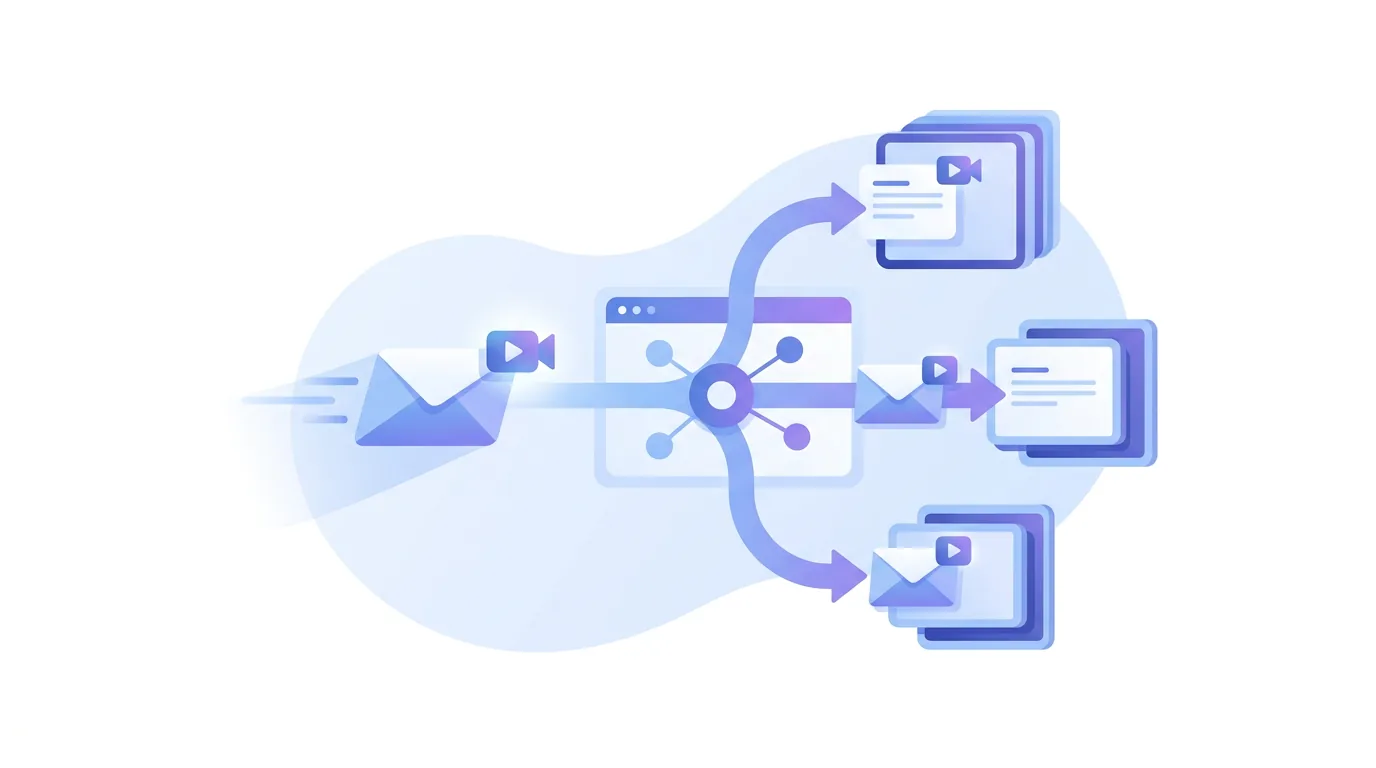
EmailFlow OS is a separate kind of tool from the CRMs above. It doesn't store MEDDIC fields; it sends personalised video email. You record one video and upload it to EmailFlow OS, connect your own Brevo account and sending domain, and import your prospect list into EmailFlow OS. EmailFlow OS then personalises that single recording for each recipient, not each company. In the two-person example above, the champion and the economic buyer each get their own version. Every version goes out from your own inbox, through your own Brevo account and on your own sending domain, never through a shared platform sender. Your SPF, DKIM and DMARC records, and your domain's reputation, stay under your control. The home page explains how EmailFlow OS personalised video email works step by step.
Questions people ask
- What is MEDDIC in sales?
- MEDDIC is a qualification checklist for complex B2B deals: Metrics, Economic Buyer, Decision Criteria, Decision Process, Identify Pain and Champion. Each letter needs evidence from the buyer, and a blank marks a risk to the forecast. Unlike SPIN or Challenger, it doesn't tell you how to run a conversation. It tells you which six facts a deal is still missing.
- What does MEDDPICC stand for?
- MEDDPICC stands for Metrics, Economic Buyer, Decision Criteria, Decision Process, Paper Process, Identify Pain, Champion and Competition. It's MEDDIC plus two letters. Paper Process covers the route from verbal yes to signature, such as procurement, legal and security review. Competition covers rival vendors, in-house builds and doing nothing. That's eight fields instead of six.
- How much does MEDDIC certification cost?
- There's no single official MEDDIC certification body. Several training providers sell courses and certificates under the MEDDIC or MEDDPICC name. The price depends on format (self-paced versus live cohort), seat count, whether coaching or CRM configuration is included, and whether it's bought per person or per team. A binding figure comes from the provider's quote for your team size and format.
- What are some sales methodologies?
- Common ones are MEDDIC and its variants MEDDICC and MEDDPICC, BANT, CHAMP, SPIN Selling, Challenger, Solution Selling, Sandler and Value Selling. They do different jobs. MEDDIC and BANT are qualification checklists that test whether a deal is real. SPIN and Challenger describe how to run the conversation, which is why teams often combine one of each.
- What is the 10-3-1 rule in sales?
- The 10-3-1 rule is an informal activity ratio: roughly ten prospects or conversations lead to three meetings or proposals and one closed deal. It isn't a standard with a defined source, and the real ratio varies by market and deal size. Use your own CRM history to work out your stage-to-stage conversion, and plan activity from that instead of a borrowed rule.
