10 min read Diesen Artikel auf Deutsch lesen
Cold Email Software: What to Check First
The short answer
Cold email software should send from your own domain and account, not from a shared platform sender. That way DKIM and SPF line up with your From address and DMARC can pass. EmailFlow OS works like this: you record one video, connect your Brevo account and sending domain, and import your prospects. EmailFlow OS then makes a personalised version for each recipient and sends it from your own inbox. Below you'll find the checklist, cold email examples and follow-up samples.
In this article
- What should cold email software actually do?
- Should cold email software send from a shared address or your own domain?
- How does EmailFlow OS work as cold email software?
- What does a good cold email example look like?
- What is a sales follow up email and when should you send one?
- Sales follow up email sample: what can you actually send?
- Is there a sales follow up email template you can fill in?
- Questions people ask
What should cold email software actually do?
Most roundups of cold email software compare feature grids. If you run your own Brevo account and sending domain, the checks that matter are narrower. Whose domain signs the mail? Where does the list live? What happens when someone asks you to stop? These are the requirements we'd hold any tool to, EmailFlow OS included:
- Sends from your domain. The From address and the DKIM signature's d= tag should both be your domain, so DMARC passes on alignment with your own records rather than riding on a shared sender's reputation.
- Keeps the prospect list next to the sender. Imports, opt-outs and suppressions belong in the same place the mail goes out from, so an address that unsubscribed doesn't get mailed again from a second system.
- Supports one-click unsubscribe. RFC 8058 defines the List-Unsubscribe-Post header, and Gmail and Yahoo require it from anyone sending more than 5,000 messages a day to their users.
- Fits under SPF's 10-lookup cap. RFC 7208 limits SPF evaluation to 10 DNS lookups, and every extra sending service you add to the record uses some of them up.
- Personalises per recipient, not per company. Two people at the same account get two different messages, so a forwarded email doesn't give away a mail merge.
- Removes hard bounces. A 5.1.1 (user unknown) should take the address off the list, not trigger a retry.
How do you weight these? Under a few hundred sends a day, alignment and unsubscribe handling matter more than throughput features. If you send into Germany, sort out the list first. UWG §7 requires prior consent for email advertising, and that includes B2B. No software settles that for you.
Should cold email software send from a shared address or your own domain?
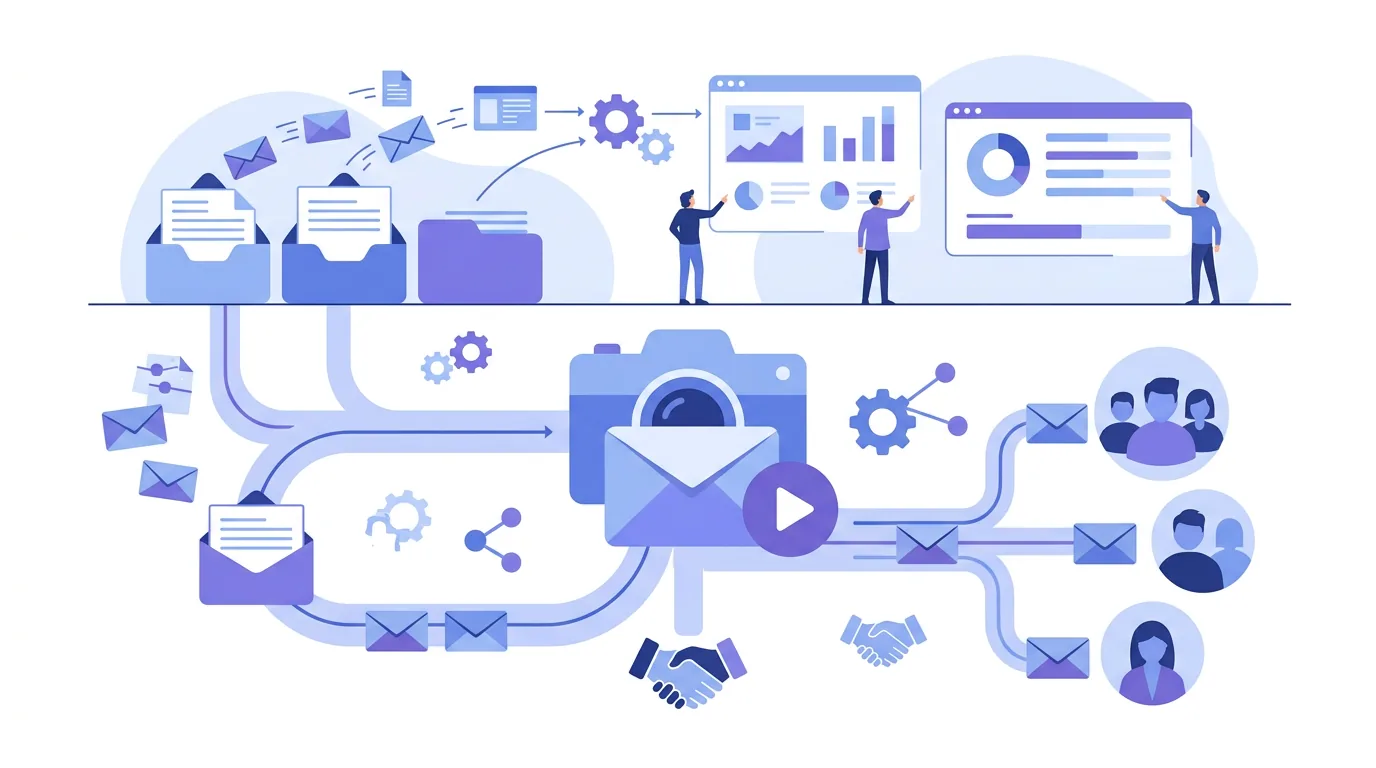
Send from your own domain. EmailFlow OS sends every message from the customer's own inbox, through the customer's own Brevo account and sending domain. There's no shared platform sender. The technical reason is DMARC. A message passes DMARC only when SPF or DKIM passes and the domain it checked aligns with the domain in the visible From header. If a tool signs with its own domain while your From says yours, alignment depends on how that tool configured things, and you can't fix it.
Reputation is the second reason. With a shared sender, other customers' complaints land on infrastructure you share, and when you leave the tool, any reputation you built stays behind. With your own domain the reputation belongs to you, and so does the downside. Google's bulk sender rules expect a spam rate below 0.3% in Postmaster Tools, and complaints count against your domain. A brand-new domain also has no history. You'll need to warm up a new sending domain before you push volume, and your SPF, DKIM and DMARC records have to be in place before the first send.
How does EmailFlow OS work as cold email software?
The workflow has a fixed sequence. First, you record one video and upload it to EmailFlow OS. Second, you connect your Brevo account and your sending domain. Third, you import your prospect list into EmailFlow OS, which is where the list lives from then on. EmailFlow OS then takes that single recording and makes a personalised version for each recipient on the list. That means one per person, not one per company. Each version goes out from your own inbox, through your Brevo account and your domain.
What does that mean in practice? You record once, not once per prospect. Your DNS records, your Brevo account and your domain stay under your control, and EmailFlow OS works through them rather than replacing them. A personalised video message per recipient also means two contacts at the same company don't receive identical videos.
There are also things it doesn't do. EmailFlow OS doesn't decide whether a message lands in the inbox, because the receiving server decides that based on authentication, reputation and content. It also doesn't make a list lawful to mail. Consent and legitimate-interest decisions stay with you.
What does a good cold email example look like?
A cold email example is useful when it's short, names one reason for writing, makes one ask and gives an easy way out. These five are written out in full. Swap in your own facts rather than copying them word for word:
- Trigger event. Subject: your Hamburg office. Hi {first_name}, I saw that {company} is opening a Hamburg office this spring. A second site usually means rewriting onboarding emails for a new team. I recorded a short video on how I'd approach that for you. Is it worth 15 minutes next week? If not, just reply 'no' and I'll leave it there.
- Problem first. Subject: support backlog after launch. Hi {first_name}, after a product launch most support teams see the same tickets dozens of times. I put together a two-minute walkthrough of how we cut repeat tickets. Want me to send it, or is this not on your list this quarter?
- Short video. Subject: a video for you, {first_name}. Hi {first_name}, instead of a long email I recorded a short video. It covers one idea for {company}'s outbound process and takes about a minute. If it's not relevant, reply 'not now' and you won't hear from me again.
- Mutual context. Subject: after your talk at {event}. Hi {first_name}, your point at {event} about slow handovers between sales and onboarding stuck with me. We work on exactly that handover. Open to a short call on Thursday or Friday?
- Plain ask. Subject: who owns outbound at {company}? Hi {first_name}, I'm trying to reach whoever owns outbound email at {company}. Is that you, or could you point me to the right person? Thanks either way.
Which one should you use? Use the trigger-event version when there's a public, recent fact to cite. The problem-first version fits when you know the pain but not the person. The video version works when you've recorded something worth watching. Use the plain ask when you don't know who owns the topic. Every version ends with an opt-out, and the subject lines are short and literal. Our cold email subject line examples cover why misleading subjects run into CAN-SPAM.
What is a sales follow up email and when should you send one?
A sales follow up email is any later message in an existing conversation. It might go to a prospect who hasn't replied, or to one you've just had a call with. Technically, a real follow-up is a reply. It carries In-Reply-To and References headers pointing to the earlier message's Message-ID, which is how RFC 5322 threading works, so mail clients show it under the first email. Putting 'Re:' on a brand-new message misstates what it is, and readers notice.
Timing has no standard number. Leave a few business days between messages, add something new each time and stop after a small, fixed number of touches. Some signals override any schedule. An explicit 'no', an unsubscribe click or a hard bounce means no further follow-ups. Gmail's bulk sender rules ask that unsubscribe requests be honoured within two days. CAN-SPAM allows 10 business days, but that's a ceiling, not a goal. Our guide to cold email follow up timing and threading goes through the cadence step by step.
Sales follow up email sample: what can you actually send?
Each sales follow up email sample below is sent as a reply in the same thread, keeps the original subject and adds one new piece of information:
- No reply, new angle. Hi {first_name}, one thing I left out last time: the walkthrough I mentioned also covers how to hand leads to onboarding without re-entering data. Should I send it over?
- Post-call recap. Hi {first_name}, thanks for the time today. As agreed, you'll check the sending domain setup with IT, and I'll send the two examples we discussed by Wednesday. Let me know if I've missed anything.
- Video follow-up. Hi {first_name}, I recorded a short video that answers the question you asked about DMARC alignment. It's about a minute long. Happy to go through it live if that's easier.
- Wrong person. Hi {first_name}, if outbound isn't on your desk, could you tell me who owns it at {company}? One name is plenty.
- Closing the loop. Hi {first_name}, I haven't heard back, so I'll assume the timing isn't right and won't follow up again. If that changes, this thread is the place to find me.
Which sample fits when? Use the new-angle sample only if you really have a new angle. Send the recap within a day of a call, while both sides remember the details. The video sample fits after a specific question. The closing-the-loop sample should be your last message, and you have to actually stop after it, or it becomes just another bump.
Is there a sales follow up email template you can fill in?
Yes. This sales follow up email template has four slots. Fill every one, or the email reads like a reminder from a machine:
Hi {first_name}, {one new fact: a resource, a result from their own world, an answer to their question}. {why it matters to their role, in one sentence}. {one ask with a yes/no answer}? If this isn't a priority, a quick 'not now' is fine and I'll close the thread. {signature with postal address}
A few things make this template fail. Filling only {company} turns it into a mail merge per company, so two people at the same company get identical text, and if one forwards it to the other the merge is obvious. A follow-up with no new information is just a bump. Sending it as a new thread instead of a reply loses the context. Leaving out the postal address breaks the CAN-SPAM requirement for commercial email. For eight more filled-in versions, see our sales follow up email template collection.
Questions people ask
- What is cold email software?
- Cold email software imports a prospect list, personalises messages and sends them to people you haven't contacted before. EmailFlow OS does this with video. You record one video, and EmailFlow OS makes a version for each recipient and sends it from your own inbox, through your own Brevo account and sending domain, not a shared platform address.
- Does cold email software need my own domain?
- For DMARC to pass on your terms, yes. DMARC passes only if SPF or DKIM passes and that domain aligns with the From header. When you send from your own domain, the alignment and the reputation are both yours. When you send through a shared sender, alignment depends on another party's configuration.
- What does Gmail require from bulk cold email senders?
- Since February 2024, anyone sending more than 5,000 messages a day to Gmail users needs SPF, DKIM and a DMARC record with at least p=none. They also need RFC 8058 one-click unsubscribe, opt-outs honoured within two days, and a spam rate below 0.3% in Postmaster Tools.
- Is cold email allowed in the EU?
- It depends on the country. Under GDPR, B2B cold email usually relies on legitimate interest under Article 6(1)(f), and Article 14 requires telling people within one month where you got their data. Germany is stricter: UWG §7 requires prior consent for email advertising, B2B included.