10 min read Diesen Artikel auf Deutsch lesen
Sales Outreach: Copy-Ready Messages by Stage
The short answer
Sales outreach that holds up has a first touch tied to one specific reason, then threaded follow-ups that each add something new, all sent from your own authenticated domain. With EmailFlow OS you record one video, connect your Brevo account and sending domain, and import your prospect list. EmailFlow OS then makes a personalised version of that recording for each recipient and sends it from your own inbox, not from a shared platform address.
In this article
- What should a sales outreach email say on first touch?
- What is a sales follow up email?
- What does a sales follow up email sample look like?
- Which sales follow up email template can I reuse?
- How do I send video sales outreach from my own Brevo account?
- What stops sales outreach from reaching the inbox?
- Do EU rules allow cold B2B sales outreach by email?
- Questions people ask
What should a sales outreach email say on first touch?
A first-touch sales outreach email has one job: give one person one specific reason to answer. The examples below are written out in full. Swap in your own details before you send them.
- Trigger event: "Hi {first name}, I saw {company} opened a second warehouse last month. When a team adds a site, label printing often ends up split across two systems for a while. That handover is what we fix. Worth 15 minutes next week to see if it applies to you? {your name}"
- Role problem: "Hi {first name}, most heads of RevOps I talk to rebuild the same pipeline report by hand every Monday. If that's you too, I can show you how we cut it to one export. If it isn't, just tell me and I'll leave it there."
- Referral: "Hi {first name}, {mutual contact} said you're the person who owns vendor onboarding at {company}. I won't pitch here. Could I ask you two questions about how you handle supplier documents today?"
- Observation: "Hi {first name}, your careers page lists four open SDR roles. Ramping that many people at once usually means the same objection-handling notes get rewritten by every new hire. We've built a fix for that. Want the one-page outline?"
- Video first touch: "Hi {first name}, I recorded a short video instead of writing three paragraphs. It covers the one change I'd make to {company}'s demo request flow. If it's not relevant, reply 'no' and I won't follow up."
Pick the trigger-event version when you've got a dated, public fact. Use the role version when all you have is a job title. Referrals only work when the mutual contact actually agreed to be named. The video version is for when what you're explaining is visual, like a flow, a page or a dashboard, and would turn into a wall of text otherwise. Your subject line has to match whichever one you pick. Our list of sales email subject lines for cold and follow-up messages pairs subjects with each situation.
What is a sales follow up email?
A sales follow up email is any message you send to a prospect after the first contact, whether that contact was an unanswered cold email, a call, a demo or a proposal. The good ones add something the earlier message didn't have, like new information, a narrower question or a clear way out. "Just checking in" adds nothing. Technically, a follow-up that should show up in the same conversation is sent as a reply. The mail client sets the In-Reply-To and References headers defined in RFC 5322, and Gmail and Outlook use those headers to group messages into one thread. If you type "Re:" into a fresh message, the subject matches but those headers are missing, so the message doesn't thread properly and it misstates what the email is. Our guide to cold email follow-up timing, threading and limits covers spacing and when to stop. In short, a follow-up that repeats the first email word for word gives the recipient nothing new to react to, and the person who ignored it once will most likely ignore it again.
What does a sales follow up email sample look like?
Here are five sales follow-up email samples, one for each common situation. Each one is complete and works as a threaded reply.
- No reply, adding value: "Hi {first name}, one thing I left out last time. The warehouse handover usually breaks at returns, not outbound. If returns are where it hurts for you, I can send the two-step workaround we use."
- After a call: "Thanks for the time today, {first name}. What I heard: you need label printing working at both sites before the November peak, and finance wants a one-site pilot first. I'll send the pilot scope by Thursday. Did I miss anything?"
- After a proposal: "Hi {first name}, I sent the proposal on {date}. Instead of asking whether you've read it: is pricing, timing or scope the part your team will push back on? I'd rather fix that now than guess."
- Video follow-up: "Hi {first name}, I didn't want to send another block of text, so I recorded a short video of the returns workflow on a setup like yours. It runs under two minutes."
- Breakup: "Hi {first name}, I've written three times, so I'll stop here. If label printing becomes a priority later, reply to this thread and it'll come straight to me."
Use the value-adding sample after a first email gets no answer, and the call recap within a day of the meeting while it's still fresh. Send the proposal sample once the agreed decision date has passed. Save the breakup for the last message, and when you say you'll stop, actually stop.
Which sales follow up email template can I reuse?
This sales follow up email template has five parts. Fill in every placeholder for each recipient, so no two messages leave your domain with the same body.
- Reference line: "Following up on {what you sent or discussed} on {day}." Name the actual thing. Don't write "my last email".
- New element: "Since then, {new fact, resource or observation tied to their company}." If you can't fill this in, don't send the follow-up yet.
- Narrow question: "Is {one specific problem} on your list for {quarter}?" Make it a question someone can answer in one line.
- Exit: "If this isn't your area, who should I ask?" or "If the timing's wrong, say so and I'll close the thread."
- Signature: your name, role, company, postal address, and a plain-language way to opt out.
Where templates go wrong is when people copy them. Hundreds of identical bodies sent from one domain look like bulk mail to filters and to people. The template only works if the second line is really about that prospect. We go through eight variants for no-reply, post-call and breakup messages in our sales follow up email template examples.
How do I send video sales outreach from my own Brevo account?
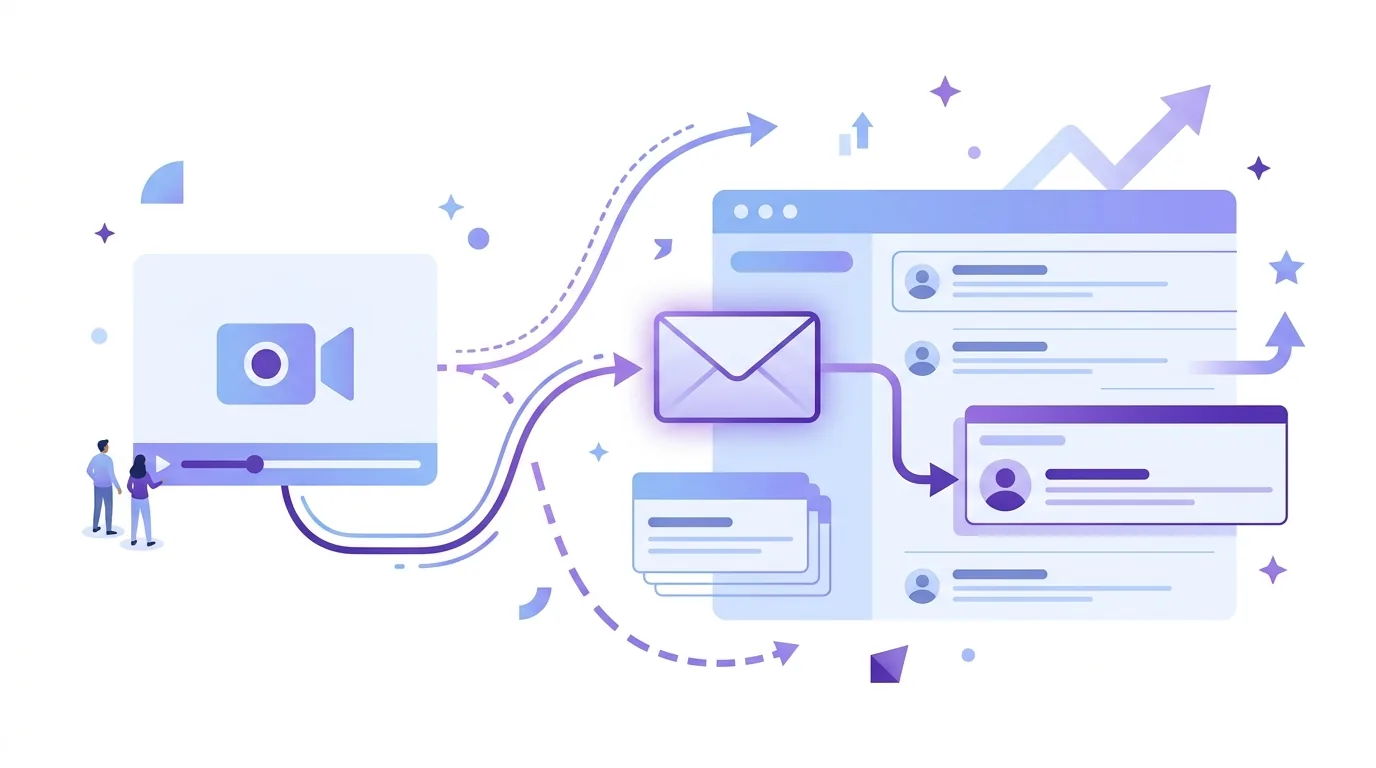
With EmailFlow OS, the workflow has these steps and nothing beyond them. First, record one video and upload it to EmailFlow OS. Then connect your Brevo account and your sending domain. Finally, import your prospect list into EmailFlow OS, which is where it stays. From there, EmailFlow OS makes a personalised version of that single recording for each recipient on the list. That's per person, not per company, so two contacts at the same firm each get their own version. Every version goes out from your own inbox, through your own Brevo account and your own sending domain. It never goes through a shared platform sender. This matters for deliverability because receiving servers judge the domain in the From address and the domain that signed the DKIM signature. Both of those are yours, so your sender reputation builds on a domain you control and isn't shared with other customers' traffic. Recording once doesn't fix a weak message. If the video has nothing specific to say, giving every recipient their own version won't change that. Read how a personalised video message per recipient fits into a cold email for the mail-client side.
What stops sales outreach from reaching the inbox?
Most outreach that never gets read was turned away at the DNS or policy level, not because of the copy. The receiving server decides where a message lands. You control what it checks.
| Failure mode | Cause | What to check |
|---|---|---|
| SPF permerror | The record needs more than the 10 DNS lookups RFC 7208 allows, often because too many include: entries have piled up | Count the includes and remove services you no longer send through |
| DKIM fails or is missing | The Brevo DKIM record was never published or was pasted with the domain doubled in the host field | Look up the selector with dig and compare it to the value Brevo shows |
| DMARC rejection or no alignment | There's no _dmarc record, or the signing domain doesn't match the From domain | Start with p=none and read the aggregate reports before you tighten the policy |
| Gmail bulk sender block | Gmail's 2024 rules for senders of 5,000+ messages a day to Gmail addresses require SPF, DKIM, DMARC and RFC 8058 one-click unsubscribe | Confirm all four are in place before you scale |
| Spam-rate throttling | Spam complaints at or above the 0.3% Gmail names as the limit | Keep lists tight and remove anyone who opts out right away |
A new domain that jumps straight to full volume can hit throttling even with clean records. Our warm-up guide gives a daily volume ramp, and the walkthrough of DKIM, DMARC and SPF for cold email senders covers the order to set them up in.
Do EU rules allow cold B2B sales outreach by email?
It depends on the country, and the rules are stricter than many US-trained teams expect. In Germany, §7(2) No. 2 UWG treats advertising email sent without the recipient's prior express consent as an unreasonable nuisance, and that applies to business recipients too. The softer presumed-consent standard for B2B covers phone calls, not email. Under the GDPR, Article 14 applies when you collect a prospect's personal data from somewhere other than the prospect. You have to tell them who you are, what you're processing and why, and on what legal basis. That has to happen at the first communication at the latest, and in any case within one month. In the US, CAN-SPAM requires a working opt-out, a valid postal address, and that opt-outs are honoured within 10 business days. EmailFlow OS sends through your own Brevo account and domain, so you're the sender, and the decisions about who's on the list and on what legal basis are yours. No tool makes that decision for you. Check how your jurisdiction applies these rules before you import a list.
Questions people ask
- What is sales outreach?
- Sales outreach is when a seller contacts a prospect who hasn't asked to be contacted, usually by email, phone or social message, to start a conversation about a specific problem. An email sequence typically has one first touch and two to four threaded follow-ups. Each follow-up should add new information instead of repeating the opener.
- How many follow-ups should a sales outreach sequence have?
- Most B2B sequences use two to four follow-ups after the first email and end with a breakup message that says you'll stop. No standard sets the number. The practical limit is the spam rate: Gmail names 0.3% in complaints as the threshold, and every extra unwanted message makes a complaint more likely.
- Should a sales follow up email be a reply or a new email?
- Send it as a reply when it continues the same topic. The client then sets the In-Reply-To and References headers from RFC 5322, and the message threads under the original. Start a new email only when you change the topic. Typing "Re:" into a new message doesn't create those headers.
- Can I send video sales outreach without using a shared sender address?
- Yes. EmailFlow OS sends every personalised version of your recording from your own inbox, through your own Brevo account and sending domain. Receiving servers check your SPF, DKIM and DMARC records, not a platform's, so your sender reputation stays tied to a domain you control.