10 min read Diesen Artikel auf Deutsch lesen Lire cet article en français Ler este artigo em português
Nonverbal Communication Percentage: 7-38-55
The short answer
Nobody has measured a single nonverbal communication percentage. The 7-38-55 split comes from Albert Mehrabian's 1967 experiments. Listeners judged a speaker's feelings when the words, the tone and the face didn't match, and in that setup tone and facial expression counted for more than the words. It doesn't apply to facts, instructions or ordinary conversation. In plain-text email both of those channels are missing. A recorded video puts face and voice back in.
In this article
- What percentage of communication is nonverbal?
- What is Albert Mehrabian's communication model?
- Why the 93% figure fails outside the lab
- What counts as nonverbal communication?
- What replaces nonverbal cues in a written email?
- Adding face and voice back to cold email
- How EmailFlow OS handles it (a EmailFlow OS product)
- Questions people ask
What percentage of communication is nonverbal?
No study has measured one nonverbal communication percentage for communication in general. The only figure with an experiment behind it is Albert Mehrabian's 7-38-55 split from 1967: 55% facial expression, 38% tone of voice and 7% words, which adds up to 93% nonverbal. But it only describes how listeners judged a speaker's feelings when the words and the delivery contradicted each other.
That's why the figures you find online don't agree. As of November 2026, the pages ranking for this search give at least four different numbers: 55% for body language with 38% for tone and 7% for words, 'around 60% to 65%' credited to unnamed body language experts, 'between 60 and 90 percent', and 93% for everything that isn't words. Only the 7-38-55 split goes back to an actual experiment. The others are estimates passed from page to page with no study behind them. Google's AI overview for this search (as of November 2026) calls the 93% claim a widely misunderstood myth. How much of a message travels without words depends on what's being said, through which channel, and whether the words and the delivery agree. When you're explaining a contract clause, the words carry nearly everything. When you're reading whether someone is annoyed, tone and face can matter more than anything they say.

What is Albert Mehrabian's communication model?
Mehrabian's model splits a speaker's message about feelings into three channels: the words (verbal), the voice (tone, pitch, emphasis) and the face or body (visual). It rests on two papers from 1967: Mehrabian and Wiener's 'Decoding of inconsistent communications' in the Journal of Personality and Social Psychology, and Mehrabian and Ferris's 'Inference of attitudes from nonverbal communication in two channels' in the Journal of Consulting Psychology. In the first, listeners heard single words spoken in a tone that sometimes clashed with the word's meaning. In the second they also saw photos of facial expressions. They then rated what attitude the speaker held, for example liking or disliking. When the channels contradicted each other, people trusted the voice and face over the word. Combining those results gives the familiar weighting: 7% verbal, 38% vocal, 55% facial. Mehrabian repeated the formula, with its conditions, in his 1971 book Silent Messages.
Three conditions limit the model, and most quotations leave them out:
- It covers messages about feelings and attitudes, not facts, requests or arguments.
- It applies when the channels are incongruent, meaning the words say one thing and the tone or face says another.
- The material was single words in a lab, not sentences, conversations or meetings.
Mehrabian himself stated these limits. If you apply 7-38-55 to a sales call or a lecture, you've stretched a narrow finding past what it measured.
Why the 93% figure fails outside the lab
Add 38 and 55 and you get 93, and that's where the 'only 7% is words' slogan comes from. Test it against something you've actually lived through and it breaks. If words carried only 7% of meaning, you could follow most of a foreign-language film with the sound on and no subtitles. You can't. You'd catch the mood and miss the plot. Phone calls, books and written contracts all work with no face at all. Psychology Today's 'Beyond Words' blog, which Google's AI overview cites for this search (as of November 2026), likewise argues that nonverbal communication isn't a numbers game.
Here's what does hold up. When tone and words clash, people tend to believe the tone. A flat 'great, thanks' reads as irritation however polite the words are. For outreach, that means delivery can undercut a well-written message, but it can't take its place. A video with a warm tone and a vague ask is still vague. Some incongruences we see in recorded sales videos, each one a mismatch of the kind Mehrabian tested:
- Saying 'I noticed your post' while the eyes visibly track a script beside the camera. The words claim attention, the face shows reading.
- Opening with 'I'll keep this short' and then talking for several minutes. The words promise brevity, the timing breaks it.
- Saying 'no pressure at all' in a fast, clipped voice. The viewer is likely to believe the pace, not the phrase.
- Smiling through a sentence about a customer's problem, such as a failed audit. The face signals a mood the words don't support.
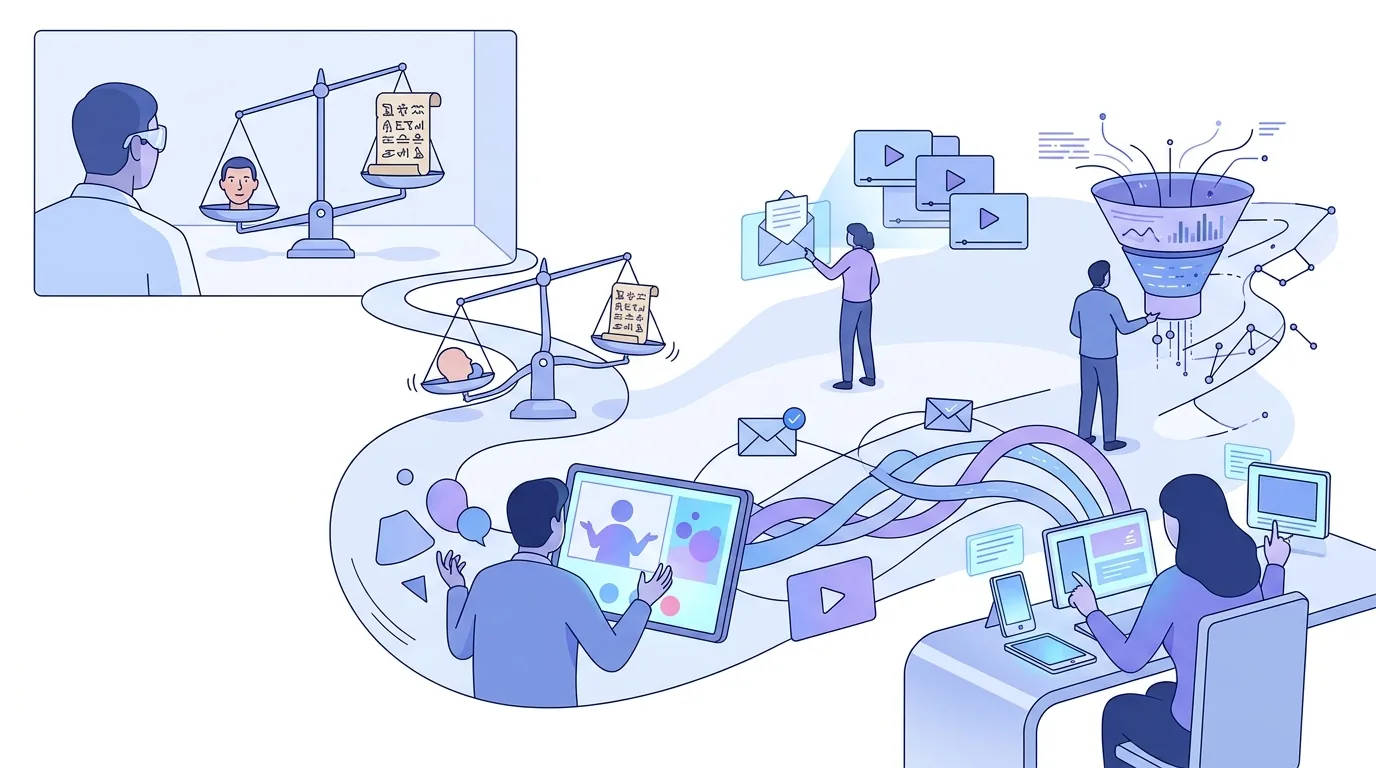
What counts as nonverbal communication?
Nonverbal communication is everything that carries meaning other than the words themselves. That includes facial expression, eye contact, gesture, posture, the voice (tone, pitch, pace, pauses), physical distance, appearance and timing. Researchers often split the voice off as 'paralanguage', which is why Mehrabian's model treats vocal and visual as separate channels. Which channels reach the other person depends on the medium:
| Channel | In-person meeting | Video call | Recorded video in email | Plain-text email |
|---|---|---|---|---|
| Words | Yes | Yes | Yes, spoken, plus the email text | Yes, written only |
| Tone of voice | Yes | Yes, compressed audio | Yes, if the audio is clean | No |
| Facial expression | Yes | Yes, framed by the camera | Yes, framed by the camera | No |
| Gesture and posture | Yes | Partly, upper body | Partly, upper body | No |
| Timing and pauses | Yes, live | Yes, live | Yes, but fixed when recorded | Only when the email is sent and how long it is |
| Feedback in the moment | Yes | Yes | No | No |
What replaces nonverbal cues in a written email?
A plain-text cold email arrives without any of the channels Mehrabian studied. So the reader fills the gap with whatever cues they have, and in email those are mostly technical and structural. The sender address and domain play the role a face plays in person. They're the first thing the recipient checks to decide who's speaking. Then come length, layout, whether the greeting uses the right name, and whether it looks typed or mass-merged. Before the person even reads it, the receiving server checks its own cues: SPF, DKIM and DMARC results for your sending domain.
That's why authentication counts as part of how a message 'looks', not just a back-office task. Our guide to SPF, DKIM and DMARC for cold email senders explains which records the receiving server checks and what a failure does to the message.
Here are some written cues from cold outreach and what they tell the reader before they've read a single sentence. Each one is the email version of a face that doesn't match the voice:
- The From address is on a different domain than the website in the signature. The reader sees two identities in one message.
- Gmail shows 'via' next to the sender name. This appears when the message was signed or sent by a domain other than the one in the From line, and it tells the reader a third party sent it.
- An unfilled merge field like 'Hi {FirstName},' gives away the template, the way a blank stare gives away someone who isn't listening.
- The email lands in the middle of the recipient's night. The timing suggests a machine, not a person.
More of these, each with a fix, are in our unprofessional email examples and fixes. Here's what doesn't work: trying to add tone with emojis, all-caps or exclamation marks. Recipients read these differently, and in a first contact they mostly signal informality you haven't earned yet.
Adding face and voice back to cold email
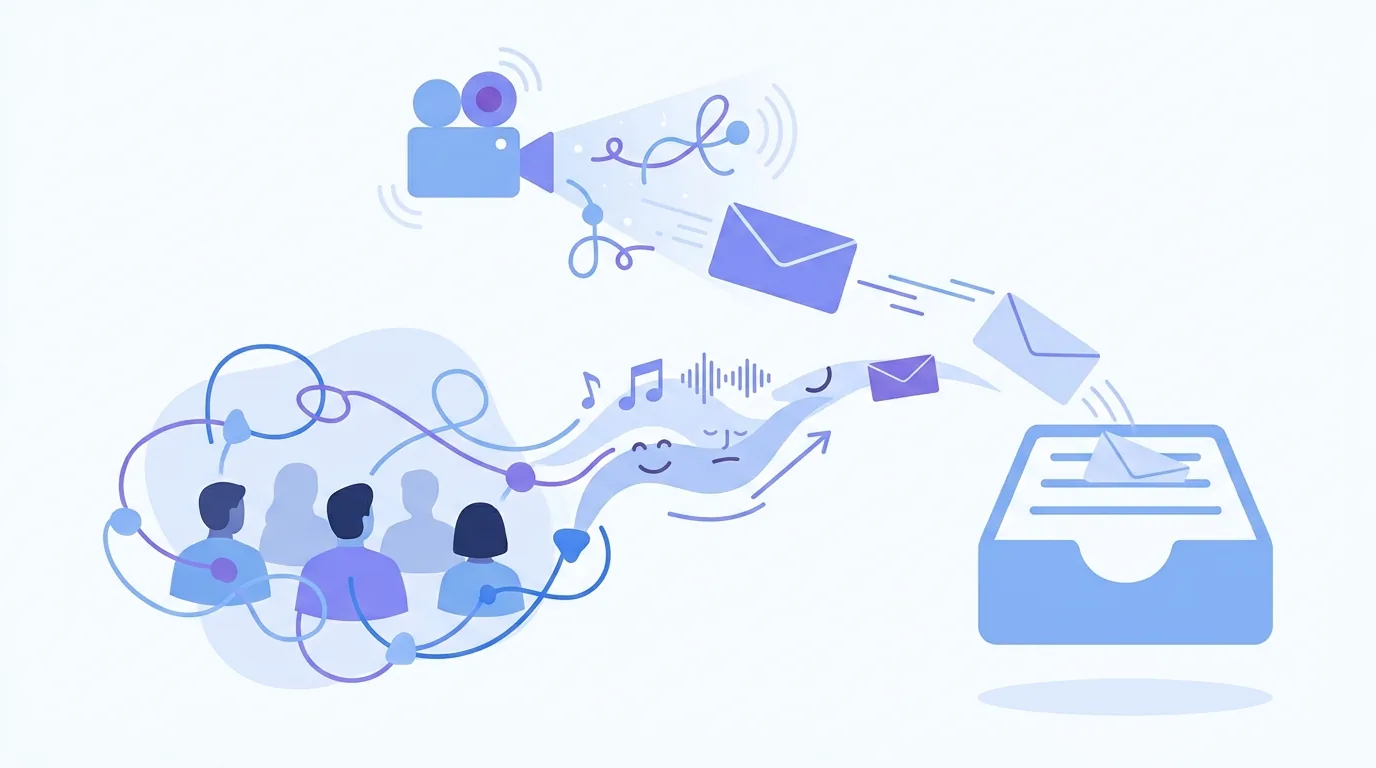
The direct way to restore the vocal and visual channels is a short recorded video. It has limits that a live meeting doesn't. There's no feedback while you talk, so a misjudged tone can't be corrected mid-sentence. Many email clients won't play video inside the message, so a video email usually shows a preview image that links to the recording. And plenty of people watch with the sound off, which is why captions are worth adding. Our article on video captions in SRT, VTT and burned-in formats covers which type still works once the video leaves your editor. If being on camera is the obstacle, the guide to being camera-shy in sales video outreach deals with framing and delivery.
How EmailFlow OS handles it (a EmailFlow OS product)
EmailFlow OS is built around exactly this channel. You record one video and upload it to EmailFlow OS. Then you connect your own Brevo account and sending domain and import your prospect list into EmailFlow OS. EmailFlow OS turns that single recording into a personalised version for each recipient, not one per company. Each version goes out from your own inbox, through your own Brevo account and your own sending domain, never from a shared platform sender. Your face and voice stay yours, and the domain cue the recipient checks first is your own domain too. For the full workflow, see the personalised video message per recipient guide or the EmailFlow OS personalised video email overview.
Questions people ask
- What percentage of communication is nonverbal?
- No single percentage has been measured. The only study-based figure is Mehrabian's 7-38-55 split from 1967: 55% face, 38% voice, 7% words, so 93% nonverbal. It comes from lab tests with single words where listeners judged a speaker's feelings while tone and words contradicted each other. For facts, instructions or normal conversation, words carry far more than 7%.
- Is 93% of communication really nonverbal?
- No. The 93% is just 38% (voice) plus 55% (face) from Mehrabian's 1967 experiments, which only covered judgments of liking or disliking when words and delivery clashed. Mehrabian himself warned against applying it to communication in general. A simple test: a phone call carries no face, and a written contract carries no voice, yet both get their meaning across.
- What percentage do nonverbal cues contribute to the communication process?
- The answer quizzes expect is 55%, which is the facial share in Mehrabian's 7-38-55 split. Count tone of voice as nonverbal too and the total is 93%. Both figures only describe how people judged feelings when words and delivery contradicted each other. No study has measured a share for communication in general, which is why figures of 60%, 65% or 90% have no single source.
- What is nonverbal communication?
- It's every signal that carries meaning other than the words: facial expression, eye contact, gesture, posture, tone, pitch, pace, pauses, distance and appearance. Tone and pace are often grouped as paralanguage, meaning the voice without the words. In writing, the closest equivalents are layout, length, timing and the sender's name and domain.
- Is it normal for a 3-year-old child to be nonverbal?
- That's a different use of the word. Here 'nonverbal' means a child isn't using spoken words yet. It has nothing to do with the share of meaning carried by body language in adult conversation. Whether a particular child's speech is on track is a question for a pediatrician or a speech-language pathologist, who can assess development directly. A general article can't answer that.
- Does the 7-38-55 rule apply to video sales messages?
- Only in a narrow sense. The rule describes how people judge a speaker's attitude when words and tone conflict. In a video, that means a tone that doesn't fit the words will be noticed and believed over them. It doesn't mean your words are 7% of the message. The offer, the reason for reaching out and the ask still carry the content.
