9 min read Alle Artikel auf Deutsch Tous les articles en français Todos os artigos em português
What Is a BDR? Role, Day, BDR vs SDR
The short answer
A BDR, or business development representative, starts conversations with accounts that haven't shown interest yet. The BDR builds a target list, researches each contact, reaches out by email, phone and LinkedIn, and qualifies whoever replies. Then they hand a booked meeting to an account executive, who runs the deal. An SDR usually works inbound leads instead. Every BDR email goes out from a sending domain, so that domain's SPF, DKIM, DMARC and warm-up affect how receiving servers treat the outreach.
In this article
- What does a BDR do?
- What a BDR's working cycle looks like
- BDR vs SDR: what's the difference?
- What does a market development representative do?
- Is BDR a stressful job?
- Which tools does a BDR use?
- Why the sending domain matters for BDR outreach
- How EmailFlow OS sends BDR video emails
- Questions people ask
What does a BDR do?
A BDR (business development representative) is an outbound sales rep. They contact accounts that have never asked to hear from the company, qualify the people who reply, and book meetings for an account executive (AE). The AE then runs discovery, the proposal and the close. Some job ads say BDRs close deals too. In most B2B sales teams, though, what a BDR delivers is a qualified meeting, not a signed contract.
Here's an example. A software company sells to logistics firms. Its BDR picks out mid-sized freight forwarders in one region, finds the operations head at each, and writes to each one about a specific problem, such as tracking shipments by hand. One prospect replies and agrees to a call. The BDR checks budget, who makes the decision and timing, books a slot with the AE, and writes up the context in the CRM. From that point the AE owns the deal. The BDR usually gets credit if the meeting happens and turns into pipeline. Our piece on the account executive role and its outreach covers the AE's side of the handoff.
What a BDR's working cycle looks like
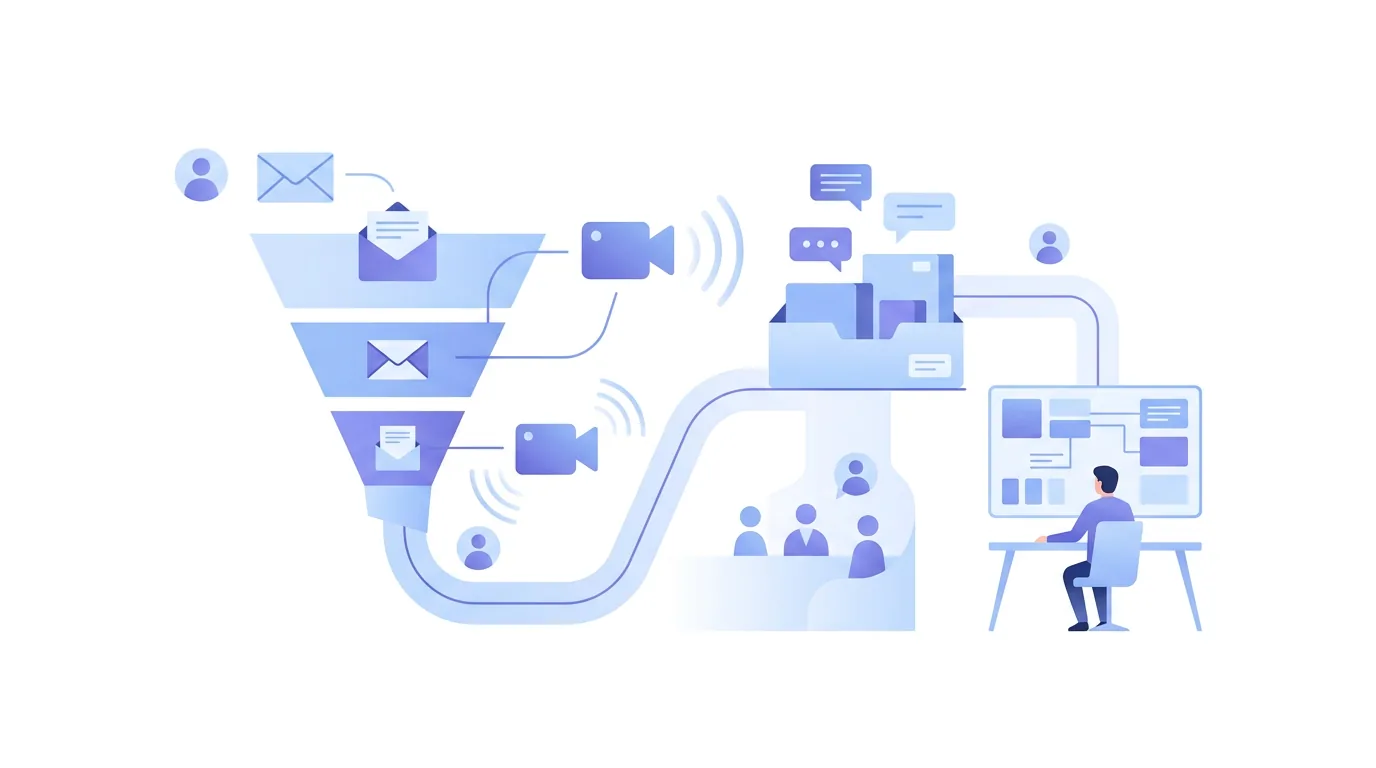
A BDR's day works as a loop, where each step feeds the next. If an early step is weak, say the list is bad, the problem shows up later as bounces and no replies.
- Build the list: choose accounts that fit the ideal customer profile and find the right person at each one, not a generic info@ address.
- Verify contact data: old or guessed addresses cause hard bounces, and receiving servers count those against the sending domain.
- Research each person: their role, recent company events and the problem they probably have. Skip this and the message reads like a mass send.
- Run a sequence: a first touch, then follow-ups spread over days or weeks, often mixing email, calls and LinkedIn.
- Qualify replies: check budget, authority, need and timing, or use the team's framework, such as BANT or MEDDIC.
- Hand off: book the meeting with the AE and record what you learned in the CRM, so the prospect doesn't have to repeat themselves.
- Log and review: mark which accounts are closed, paused or declined. Anyone who opts out comes off every list.
BDR vs SDR: what's the difference?
Both are early-stage sales roles that hand meetings to AEs. The usual difference is where the leads come from. An SDR (sales development representative) works inbound leads: people who filled in a form, started a trial or downloaded something. A BDR works outbound and contacts accounts that haven't shown interest. That's a convention, not a standard. Plenty of companies use the two titles interchangeably, or call everyone an SDR. To see what a job really involves, check where the job ad says the leads come from. Our guide to the SDR in sales goes deeper on the inbound side and its handoff.
| BDR (business development representative) | SDR (sales development representative) | |
|---|---|---|
| Lead source | Outbound: accounts that haven't shown interest | Mostly inbound: forms, trials, content downloads |
| First contact | The BDR writes or calls first, cold | The prospect acted first and the SDR responds |
| Main skill | Targeting, research, writing first messages | Fast response, qualifying, routing |
| Typical output | Qualified meeting booked for an AE | Qualified meeting, or a lead marked as not a fit |
| Main email risk | Cold sending affects the sending domain's reputation | Response speed; volume follows inbound demand |
What does a market development representative do?
A market development representative (MDR) is even closer to marketing than an SDR. Teams that use the title usually have MDRs follow up on marketing activity: webinar attendees, badge scans from events, people who responded to a campaign. Many MDRs report to marketing, not sales. Their job is to decide which of those contacts deserve a sales conversation and pass those on. The title is less common than BDR or SDR, and what it covers varies more between companies. Sometimes an MDR is just an SDR with a different reporting line. Sometimes the role includes early outreach into a new region or vertical. As with the other titles, the job ad's description of lead sources tells you more than the acronym does.
Is BDR a stressful job?
It can be, and the causes are built into the role. Most BDRs have a quota measured in meetings booked or pipeline created, and it's checked weekly or monthly. Most outreach gets no reply or a no, so rejection happens every day. Activity metrics like emails sent and calls made are easy to count, so some teams manage by them, which pushes reps toward volume instead of relevance. There's also a risk people rarely mention: a BDR's results depend on systems they may not control. If the sending domain has no DMARC record, or stale addresses on the list push bounces up, messages can land in spam no matter how good the copy is. The rep's numbers fall for reasons they can't see. Checking DNS and list hygiene before blaming the rep removes a real source of that pressure. To see how targets are set and measured, read what a sales quota is.
Which tools does a BDR use?
A BDR's toolset usually has five layers: an activity record, a contact source, a research tool, a mailbox and a sending platform. The table compares named options in each layer on the same two questions: what the BDR uses it for, and where it stops.
| Category | Examples | What the BDR uses it for | Where it stops |
|---|---|---|---|
| CRM | Salesforce, HubSpot, Pipedrive | Logging accounts, contacts, activities and the AE handoff | Only as accurate as what reps enter; it doesn't write the outreach |
| Contact data | ZoomInfo, Apollo, Cognism | Finding names, roles and business addresses for target accounts | Data goes stale; addresses still need checking before sending |
| Social research | LinkedIn Sales Navigator | Finding the right person, tracking job changes, messaging on LinkedIn | Messages stay inside LinkedIn; it doesn't send email |
| Mailbox | Google Workspace, Microsoft Outlook business mailboxes | The inbox the BDR sends from and where replies arrive | Per-user sending limits apply; you set the DNS records yourself |
| Email platform | Brevo | Sending from your own authenticated domain | You set up domain authentication and warm-up yourself |
Why the sending domain matters for BDR outreach
The receiving server judges every cold email a BDR sends, and it looks at the sending domain as well as the message. Three DNS records do most of that work. SPF is a TXT record that lists the servers allowed to send for the domain; a message from a server not on that list fails the check. DKIM adds a cryptographic signature to each message, and the receiver checks it against a public key published in the domain's DNS, so it can tell whether anyone changed the message on the way. DMARC tells receivers what to do when SPF and DKIM fail or don't match the visible From domain, and where to send aggregate reports. Google's email sender guidelines expect bulk senders to have all three in place and to offer one-click unsubscribe. A new domain also has no sending history, so you need to raise volume gradually. If you run a full sequence from the first day, the domain can end up with a reputation that's hard to repair. Our guide to DKIM, DMARC and SPF for cold email senders explains each record, and email warm-up explains how to ramp up.
The law also changes from market to market. In the US, the CAN-SPAM Act allows commercial email without prior consent, but it requires accurate headers, a physical postal address and a working opt-out, and the FTC's CAN-SPAM compliance guide sets a deadline for honouring opt-out requests. In Germany, the Act against Unfair Competition (UWG) generally requires prior consent for email advertising, including B2B. The GDPR gives every person the right to object to their data being processed for direct marketing, and after an objection the data can't be used for it any more. A BDR team selling into the EU needs its own legal assessment before building an email sequence.
How EmailFlow OS sends BDR video emails
EmailFlow OS, a EmailFlow OS product, handles personalised AI video email for B2B cold outreach. The BDR records one video and uploads it to EmailFlow OS. They connect their own Brevo account and sending domain, then import their prospect list into EmailFlow OS, where the list is kept. EmailFlow OS personalises that one recording for each recipient, not for each company. Take the freight-forwarder example above: if the BDR writes to the operations head and the finance lead at the same firm, each of them gets a separate version. Every version goes out from the BDR's own inbox, through their own Brevo account and their own sending domain, never through a shared platform sender. The customer stays in charge of the domain's SPF, DKIM and DMARC setup, its warm-up and its reputation. The home page explains how personalised video email works in EmailFlow OS.
Questions people ask
- What is a BDR?
- A BDR is a business development representative. It's an outbound sales role. The BDR picks target accounts, contacts people who haven't shown interest by email, phone or LinkedIn, qualifies whoever replies and books a meeting for an account executive. An SDR, by contrast, usually responds to inbound leads such as form fills and trials, though many companies use the two titles interchangeably.
- What does BDR stand for in sales?
- BDR stands for business development representative. It's an outbound sales role: the BDR contacts accounts that haven't shown interest, qualifies the ones that reply, and books meetings for an account executive. It's narrower than business development as a function, which also covers partnerships and new markets. It also differs from SDR, the title usually given to reps who work inbound leads.
- Is a BDR an entry-level job?
- Usually, yes. Many people start in sales as a BDR or SDR. The role teaches targeting, writing, objection handling and qualifying without making you responsible for the whole deal. The usual next step is account executive. Other paths lead to BDR team lead or manager, or into marketing or revenue operations.
- How is a BDR measured?
- Most BDRs are measured on qualified meetings booked, or on pipeline created from those meetings, against a monthly or quarterly quota. Teams often track activity counts like emails sent and calls made as well. Open rates tell you little for cold email, because image blocking and privacy proxies make tracking pixels unreliable.
- Does a BDR close deals?
- In most B2B teams, no. The BDR's job ends at the qualified handoff, and the account executive handles discovery, the proposal, negotiation and the close. In small companies, or with low-priced products, one person may do both, and some job ads still list closing as a BDR duty. Whoever signs the contract shows you which model a team uses.
