10 min read Diesen Artikel auf Deutsch lesen
Outbound Sales: Channels, Process, Follow-Ups
The short answer
Outbound sales means the seller makes first contact with buyers who haven't asked to hear from them, by cold email, phone, LinkedIn or video. It runs in six steps: define who to target, build and verify a list, pick a channel per contact, send from an authenticated domain (SPF, DKIM, DMARC), follow up in the same thread, and stop on a reply or opt-out. Check the consent rules for each recipient's country before you send any email.
In this article
- What is outbound sales?
- What is outbound sales vs. inbound sales?
- What is prospecting in sales?
- The outbound sales process in six steps
- What is an example of outbound sales?
- Which outbound channel fits which situation?
- Which tools does an outbound sales team need?
- How EmailFlow OS handles the video email step
- Sales follow up email: templates by situation
- Sales follow up email template after no reply
- Follow up email after sales call
- What legal rules apply to outbound sales email?
- Is outbound sales a good job?
- Questions people ask
What is outbound sales?
In outbound sales, the seller starts the conversation. The prospect hasn't filled in a form, booked a demo or replied to an ad. A rep, a sales development rep (SDR) or a founder picks a company and a person and gets in touch first, usually by cold email, cold call, a LinkedIn message or a recorded video. All of these definitions share one test: who made first contact. If the seller did, it's outbound. That has a practical consequence. Because the recipient never asked for the message, every outbound email gets judged twice. The receiving mail server checks whether the sending domain is authenticated and has a good reputation. Then the person decides whether the message is relevant enough to answer. A weak list or an unauthenticated domain fails the first check, and good copy can't fix that.
What is outbound sales vs. inbound sales?
Inbound sales handles buyers who came to you first: they filled in a contact form, signed up for a trial, downloaded a guide or answered a campaign. Outbound sales goes after buyers who haven't shown any interest yet. The two differ in three ways you can check. First, the trigger: inbound starts with an action by the prospect, outbound with a decision by the seller. Second, legal footing: inbound email often rests on consent the prospect gave, while outbound email to people in the EU has to rely on something else, which is a real constraint in Germany (see the section on rules below). Third, control: with inbound you can only work with the demand you get, while outbound lets you choose the accounts. Most B2B teams run both. Inbound fills the pipeline with people already looking, and outbound reaches the accounts that would never have found you on their own.
What is prospecting in sales?
Prospecting is the part of outbound sales that happens before first contact. You find companies that fit your ideal customer profile, identify the person who owns the problem, collect their verified contact details and note a reason to get in touch now, such as a new hire, a funding round or a product launch. A lead is any name you collected. A prospect is a lead you've checked against your criteria. Prospecting usually fails in two ways. Either the list contains addresses that bounce, or it contains people with no plausible reason to care. Both show up later as poor results that look like a copy problem. Our article on what prospecting means in sales and marketing covers the stages in more detail.
The outbound sales process in six steps
- Define the target. Write down the industry, company size, role and the problem you solve for that role. Any account that doesn't match the description stays off the list.
- Build and verify the list. Pull contacts from a data provider or from your own research, then run email verification before importing. Addresses a verifier marks as catch-all or unknown aren't confirmed, so treat them as a risk.
- Choose a channel for each contact. Email suits contacts you can't reach by phone. Calls suit roles that answer the phone. LinkedIn suits people who are active there.
- Prepare the sending domain. Publish SPF and DKIM for the service that sends your mail, add a DMARC record and warm the domain up before you send at volume.
- Send and follow up. Send follow-ups as replies in the original thread so they carry the In-Reply-To header. A new email with a fake 'Re:' subject doesn't thread.
- Stop. End the sequence on a reply, a bounce or an opt-out, and add opt-outs to a suppression list that every tool you use respects.
Step four is where many outbound programmes break without anyone noticing. If DKIM signs with the platform's domain instead of yours, DMARC alignment with your From address can fail. Our guide to DKIM, DMARC and SPF for cold email senders explains how to check which domain is signing.
What is an example of outbound sales?
Say you sell payroll software to mid-sized logistics firms. Your SDR filters a contact database for heads of HR at companies that fit, verifies the email addresses and notices that one of them just opened several new depots. The SDR sends a short email from the company domain. It mentions the new depots, asks one question about onboarding drivers across sites and gives the SDR's direct phone number. If there's no reply, the SDR calls a few days later. After that, a follow-up goes out in the same thread with a short example of how a similar setup handles payroll across several sites. If the prospect writes back 'not now', the sequence stops and the contact gets a reminder for a later quarter. If they write 'remove me', the address goes on the suppression list straight away. Every step started with the seller, and that's what makes it outbound.
Which outbound channel fits which situation?
Compare the channels on the same three questions: what the seller controls, where the channel stops working, and which rule applies. The table sticks to properties that are true of the channel itself, whatever tool you use.
| Channel | What the seller controls | Where it stops | Rule to check |
|---|---|---|---|
| Cold email | Timing, wording, sending domain, follow-up thread | The receiving server decides between inbox, spam folder and rejection. Domain reputation and bounces weigh heavily | US: CAN-SPAM opt-out and postal address. Germany: the UWG's consent requirement for email advertising |
| Cold call | Script, call time, live handling of objections | Reach depends on direct numbers and whether people pick up. A call doesn't scale per rep the way email does | US: Telemarketing Sales Rule and the Do Not Call registry. Germany: the UWG requires at least presumed consent for calls to businesses |
| LinkedIn message | Connection note, profile, timing | Only reaches active users. The LinkedIn User Agreement prohibits automated bots | LinkedIn User Agreement |
| Video email | One recording, the email around it, the sending domain | Most email clients don't play video inline, so the email links to a landing page or a thumbnail | The same email rules as cold email |
Which tools does an outbound sales team need?
Sort tools by job, not by brand. Each job has its own established options. Contact data: Apollo.io, ZoomInfo and Cognism sell B2B contact databases, and coverage differs by region and industry, so test a sample of your own target accounts before you commit. Account research: LinkedIn Sales Navigator searches LinkedIn's member base by role and company. CRM: Salesforce and HubSpot store accounts, contacts and deal stages. Calling: Aircall and Dialpad provide cloud phone systems that log calls. Email sending: Brevo sends from your own authenticated domain. The question that decides each choice is the same: where does the data live, and whose domain signs the mail? For a fuller breakdown by job, see our overview of sales prospecting software.
How EmailFlow OS handles the video email step
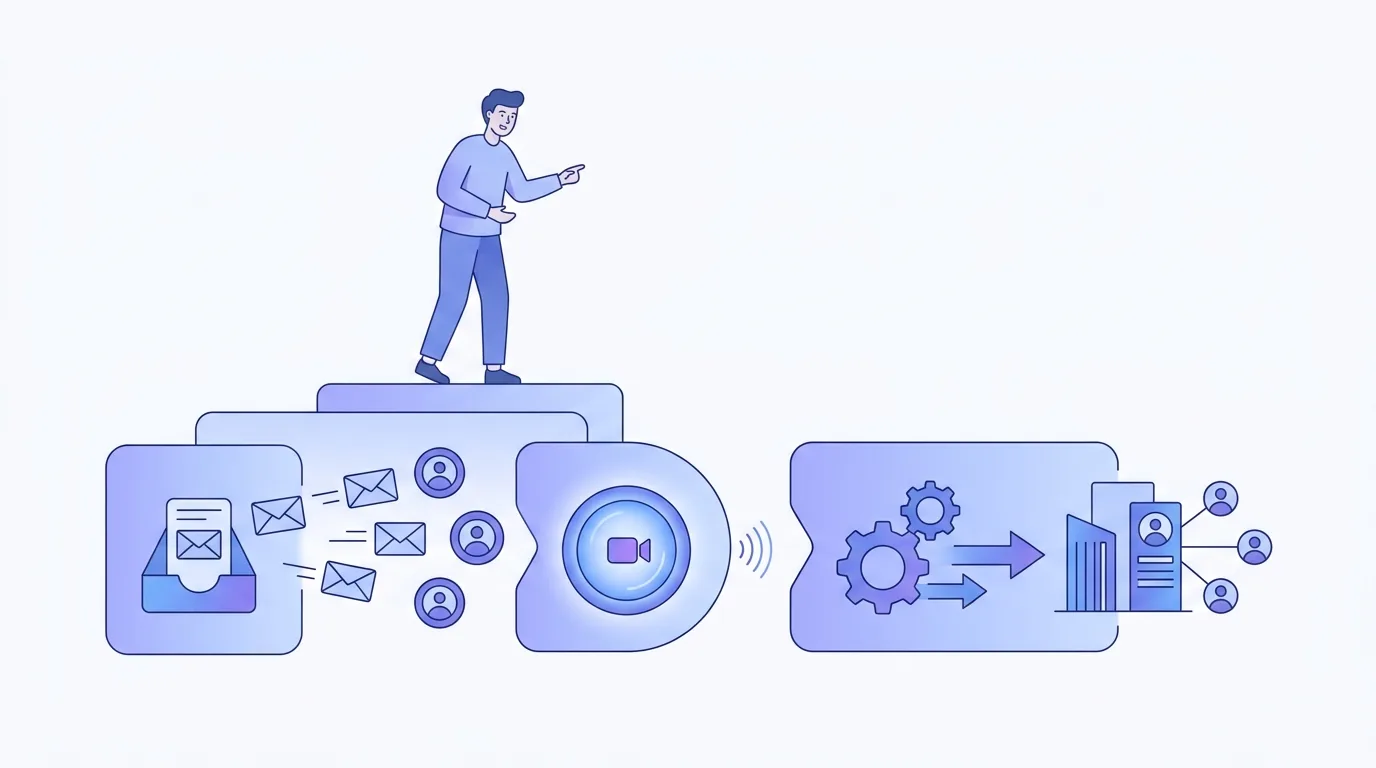
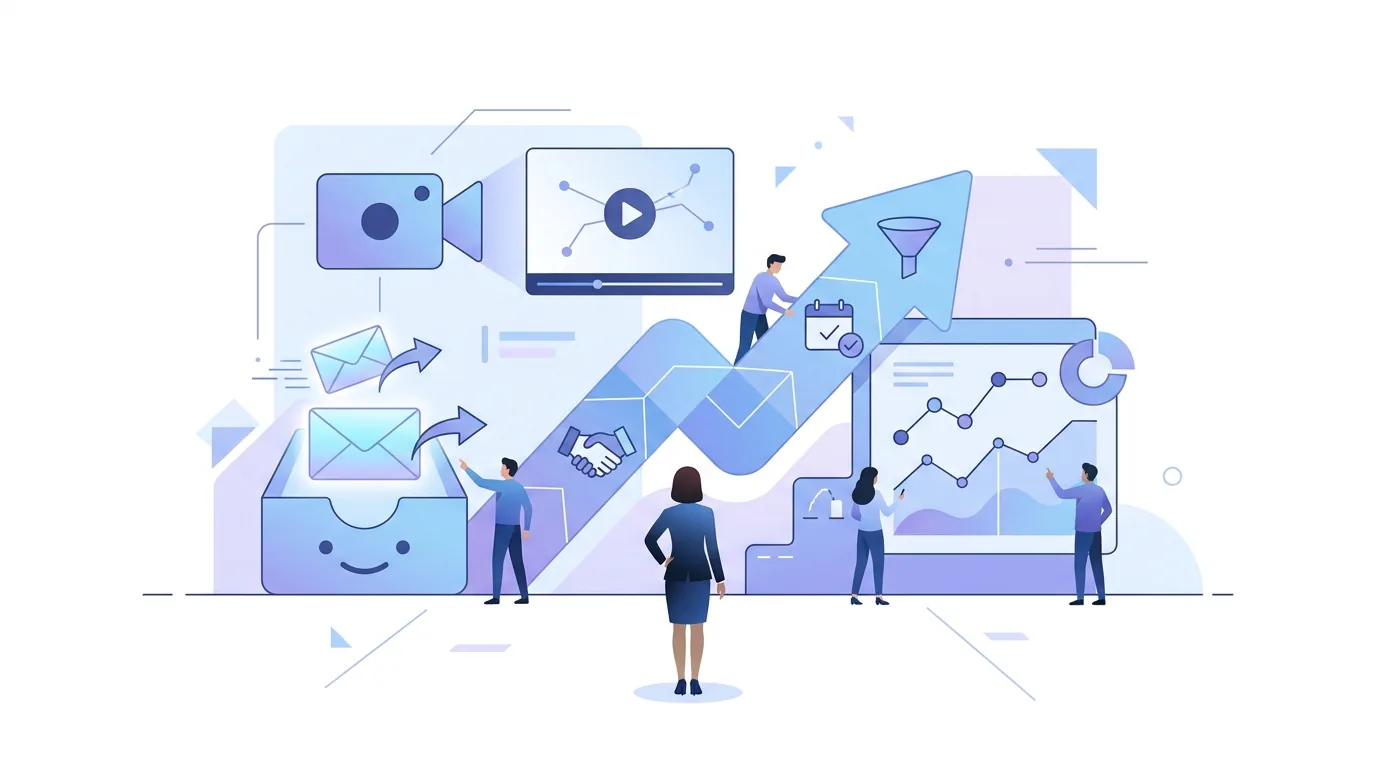
EmailFlow OS covers one job in an outbound process: personalised video email. You record one video and upload it to EmailFlow OS. Then you connect your own Brevo account and your sending domain, and import your prospect list into EmailFlow OS. From that one recording, EmailFlow OS creates a personalised version for each recipient, not one per company, so two people at the same account get two different versions. Each version goes out from your own inbox, through your Brevo account and your sending domain. There's no shared platform sender. Your SPF, DKIM and DMARC setup, your domain's reputation and your Brevo account stay under your control, and so do the decisions about volume and warm-up. What EmailFlow OS doesn't do is decide where the email lands. The recipient's server does that. You can read how the mechanism works on the EmailFlow OS page on personalised AI video email.
Sales follow up email: templates by situation
A sales follow up email is the second or later message in an outbound sequence. Send it as a reply in the original thread, ask one question and give the reader a new reason to answer. Repeating the first email doesn't count. More copy-ready variants are in our sales follow up email templates.
Sales follow up email template after no reply
Hi Anna, a quick follow-up on my note about payroll across your new depots. Is onboarding drivers at several sites something you're dealing with this quarter, or should I check back later? A one-word answer is fine.
Follow up email after sales call
Hi Anna, thanks for the call today. As agreed: you're checking the depot rollout dates with your ops lead, and I'll send the integration notes by Thursday. Shall we keep Tuesday morning for a short review?
After a call, recap what each side agreed to do and suggest one date. A recap without a date tends to stall. The templates for follow-up emails after a sales call cover the other outcomes, such as 'not interested' and 'send me pricing'.
What legal rules apply to outbound sales email?
In the US, the FTC's CAN-SPAM compliance guide requires accurate header information, a subject line that isn't deceptive, a valid postal address and a working opt-out, and it says opt-outs must be honoured within 10 business days. CAN-SPAM has no exemption for B2B email. In Germany, the Act Against Unfair Competition (UWG) treats advertising by email without prior express consent as an unreasonable nuisance, and that applies to business recipients too. Under the GDPR, you also need a legal basis for processing the prospect's personal data in the first place. Outbound teams often point to legitimate interest, but that is a balancing test, not a blanket permission. No tool settles any of these questions for you. They depend on whom you contact, on what basis and how you handle objections.
Is outbound sales a good job?
Outbound sales is a common way into B2B sales. The usual entry role is SDR or BDR, where the job is booking meetings for account executives. It suits people who can handle a lot of rejection, write short and clear messages, and research a company quickly. It doesn't suit people who need every conversation to be welcome. Most contacts don't reply, and the measure of the job is booked meetings or qualified pipeline, usually against a quota. The skills carry over: prospecting, handling objections and running a CRM are the basics of account executive work later on. Before you take the job, ask how the quota is set, who builds the lists, and whether the team sends from domains that are authenticated and warmed up. Reps measured on volume from a burned domain are being measured on something they can't control.
Questions people ask
- What is the difference between an SDR and an account executive?
- An SDR (sales development representative) runs outbound prospecting. They research accounts, make first contact and book qualified meetings. An account executive takes over from that meeting, runs discovery and demos, negotiates and closes the deal. In smaller teams, one person often does both. In larger teams the split lets SDRs specialise in first contact, while AEs handle deals that are already in the pipeline.
- How many follow-ups should an outbound sequence have?
- There's no single correct number. Set exit rules that matter more than the count: stop at once on a reply, a hard bounce or an opt-out, and end with a short breakup email that offers a one-word answer. Every follow-up counts toward your mailbox's daily sending volume, so a longer sequence takes capacity away from first-touch emails sent from the same domain.
- Should outbound email go from my main company domain?
- Many teams send outbound from a separate domain that's close to the brand, with its own SPF, DKIM and DMARC records, so that complaints and bounces don't affect the reputation of the main domain used for invoices and support mail. Either way, the domain has to be authenticated and warmed up before you send at volume, and DKIM should sign with your domain rather than a platform's.