12 min read Diesen Artikel auf Deutsch lesen Lire cet article en français Ler este artigo em português
Sales Techniques: Examples and Follow-Ups
The short answer
A sales technique is a repeatable move used at one stage of a sale. Discovery uses SPIN or consultative questions, objections get an acknowledge-and-ask reply, and the close is a summary or a dated next step. The follow-up is a reply in the original thread with one new fact and one ask. Choose by stage. Don't close before the buyer has confirmed a problem in their own words, and stop following up when they say no.
In this article
- What are sales techniques, and how do they differ from a sales process?
- What are the seven stages of sales?
- What is prospecting in sales?
- Discovery techniques: questions to ask before you pitch
- What is consultative selling?
- How to approach a client for sales
- How to handle sales objections
- What are the different types of sales closing techniques?
- Sales follow-up email templates
- Follow-up email after a sales call
- How EmailFlow OS sends one video per recipient
- Questions people ask
What are sales techniques, and how do they differ from a sales process?
A sales technique is one specific move: a question, a way of answering an objection, a closing line, a follow-up email. A sales process is the order those moves happen in. A methodology like SPIN Selling (Neil Rackham's book of that name) or The Challenger Sale (Matthew Dixon and Brent Adamson) is a named bundle of techniques with rules for when to use each one. People mix the three up, and that's why long technique lists put 'relationship selling' next to 'ask for the meeting'. The first is an attitude. The second is something you actually do.
Here's the practical test: you can write a technique down as a sentence and say exactly when to use it. If you can't, it's a mindset, not a technique. Everything below is written out in full and tied to a stage of the sale. Most techniques fail because they're used at the wrong stage, like a closing line before the buyer has agreed there's a problem, or a feature pitch in a first cold email.
What are the seven stages of sales?
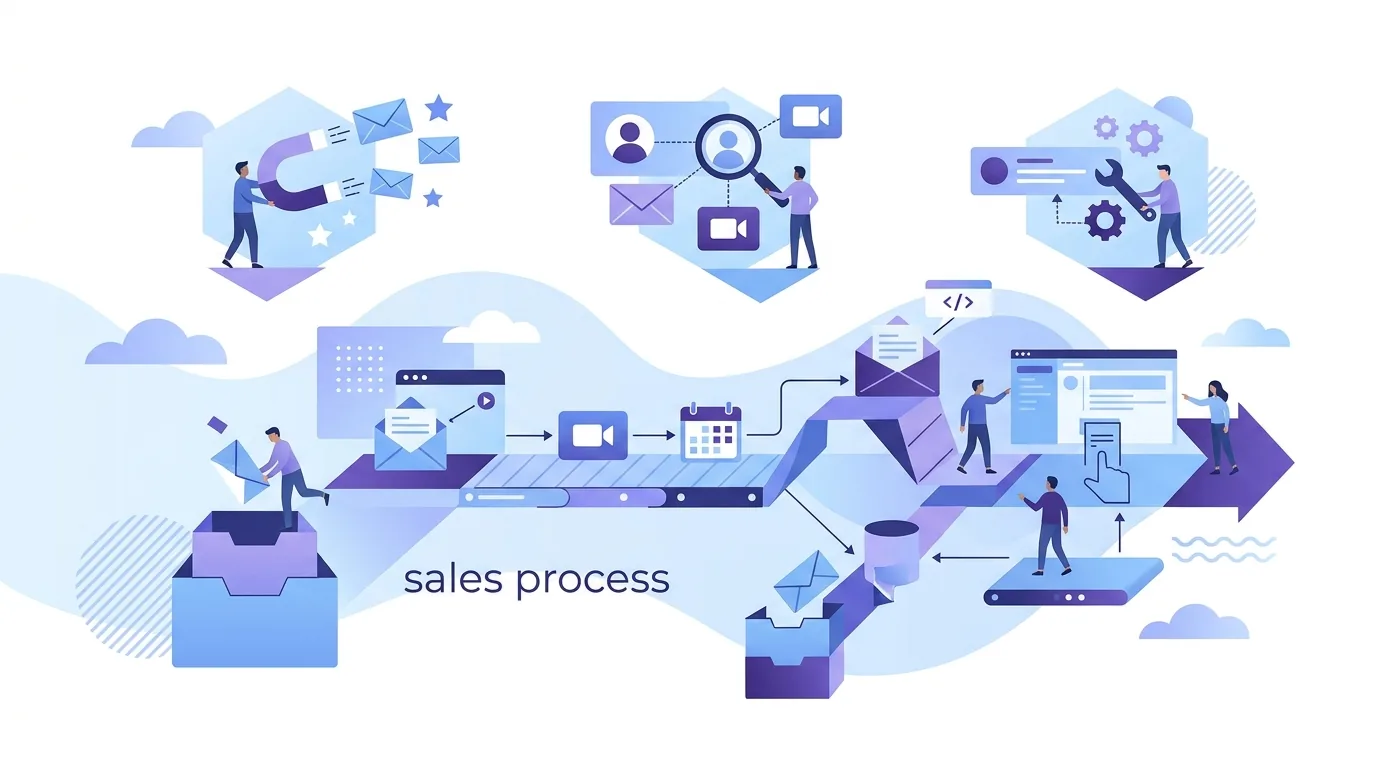
Indeed's career guide lists seven common elements of a sale: prospecting, preparation, approach, presentation, handling objections, closing and follow-up. The table matches each stage with a technique that fits it and the mistake that most often breaks it.
| Stage | What happens | Technique that fits | What goes wrong |
|---|---|---|---|
| Prospecting | Finding and qualifying people who might buy | Trigger-based list building (a new hire, a funding round, a tool change) | Buying a broad list. Unverified addresses bounce and hurt the sending domain |
| Preparation | Researching the account and the person | One sentence on why this person, why now | Research that never shows up in the message |
| Approach | First contact by email, phone or social | Observation opener with one low-effort ask | Pitching the product in the first line |
| Presentation | Showing how the offer solves the confirmed problem | Problem–solution, using the buyer's own words | A generic deck that ignores what came out in discovery |
| Handling objections | Answering doubts on price, timing or fit | Acknowledge, clarify, answer, check | Arguing before you understand the objection |
| Closing | Agreeing on a decision or the next step | Summary close or a dated next-step close | Pressure closes with invented deadlines |
| Follow-up | Keeping the deal moving after each contact | Threaded reply with one new fact and one ask | 'Just checking in' emails with nothing new in them |
What is prospecting in sales?
Prospecting is the stage before first contact. You find people who might need what you sell, research them, and decide whether they're worth contacting at all. A lead is a name that came in. A prospect is a lead you've checked for fit: right role, right company, a plausible reason to buy now. In outbound B2B, prospecting also includes checking that the addresses work. Hard bounces from a stale list are recorded against your sending domain, so verify the list before you import it, not after the first send. Our guide on what prospecting is in sales and marketing covers the lead-versus-prospect split in more detail.
Discovery techniques: questions to ask before you pitch
- SPIN situation question: 'How do you assign inbound leads to reps today, by territory or round-robin?'
- SPIN problem question: 'Where does that break down? Do leads ever sit unassigned overnight?'
- SPIN implication question: 'When a lead waits until the next morning, what happens to that deal?'
- SPIN need-payoff question: 'If every lead had an owner the same day it came in, what would that change for your team?'
- Consultative open question: 'Walk me through the last deal you lost to no decision. Where did it stall?'
- Challenger reframe: 'Most teams we talk to measure reply speed. The ones that stall usually haven't agreed who owns the first reply. Is that settled on your side?'
- Active-listening summary: 'So the real cost isn't the tool, it's the days before anyone answers. Did I get that right?'
Use SPIN when the buyer hasn't yet put a cost on the problem. The implication question is the one that does that, so don't skip it. Use the Challenger reframe only once you know the account well enough to be right. A confident reframe that misreads the buyer's business ends the conversation faster than a weak question would. The summary goes at the end of every discovery block. If the buyer corrects you, that correction is your next question.
What is consultative selling?
Consultative selling means you diagnose before you prescribe. The seller asks about the buyer's goals, current process and constraints, then recommends whatever actually fits. Sometimes that's a smaller package, and sometimes it's nothing. Here's the checkable rule: in a consultative call, the seller doesn't name a product until the buyer has described a problem in their own words. It doesn't work in very short transactional sales, where the buyer already knows what they want and extra questions just slow them down.
How to approach a client for sales
- Trigger opener: 'Saw you're hiring SDRs in Berlin. Teams growing that fast usually rebuild lead routing within the first few months. Is that on your list?'
- Observation opener: 'Your pricing page sends demo requests to a general inbox. Who picks those up today?'
- Referral opener: 'Anna from your Munich office said you own outbound tooling. Is that still right, or should I talk to someone else?'
- Permission opener: 'Would a short walkthrough of how other RevOps teams handle this be useful, or is it off your radar?'
- Video opener: a short recording that names the problem you saw, sent with one line of text and one question underneath.
Every opener ends with one question the buyer can answer in a word. If you ask for a full meeting in the first message, you've skipped the stages where trust gets built. The rules depend on the channel and the country. In the US, the FTC's CAN-SPAM guidance requires a valid postal address and an opt-out that's honoured within 10 business days. In Germany, the unfair-competition act (UWG) generally requires prior consent for advertising email, so check the legal basis for each recipient before you send the first message.
How to handle sales objections
- Price: 'Fair. Is it the total that's too high, or the timing of the payment? Those have different fixes.'
- Timing: 'Understood. What has to happen first? If it's next year's budget, should I come back once it's approved?'
- Incumbent: 'Makes sense if it's working. What would have to go wrong with the current setup before you'd look again?'
- Authority: 'Who else would want a say? I can send a one-page summary you can forward as it is.'
- Brush-off ('send me information'): 'Happy to. Which part should it cover, setup or cost, so it's not a generic brochure?'
The pattern is the same each time: acknowledge, ask what's behind the objection, answer that, then check. Don't answer the objection as first stated. 'Too expensive' often means 'not convinced it works', and a discount doesn't fix that. A clear 'not interested' isn't an objection. It's an answer, and it ends the sequence.
What are the different types of sales closing techniques?
- Summary close: 'You said routing delays cost you deals, and setup has to fit inside your current CRM. This does both. Shall we set a start date for the pilot?'
- Next-step close: 'Can we put a short call in the diary with your IT lead this week to check the integration?'
- Alternative-choice close: 'Would you rather start with the sales team only, or both sales and support?'
- Trial close: 'How close is this to what you need? What's still missing?'
- Assumptive close: 'I'll send the order form to you and to procurement. Is Maria the right contact there?'
- Deadline close: 'The onboarding slots for this month close on Friday.' Only use it if that deadline actually exists.
The summary and next-step closes work at almost any stage because they only ask for the next step. Use the assumptive close only after the buyer has said yes in substance. Used earlier, it reads as pressure. A deadline close with a made-up date fails the first time the buyer checks it, and in the EU, inventing urgency can count as a misleading commercial practice. In complex B2B deals, the most common close is a small one: an agreed date for the next conversation.
Sales follow-up email templates
A sales follow-up email does one job: it gives the buyer a reason to reply that the last message didn't. Send it as a reply in the original thread, not as a new email with 'Re:' typed into the subject. A real reply carries the In-Reply-To and References headers from the internet message format standard, which is what lets mail clients thread the message. A typed 'Re:' without those headers reads as a fake reply. Every follow-up also counts toward your daily volume per mailbox, and any address that hard-bounced on the first send should come off the list before the follow-up goes out.
- New-fact follow-up: 'Quick addition to my note below: the integration I mentioned also reads from HubSpot, which I think you use. Worth a look, or not relevant?'
- One-question follow-up: 'Is lead routing something you're working on this quarter, or should I drop it for now?'
- Resource follow-up: 'Here's the short setup checklist I mentioned. No reply needed if the timing's wrong.'
- Right-person follow-up: 'If this isn't yours, who owns outbound tooling on your team? Happy to take it to them.'
- Breakup follow-up: 'I'll stop here so I'm not cluttering your inbox. If it comes up later, a one-word reply is enough.'
Use them in this order and stop after the breakup. Repeating the same ask with 'just bumping this' adds volume without adding a reason to reply. You'll find more variants by situation in our sales follow-up email templates, and the timing between touches is covered in the guide to building a sales cadence with exit rules.
Follow-up email after a sales call
Send the recap the same day, in the thread where the meeting was booked. Template: 'Thanks for the time today. What I heard: leads wait overnight, and any fix has to run inside your CRM. Agreed next step: a call with Tom from IT on [day, date, time]. I've sent the invite. If I misread anything, just correct it here.' The structure is recap, the buyer's words, one dated next step, and an invitation to correct you. A recap without a date leaves both sides waiting for the other. More templates by call outcome are in our guide to the follow-up email after a sales call.
How EmailFlow OS sends one video per recipient
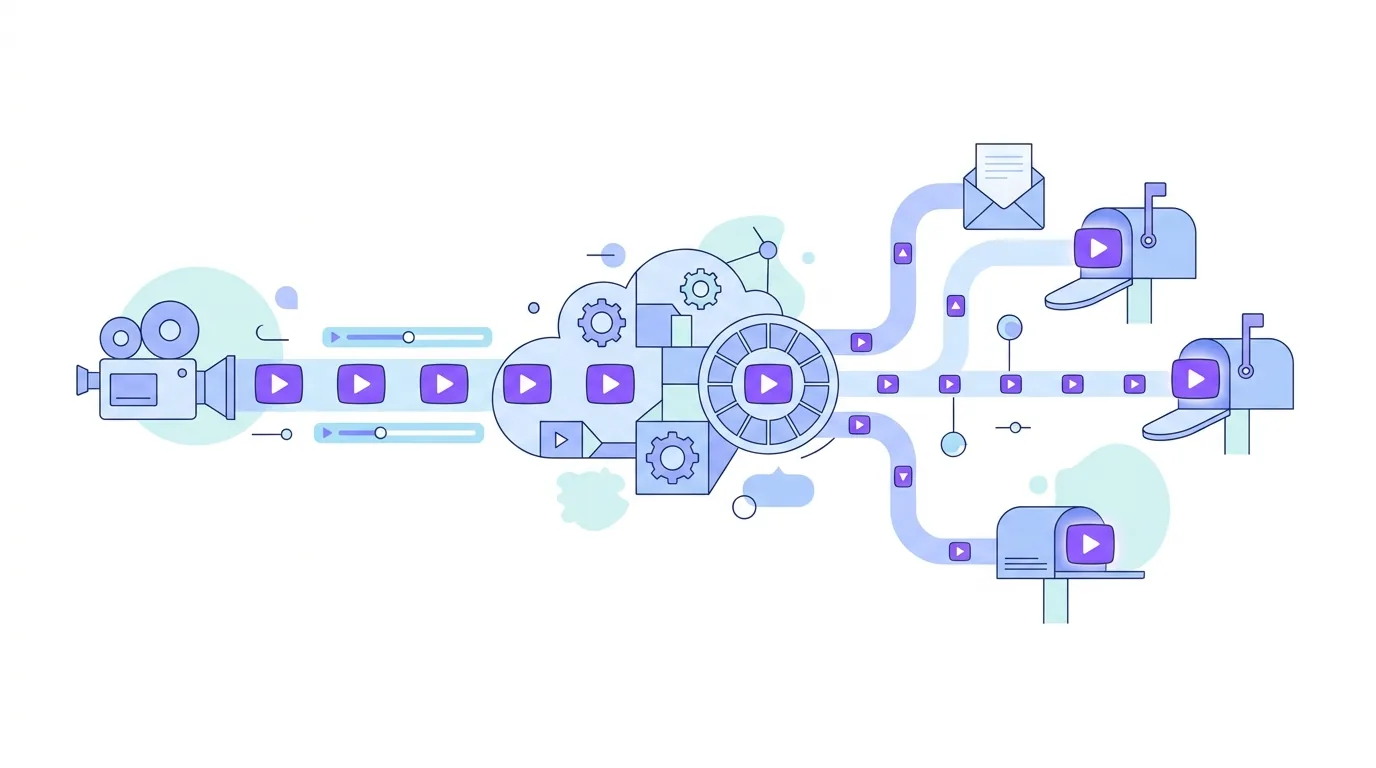
Several of the techniques above, like the video opener, the recap and the new-fact follow-up, can go out as video instead of text. That's what EmailFlow OS does, and it's an EmailFlow OS product, not one of the general sales techniques. You record one video and upload it to EmailFlow OS. You connect your own Brevo account and sending domain, then import your prospect list into EmailFlow OS. EmailFlow OS creates a personalised version of that single recording for each recipient, not each company, and sends every version from your own inbox, through your Brevo account and your domain. It never goes through a shared platform sender.
Because the mail goes out under your domain, your own SPF, DKIM and DMARC records sign it, and the reputation it builds stays with your domain. Our guide to DKIM, DMARC and SPF for cold email senders explains how to set up those records before you send. The receiving server still decides where each message lands, and you still decide whether you have a legal basis to email each person. How the product fits together is on the EmailFlow OS home page for personalised video outreach.
Questions people ask
- What is the SPIN selling technique?
- SPIN is a questioning method from Neil Rackham's book SPIN Selling. It uses four types of question in order: Situation (the current setup), Problem (where it breaks), Implication (what the break costs) and Need-payoff (what fixing it would change). The implication question matters most, because it lets the buyer put a cost on the problem themselves instead of you asserting it.
- What is the difference between solution selling and consultative selling?
- Solution selling starts from a known product and maps the buyer's pain onto it. Consultative selling starts from the buyer's situation and can end with recommending a smaller offer or nothing at all. In practice, solution selling suits a defined product line, while consultative selling suits complex or custom deals where the right scope only becomes clear during discovery.
- How many follow-up emails should a sales sequence have?
- No fixed number holds for every market, and we don't publish one. A practical rule is to stop when you've run out of new reasons to write. That's usually after a new-fact, a one-question, a right-person and a breakup email. A clear 'no' or an opt-out request ends the sequence at once, and under the FTC's CAN-SPAM guidance an opt-out must be honoured within 10 business days.
- Should a sales follow-up email be a new email or a reply?
- A reply. Replying in the original thread keeps the In-Reply-To and References headers, so the buyer sees the whole conversation in one place. A new email with 'Re:' typed into the subject lacks those headers, so it may not thread and reads as a fake reply. Start a new thread only when the topic actually changes, for example after a lost deal reopens months later.