11 min read Diesen Artikel auf Deutsch lesen Lire cet article en français Ler este artigo em português
B2C Sales vs B2B: Tools and Follow-Up Emails
The short answer
B2C sales means selling products directly to individual consumers for their own use. One person decides, usually without a formal approval step, and in the EU, marketing email to consumers generally needs prior consent. B2B sales means selling to a company's buying group over several conversations. In B2B outreach, a follow-up is a short reply in the original thread, sent from your own authenticated domain, that refers to something the prospect actually said.
In this article
- What does B2C sales mean?
- B2C vs B2B sales: what actually differs?
- Which B2C sales habits carry over to B2B outreach, and which don't?
- Which tools run B2C sales, and which suit B2B outreach?
- Where EmailFlow OS fits: a EmailFlow OS product
- Follow-up sales email: format, template and sample
- Follow-up email format for sales
- Follow-up sales email template
- Follow-up sales email sample
- Follow-up email after a sales call
- Email consent rules: B2C vs B2B
- Questions people ask
What does B2C sales mean?
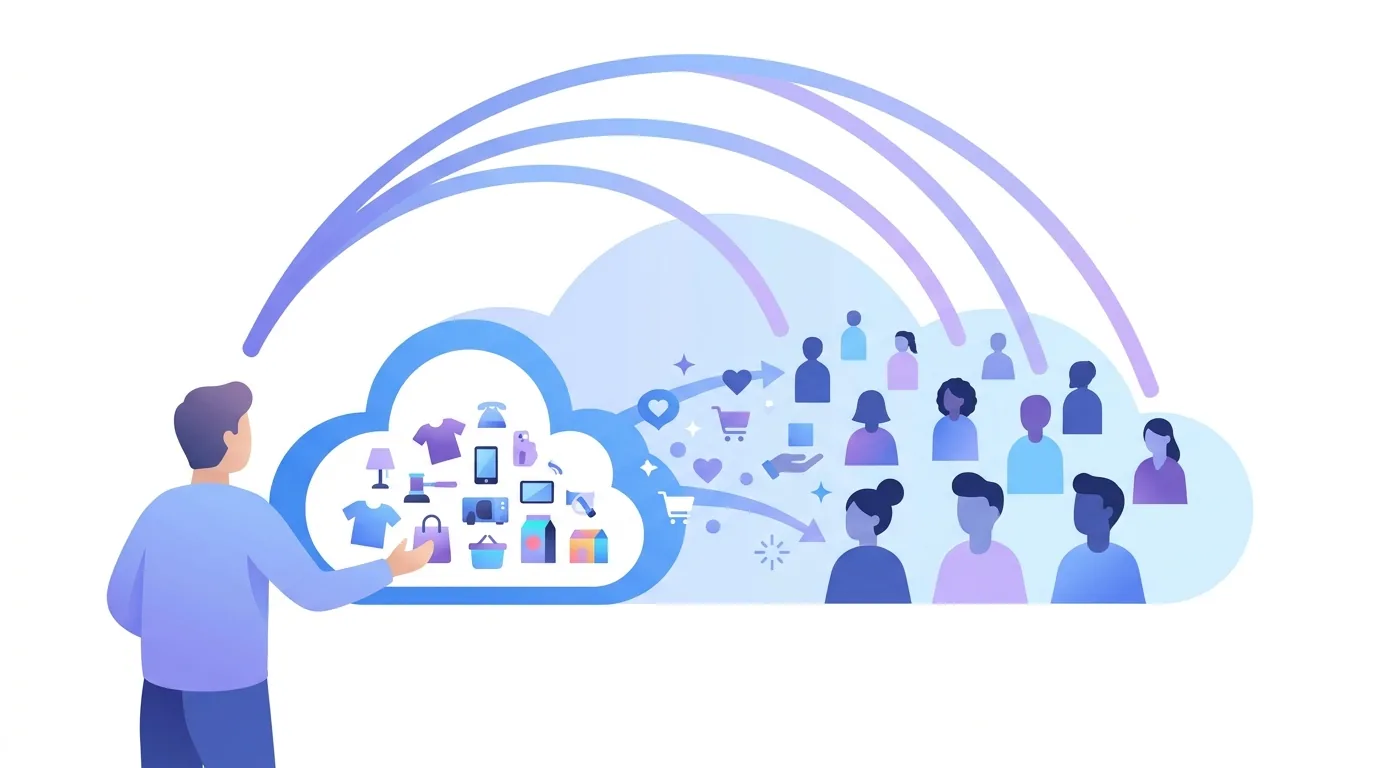
B2C stands for business-to-consumer. Investopedia defines B2C as companies selling products and services directly to individual end users for personal use, not to other businesses. Retailers, subscription apps, online shops and car dealerships all sell B2C. In B2C sales, the buyer and the user are usually the same person, and that person spends their own money. Most of the other differences come from that. No procurement team checks the offer, no contract goes through legal review, and the buyer rarely has to justify the purchase to anyone. So B2C sales relies on mass channels: the storefront, the product page, ads and consumer email lists. If there's a sales rep at all, they often meet the buyer at the moment of decision, on a car lot or a phone line. A B2C seller rarely spends weeks researching one named buyer. B2B sales works the other way round: a short list of named accounts, several people in each one, and contact that builds over weeks or months.
B2C vs B2B sales: what actually differs?
Most comparisons stop at "B2C is faster, B2B builds relationships." When you're choosing tools and channels, you need the properties that change your setup: who decides, how contact starts, which consent rule governs email, and what your sending infrastructure has to handle. Our guide to the B2B sales process and its stages covers the B2B side in more depth.
| Property | B2C sales | B2B sales |
|---|---|---|
| Buyer | One consumer, usually also the user | A buying group: user, budget holder, sometimes procurement and IT |
| Decision path | Individual decision, often in one session | Several conversations, internal approval, sometimes a formal tender |
| How contact starts | Consumer comes to the shop, site or ad; outbound is limited by consent rules | Outbound prospecting to named people is common, as is inbound |
| Email type | Campaigns to opted-in subscribers, transactional mail (receipts, shipping) | One-to-one outreach and follow-ups to named contacts |
| EU email rule | Prior consent for marketing email to consumers under the EU ePrivacy Directive | The Directive leaves legal persons to member-state rules; Germany's Act against Unfair Competition (UWG) requires prior express consent for email advertising to businesses too |
| Sending setup | High-volume list sends from a marketing platform | Low-volume, per-person sends from a real inbox on the company's own domain |
The last two rows are where people get caught out. Blasting one identical message to a large list from a campaign tool is a B2C habit, and it doesn't carry over to B2B cold outreach. Receiving mail servers judge each sender domain by how its mail is received. A sudden list send to people who never opted in produces the complaint and bounce patterns those filters weigh.
Which B2C sales habits carry over to B2B outreach, and which don't?
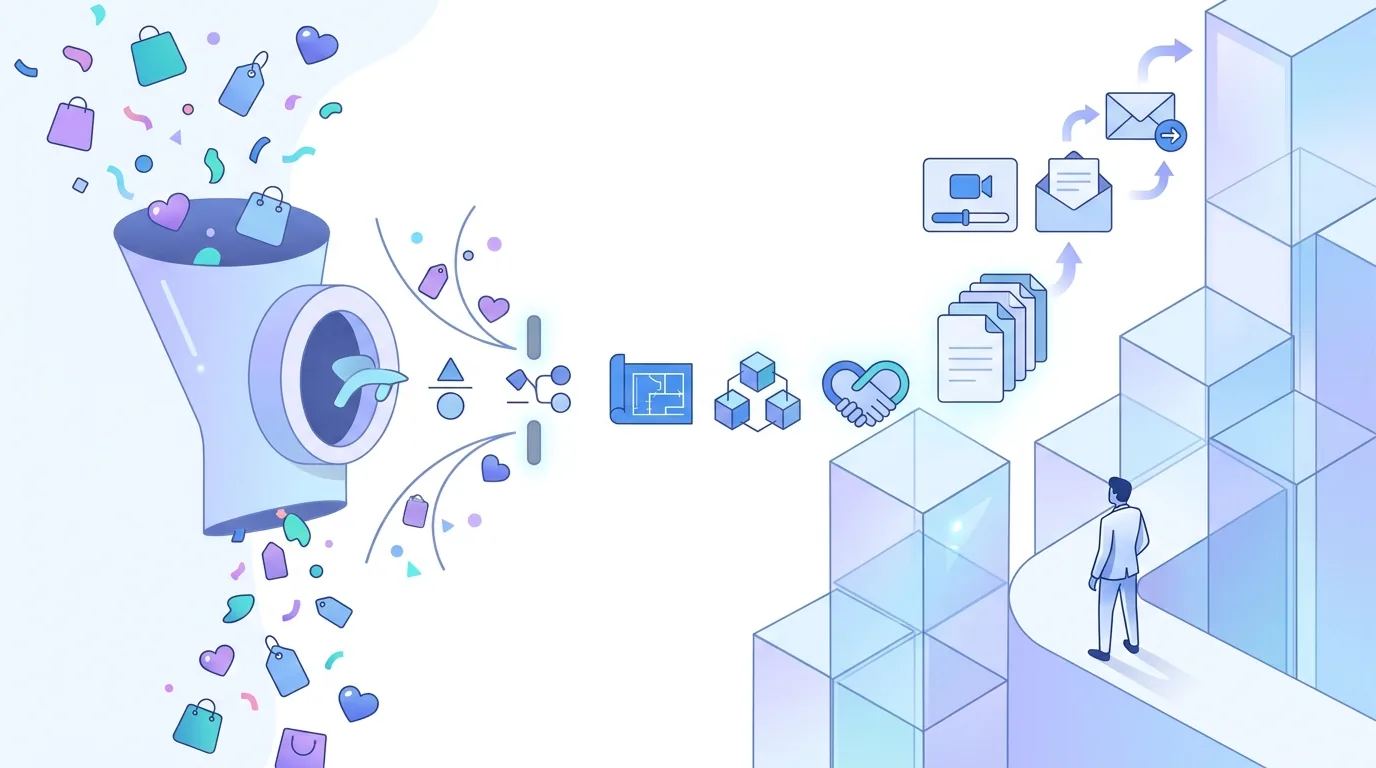
Some B2C practices work in B2B outreach. Others break once a buying group is involved. The difference usually comes down to who reads the message and what they have to do next.
- Carries over: one clear next step per message. A B2C checkout page asks for one action. A B2B email with a single ask (a reply or a time slot) is easier to answer than one that offers several links.
- Carries over: speaking to one person. B2C copy addresses an individual. A B2B email written to a named person, about their situation, reads differently from one written to "your team".
- Carries over: always-on availability. Shop-style self-service, such as booking links and recorded demos, lets a prospect move forward outside office hours.
- Doesn't carry over: impulse urgency. Countdown-style pressure doesn't fit a purchase that needs internal sign-off. The buyer can't act on it alone, so it just adds noise.
- Doesn't carry over: list blasting. Consumer campaigns go to opted-in subscribers. Run the same mechanics on a cold B2B list and you send identical mail to people with no prior relationship, which is exactly what spam filters and complaint buttons react to.
- Doesn't carry over: a single decision maker. A B2B follow-up often has to give your contact something they can forward internally. A B2C message never needs to do that.
If you're working out who on your side owns which of these steps, our overview of the types of sales jobs and their handoffs maps the roles.
Which tools run B2C sales, and which suit B2B outreach?
Your tools follow your sales motion. B2C sales tools are built around a storefront and a subscriber list. B2B outreach tools are built around named contacts, deal stages and one-to-one sends. The table compares widely used products on the same three properties: what each is built around, which motion it suits, and where it stops for one-to-one B2B outreach. Check current features in each vendor's own documentation before you decide.
| Tool | Built around | Suits | Where it stops for one-to-one B2B outreach |
|---|---|---|---|
| Shopify | An online storefront and checkout | B2C product sales | It's a commerce platform. Outbound prospecting isn't its job |
| Klaviyo | Email and SMS marketing tied to e-commerce data | B2C campaigns and automated flows to subscribers | Designed for opted-in consumer lists, not cold contact with named business buyers |
| Mailchimp | Email marketing campaigns to an audience list | B2C and B2B newsletters to subscribers | Campaigns go to a list or segment, not as individual replies in a person-to-person thread |
| Brevo | Email marketing plus transactional sending on your own domain | Campaigns, transactional mail and sending through your own authenticated domain | On its own it's a sending platform. Sequencing and per-person content depend on what you build on top of it |
| HubSpot | CRM with marketing and sales modules | Teams running both marketing and sales in one system | Its value depends on clean contact and deal data. It won't fix a cold list or a weak sending domain |
| Pipedrive | A sales pipeline CRM | Small B2B sales teams tracking deals by stage | Tracks deals and activities. Reaching new contacts still depends on your channel and sending setup |
None of these is always "the B2C tool" or "the B2B tool". Many teams run a CRM for deals and a marketing platform for subscribers, and keep cold outreach on a separate path. That way cold sends build their own reputation record instead of sharing one with the domain that sends receipts and newsletters.
Where EmailFlow OS fits: a EmailFlow OS product
EmailFlow OS is built for B2B cold outreach, not B2C consumer campaigns. You record one video and upload it to EmailFlow OS. You connect your own Brevo account and your own sending domain. Then you import your prospect list into EmailFlow OS, and the list lives there. EmailFlow OS personalises that single recording for each recipient, not once per company, so two contacts at the same account each get their own version. Each version is sent from your own inbox, through your Brevo account and your sending domain. Nothing goes out from a shared platform address.
This means the sender reputation that receiving servers evaluate belongs to your domain, and the SPF, DKIM and DMARC records you publish are the ones those servers check. The domain and the Brevo account stay under your control. The recipient's mail server decides where each message is filed, not EmailFlow OS. Details are on the page about personalised AI video email for B2B outreach.
Follow-up sales email: format, template and sample
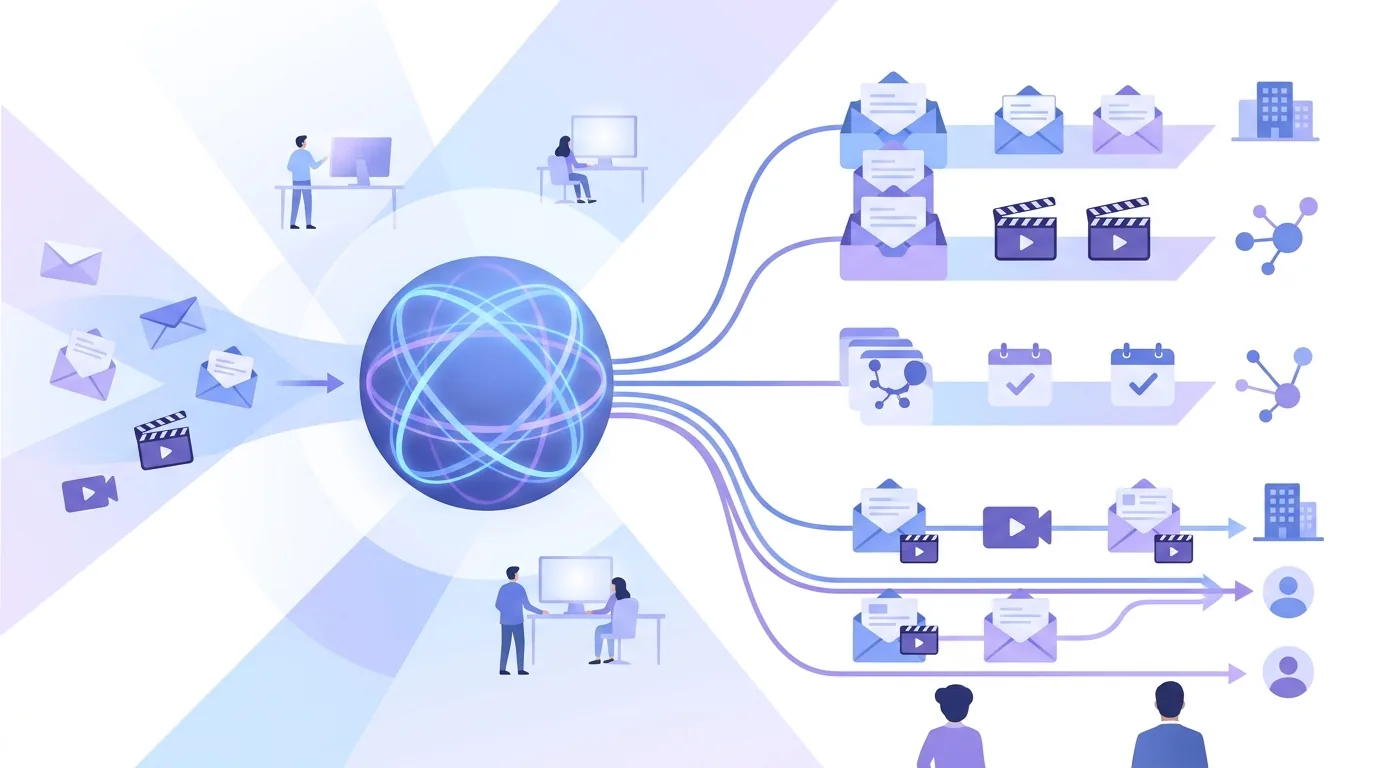
If you're searching for a follow-up sales email, a follow-up email format for sales or follow-up email templates for sales, you usually want three things: a structure to copy, a sample to adapt and a rule for when to send it. Each part below works on its own.
Follow-up email format for sales
- Thread: send it as a reply to your earlier message. Mail clients group a reply into a thread using the In-Reply-To and References headers from the internet message format standard, so the prospect sees the history without having to search for it.
- Subject: keep the original subject with the "Re:" your mail client adds. Never put a fake "Re:" on a first message.
- Opening line: one sentence that says what's new (an answer, a resource or a date) instead of "just checking in".
- Body: a few short sentences tied to something the prospect said or does.
- Ask: one question they can answer in a line.
- Sender: the same person and the same authenticated domain as the first email.
Follow-up sales email template
Hi [First name], following up on my note about [specific problem]. Since then I [found / put together / recorded] [one concrete thing] that covers [their situation]. Would it be useful if I sent it over, or is [colleague's role] the better person for this? [Your name]
Follow-up sales email sample
Hi Dana, a quick follow-up on my email about onboarding new reps across both of your regions. You mentioned on LinkedIn that the new office opens next quarter, so I've written down how teams usually split shared playbooks between sites. Want me to send the short outline, or should I talk to whoever runs enablement? Sam
For more variations by situation, see our collection of sales follow-up email templates.
Follow-up email after a sales call
A follow-up after a sales call does a different job from a follow-up to an unanswered email. The prospect has already spoken to you, so this message is a written record they can forward to their buying group. Send it the same day, while the details are fresh, and write down what was agreed rather than recapping your pitch.
- Open: thank them and restate the problem they named, in their words.
- Agreements: what you agreed on, such as the next meeting, who attends and what each side owes.
- Open points: anything you promised to check, with the answer or a date for it.
- Ask: confirm the next step or the people to invite.
Two things commonly go wrong: the follow-up re-pitches the whole product, or it comes from a different address than the one the prospect already knows. Either one makes the message harder to forward internally. You'll find worked examples in our guide to the follow-up email after a sales call, and the timing and threading limits for cold sequences are in cold email follow-up timing.
Email consent rules: B2C vs B2B
In the EU, consent is where B2C and B2B email differ most. The EU ePrivacy Directive requires prior consent for direct-marketing email to natural persons, meaning consumers. It allows an existing-customer exception for similar products, as long as the recipient can opt out easily in every message. It leaves the protection of legal persons to the member states, so B2B rules vary by country. Germany's Act against Unfair Competition (UWG) requires prior express consent for email advertising whether the recipient is a consumer or a business, with its own existing-customer exception. The personal data of business contacts still falls under the GDPR. Its recitals say direct marketing can count as a legitimate interest, but that has to be weighed case by case. In the US, the CAN-SPAM Act covers commercial email, including business-to-business email. It requires accurate headers, a physical postal address and a working opt-out. No tool meets any of these rules for you. That depends on how you collect contacts and how you run your outreach. Our explainer on SPF, DKIM and DMARC for cold email senders covers the technical side of sending from your own domain.
Questions people ask
- What does B2C selling mean?
- B2C selling means a business sells directly to an individual consumer who buys for personal use, as Investopedia defines it. In B2B a buying group approves the purchase, but in B2C one person decides. That's why B2C relies on storefronts, ads and subscriber email, while B2B relies on contact with named people at specific companies.
- What are the 5 sales techniques?
- There's no standard list of five, and trainers group them differently. Five that are commonly taught are consultative selling (diagnosing before proposing), solution selling, social selling, value-based selling and the assumptive close. They differ in where they start: the buyer's problem, the product, the network, the economic case or the closing step.
- What is the 3-3-3 rule in sales?
- The 3-3-3 rule has no fixed definition. It's a mnemonic that trainers fill in differently, usually as a short research step, a few points about the prospect and a brief message. Use it to keep messages short and specific, not as a full method. In email, one relevant point and one ask matter more than hitting an exact count of anything.
- How risky is B2B sales?
- B2B sales risk comes from its structure, not its volume. Cycles are longer, so forecasts slip. Revenue often depends on a few large accounts, so losing one hurts. A deal can stall when one member of the buying group objects or leaves. Outreach adds a second risk: careless cold sending can damage the reputation of the domain your whole company uses for email.
