12 min read Diesen Artikel auf Deutsch lesen Lire cet article en français Ler este artigo em português
Sales Enablement: Process, Tools, Follow-Ups
The short answer
Sales enablement means giving reps what they need at each buying stage: approved content, onboarding, ongoing coaching, and a sending setup that works. To run it, find where deals stall, build or fix the asset for that stage, train reps on it, and check whether they use it. For email outreach, that includes sending from your own authenticated domain (SPF, DKIM, DMARC) and a follow-up template that replies in the original thread.
In this article
- What is sales enablement?
- How does the sales enablement process work?
- Sales enablement vs sales operations vs marketing: who owns what?
- Which sales enablement tools are there?
- What does sales enablement need for email outreach?
- Where EmailFlow OS fits in an enablement stack
- Sales follow-up emails: what reps should be handed
- What is a sales follow-up email?
- Sales follow-up email template
- Sales follow-up email examples
- Follow-up sales email sample
- Sales pitch structure
- Why does sales enablement fail?
- Questions people ask
What is sales enablement?
Sales enablement is the ongoing work of giving salespeople the content, training, coaching and tools they need at each stage of a deal, so they can move the buyer to the next stage without improvising. It runs as a loop: find the stage where deals stall, build or fix one asset for it, train reps on it, then check whether they actually use it. For teams that prospect by email, it also covers the sending setup, meaning the rep's own authenticated domain and follow-up templates that reply in the original thread.
"Enablement" just means making someone able to do something. In sales, that means a rep can answer a pricing objection without pinging marketing, pull up the right case study during a live call, and send a follow-up from a properly authenticated company domain. If your internal doc needs a one-sentence definition, use this one: sales enablement is the function that finds where reps get stuck and fixes it with an asset, a skill or a system.
Here's an example. Your deals keep stalling after the discovery call because reps send long recaps with no clear next step. The enablement fix has three parts: a recap template with one ask, a short coaching session where reps rewrite their last three recaps, and a check two weeks later on whether anyone's using the template. Notice what's not on that list: buying a new platform. Most enablement problems are content or habit problems long before they become software problems.
A second example, from the email side most enablement guides skip. A team's new outbound reps each set up sending on a fresh subdomain, and nobody publishes a DMARC record for it. The template is fine; the problem is that receiving servers get no policy for the domain and the team gets no aggregate reports showing which sources send in its name. The enablement fix here isn't training at all: it's a one-page sending checklist (SPF, DKIM, DMARC, gradual warm-up) that every new rep's domain has to pass before the first sequence starts.
How does the sales enablement process work?
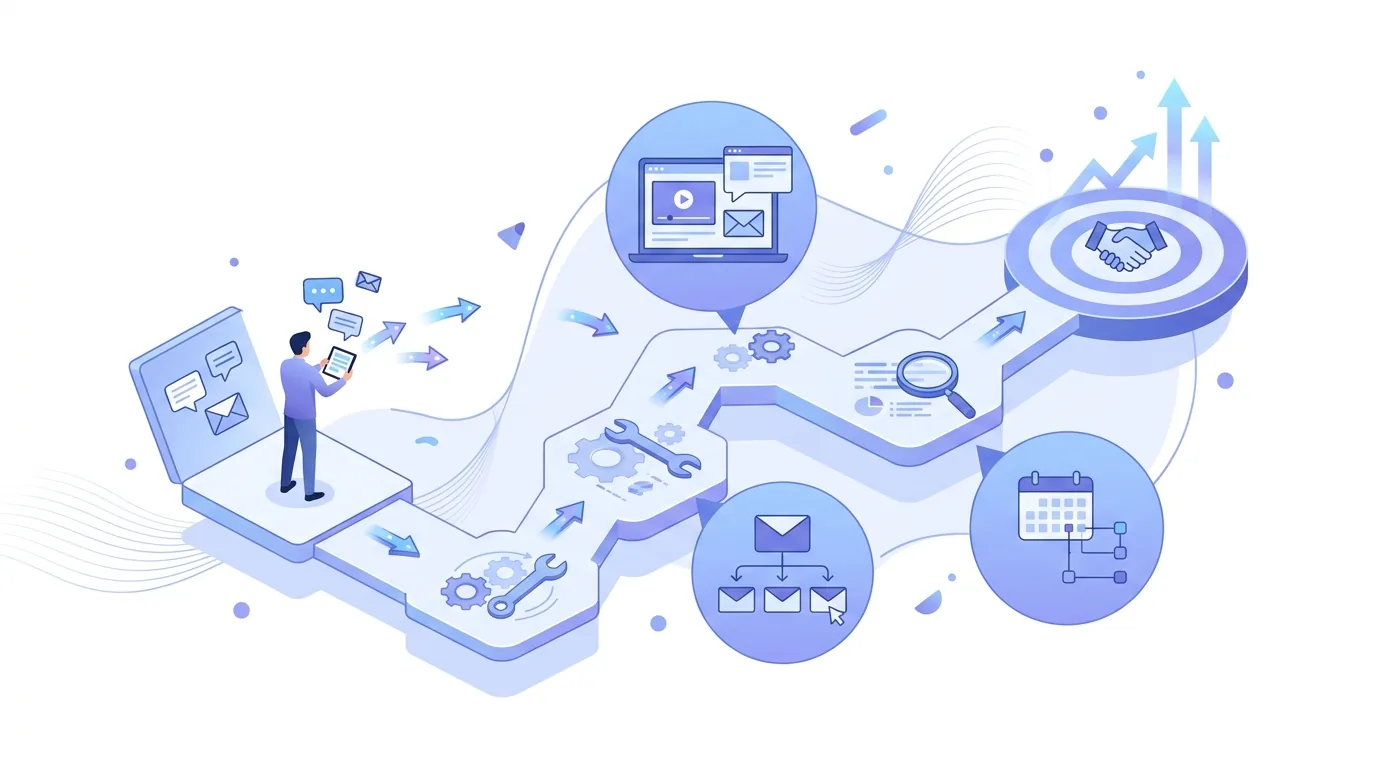
The process runs in a loop, not as a one-off project. Each pass begins with one specific point where deals stall and ends with a check on whether the fix got used.
- Diagnose the stage. Use your CRM to find where deals stall or get dropped, and write down the stage's exit criterion: what the buyer has to do before the deal moves forward.
- Build or fix the asset. That might be a one-pager, an objection answer, a call script or an email template. One asset per problem, written for the buyer in that stage, not for a general audience.
- Onboard new reps. A 30-60-90 day plan splits ramp-up into learning the product and process, running the motions with supervision, then working independently. Each phase gets a concrete checkpoint.
- Coach existing reps. Managers review real calls and real emails against the asset. Reading a template is one thing. Rewriting your own sent emails with it is what changes habits.
- Measure use, then repeat. Track whether reps open and send the asset, and whether deals in that stage meet the exit criterion. If the asset goes unused, fix its findability or relevance before you write another one.
Step one usually works best with stage definitions everyone already agrees on. If your team doesn't have those yet, the breakdown of an enterprise sales process with exit criteria per stage is a sensible place to start.
Sales enablement vs sales operations vs marketing: who owns what?
These three functions overlap, and that's where things go wrong. When nobody owns a template, it's either missing or there are three conflicting versions of it. Here's a common way to split the work. Your org chart may draw the lines somewhere else, but each item should have exactly one owner.
| Function | Owns | Typical output | Doesn't own |
|---|---|---|---|
| Sales enablement | Rep readiness: training, coaching, stage-specific content | Onboarding plans, playbooks, objection guides, email templates | Territory design, quota setting |
| Sales operations | Systems and data: CRM, routing, reporting, quotas | Pipeline reports, territory maps, CRM fields | What reps say to buyers |
| Marketing | Market message and demand | Positioning, case studies, campaigns | Rep-level coaching |
| Sales managers | Day-to-day performance of their reps | Call reviews, deal reviews | Company-wide content library |
Which sales enablement tools are there?
"Sales enablement tool" covers several categories that solve different problems. Pick based on the bottleneck you found in step one, not on the label. The table compares each category by the same three properties: the job it does, what it needs from you, and where it stops.
| Category | Example products | Job it does | What it needs from you | Where it stops |
|---|---|---|---|---|
| Content management | Highspot, Seismic, Showpad | Central library of approved sales content that reps can search | Someone who keeps content current and retires old versions | Can't fix content that's weak to begin with |
| Training and coaching | Allego, Mindtickle | Onboarding courses, practice recordings, manager feedback | Managers who make time to review | Practice doesn't carry over unless it's tied to real deals |
| CRM with sales features | Salesforce Sales Cloud, HubSpot Sales Hub | Pipeline stages, email templates and activity logging in one place | Clean stage definitions and consistent data entry | Templates are only as good as what gets written into them |
| Conversation intelligence | Gong | Records and transcribes calls so managers can review them | Consent handling for call recording under the laws that apply to you | Shows what happened, not what to do next |
What doesn't work: buying a content platform before you have content worth storing in it. An empty, well-organised library still leaves reps writing their own emails from scratch.
What does sales enablement need for email outreach?
Most enablement guides stop at content and training. For teams that prospect by email, there's a third layer: the sending setup. If that's broken, the best template in the world never gets read. Reps should send from your company's own domain, and that domain needs three DNS records, each defined in an IETF standard. SPF lists the servers allowed to send for the domain. DKIM adds a cryptographic signature that the receiving server checks against a public key published in your DNS. DMARC tells receivers what to do when SPF or DKIM alignment with the visible From domain fails, and where to send aggregate reports.
A new domain should also start with low daily volume and build up gradually. That's warm-up: receiving servers judge reputation partly from sending history, and a brand-new domain doesn't have any. Consent rules vary by country, too. In some EU countries, Germany among them, unsolicited advertising email can require prior consent even when the recipient is a business. Enablement should give reps written guidance on which lists they may email and on what basis, checked by whoever handles legal questions in your company. The checks and records are covered in detail in the guide to SPF, DKIM and DMARC for cold email senders.
Where EmailFlow OS fits in an enablement stack
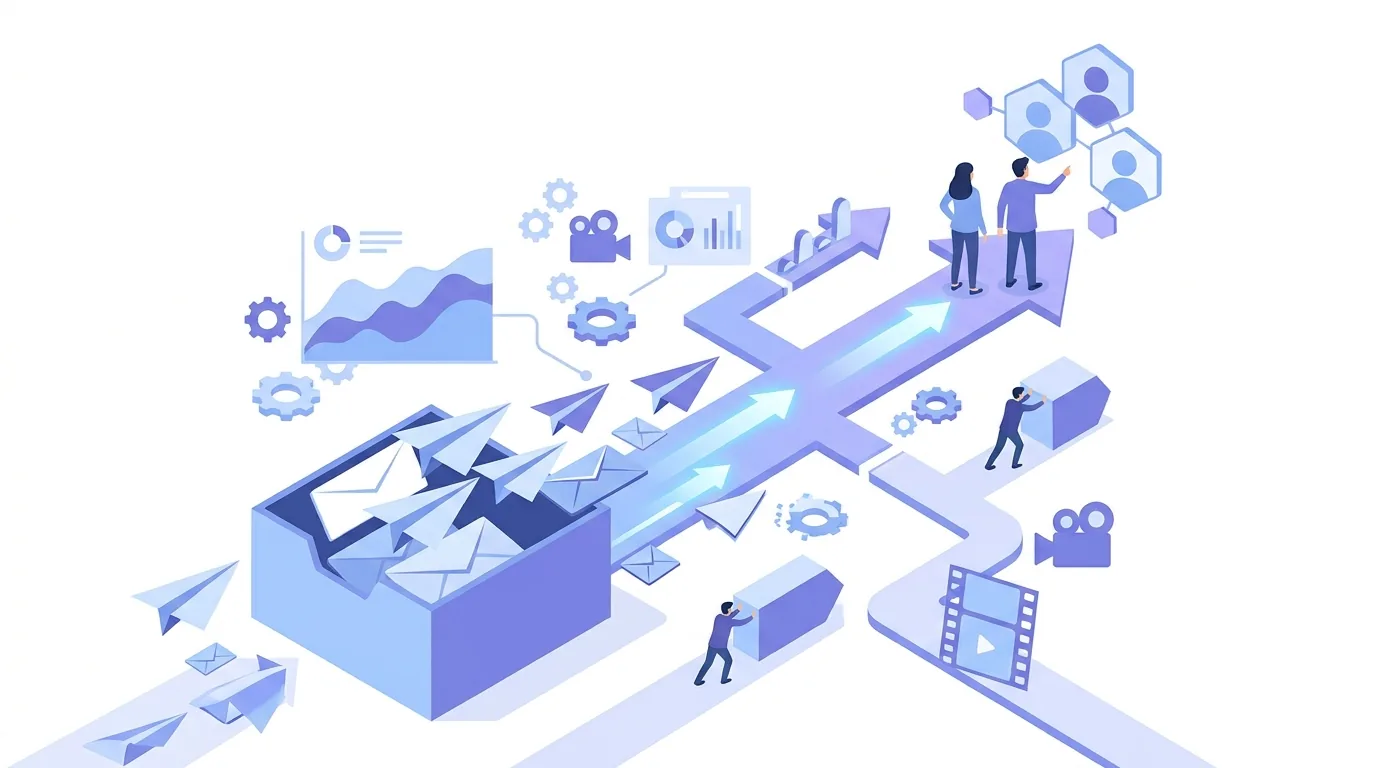
EmailFlow OS is a EmailFlow OS product for personalised video email in B2B cold outreach. It covers the sending part of email enablement, not content libraries or coaching. Here's how it works. A rep records one video and uploads it to EmailFlow OS, connects their Brevo account and sending domain, and imports the prospect list into EmailFlow OS. EmailFlow OS then personalises that single recording per recipient, not per company, so two contacts at the same account each get their own version.
Each version goes out from the rep's own inbox, through the customer's own Brevo account and own sending domain, never through a shared platform sender. The DNS records and the Brevo account stay under the customer's control, and the sending history builds up on the customer's own domain rather than on an address shared with other senders. Where a message is filed is decided by the receiving server, which is why the SPF, DKIM and DMARC setup above still matters. You'll find the full mechanism on the EmailFlow OS personalised video email page.
Sales follow-up emails: what reps should be handed
Follow-up templates are among the most-requested enablement assets, because most reps write them under time pressure. Each part below stands on its own.
What is a sales follow-up email?
A sales follow-up email is a message to a prospect who's already heard from you, whether that was an earlier email, a call or a meeting. It adds one new piece of information and asks one question. Sent as a reply in the original thread, it carries the In-Reply-To header, so the prospect sees the full history in one place and doesn't get a new, unconnected message.
Sales follow-up email template
Template: Subject: keep the original subject (reply in the thread). Body: "Hi [First name], one thing I didn't mention last time: [one new fact tied to their situation, such as a trigger, a figure from their own report, or a relevant change]. Would it make sense to have a short call about [specific problem] next week? [Signature with full name, company, and a way to opt out]". The two rules behind it: one new fact, one ask. A template that just says "checking in" gives the prospect nothing new to respond to. There are ten more variants by situation in the sales follow-up email template collection.
Sales follow-up email examples
- After no reply: "Hi Anna, since my last note your team posted two openings for outbound reps. If onboarding them is on your list, I can share how other teams structure the first month. Worth a short call?"
- After a call: "Hi Marc, as agreed: the security questionnaire is attached, and the pilot scope is three users. Can you confirm Thursday works for the review with your IT lead?"
- After a quote: "Hi Lena, one point I left out of the quote: the setup line covers the DNS configuration. Does the quote need to go to procurement in a specific format?"
Follow-up sales email sample
Sample, sent as a reply in the original thread: "Hi Tom, quick addition to my email from Tuesday. Your careers page now lists a sales enablement role, which usually means onboarding content is being rebuilt. I recorded a short walkthrough of how we'd structure the first-week email templates. Want me to send it over, or is someone else the right person for this? Best, Sara". It holds up as a sample because the new fact can be checked, the ask can be answered with yes or no, and there's a way out built in.
Sales pitch structure
A pitch that enablement can hand to every rep follows a fixed order: trigger (why now), problem, impact, mechanism (how your offer solves it), proof, ask. Keeping the order fixed means a manager can spot right away which part is missing when reviewing a rep's email. A full walkthrough with email, call and video versions is in the article on sales pitch structure, examples and follow-ups.
Why does sales enablement fail?
- Content nobody can find: assets sit in a shared drive with several versions each, so reps write their own. The fix is one owner and one current version per asset.
- Training without follow-through: a one-time onboarding week with no manager review afterwards. The fix is coaching on real sent emails and recorded calls.
- Measuring activity instead of stage movement: counting how many emails went out says nothing about whether deals met their exit criterion.
- Ignoring the sending setup: missing DKIM or a DMARC record with no alignment means receiving servers have no reason to trust the domain, no matter how good the template is.
- Shared or borrowed sending domains: if reps send through an address the company doesn't control, it can't change the DNS records, and its sending history is mixed with that of other senders.
Questions people ask
- What is sales enablement?
- Sales enablement is the function that gives reps the content, training, coaching and tools they need at each deal stage. It works as a loop: diagnose the stage where deals stall, build one asset for it, train reps, then check use against the stage's exit criterion. For email outreach it also includes an authenticated own sending domain with SPF, DKIM and DMARC records.
- What does a sales enablement manager do?
- A sales enablement manager owns rep readiness rather than systems or quotas. Typical work: writing onboarding plans, keeping one current version of each playbook, objection guide and email template, running coaching sessions on real calls and sent emails, and checking whether reps use the assets. Sales operations, by contrast, owns the CRM, routing, reporting and territory design.
- What is the 30-60-90 rule in sales?
- In sales onboarding, the 30-60-90 rule is a ramp-up plan split into three phases, named after the day marks where each one ends. The first is for learning the product, the buyer and the process. The second is for running real motions like calls and emails with a manager reviewing them. The third is for working independently against agreed targets. Each phase ends with a checkpoint, such as passing a mock discovery call.
- What is the lowest position in sales?
- The entry-level role in most B2B sales teams is the sales development representative (SDR) or business development representative (BDR). SDRs usually qualify inbound leads, while BDRs prospect outbound, but many companies use the two titles interchangeably. Either way, the role books meetings and hands qualified prospects to an account executive, who owns the deal through to signature.
- How do you define sales enablement in one sentence?
- Sales enablement is the function that finds where reps get stuck in a deal and fixes it with an asset, a skill or a system. It's different from sales operations, which owns the CRM, data and quotas, and from marketing, which owns market-level messaging and demand generation rather than coaching individual reps.
