13 min read Diesen Artikel auf Deutsch lesen Lire cet article en français Ler este artigo em português
Types of Sales Jobs: Roles, Paths, Emails
The short answer
Sales jobs differ by which stage of the sales cycle they own. SDRs and BDRs find and qualify prospects and book meetings. Account executives run discovery, demos and negotiation, then close. Account managers keep and grow existing customers. Sales engineers handle the technical proof, and sales managers own the team's numbers. To pick a role, start with the stage you want to own. Then choose between inside and field work, and decide what you want to sell.
In this article
- What do sales jobs consist of?
- Types of sales jobs by stage of the sales cycle
- Example: one B2B deal passing through five sales roles
- Inside sales vs outside sales, B2B vs B2C
- What are 10 common sales job titles?
- What are the four types of salespeople?
- How does a sales career path usually progress?
- What is a sales follow-up email?
- Sales follow-up email template
- Sales follow-up email examples by role
- Sales pitch structure
- Where EmailFlow OS fits for outbound sales roles
- Questions people ask
The main types of sales jobs are sales development (SDR and BDR), account executive, account manager, sales engineer and sales management. Each one owns a different stage of the sales cycle: first contact, closing, keeping the customer, technical proof or leading the team. On top of that, every role splits into inside or outside sales and into B2B or B2C, so the stage you own, the channel you sell through and what you sell together define the job.
What do sales jobs consist of?
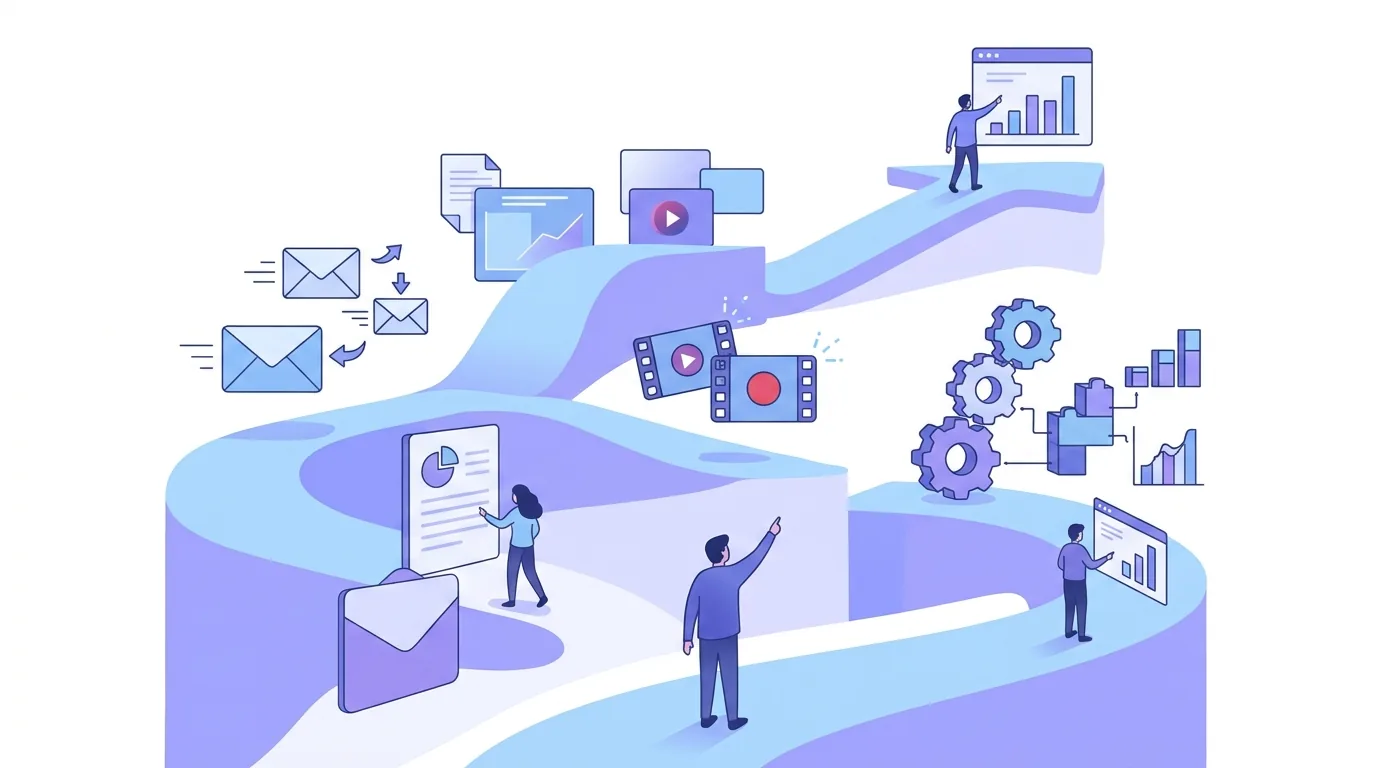
Every sales job is one piece of the same chain: find a potential buyer, check that they fit, show them how the product solves their problem, agree on terms, and then keep the customer. Small companies often give that whole chain to one person. Larger teams split it up, and that split is where the different types of sales jobs come from. The day-to-day work is a mix of research, outreach by email and phone, meetings, CRM updates and follow-ups. How that mix is weighted depends on the stage the role owns. An SDR might spend most of the day on first contact and almost none on contracts. An account manager is the other way round. Pay usually follows the same logic. Roles with a hard number to hit, like booked meetings or closed revenue, tend to combine a base salary with commission. Roles focused on retention more often tie the variable part to renewals or expansion. Before you compare job titles, ask what you'd be measured on. That one question tells you more about a job than its title does.
Types of sales jobs by stage of the sales cycle
The most useful way to sort sales roles is by the stage they own and by what they hand to the next person. Titles differ from company to company, but these handoffs are usually the same. For a closer look at the entry-level role, see our guide to the sales development representative job and pay.
| Role | Stage it owns | Typical measure | Hands off to |
|---|---|---|---|
| Sales Development Representative (SDR) | Qualifying inbound leads and outbound prospects | Qualified meetings booked | Account executive |
| Business Development Representative (BDR) | Mostly outbound first contact with target accounts | Qualified meetings or opportunities created | Account executive |
| Account Executive (AE) | Discovery, demo, proposal, negotiation, close | Closed revenue against quota | Account manager or customer success |
| Outside / Field Sales Representative | The full cycle, in person in a territory | Territory revenue | Often nobody: keeps the account |
| Sales Engineer / Solutions Consultant | Technical discovery, demos, proof of concept | Technical win on deals the AE runs | Back to the AE |
| Account Manager | Renewals, upsell and cross-sell to existing customers | Retention and expansion revenue | Stays with the account |
| Sales Manager | Coaching, forecasting, pipeline reviews for a team | Team quota attainment | Head of Sales |
| Head of Sales / VP Sales | Sales strategy, hiring, territories, compensation plans | Company revenue target | Executive team |
What goes wrong is nearly always the handoff. If an SDR books a meeting that doesn't fit, the AE wastes a call. If an AE closes a deal without writing down what was promised, the account manager inherits expectations nobody told them about. Our article on the SDR in sales and the handoff to the AE covers which notes make that transfer work.
Example: one B2B deal passing through five sales roles
Take an illustrative case: a company selling scheduling software to logistics firms. The roles touch the same deal in a fixed order, and each one leaves something behind for the next.
- BDR: spots that a target firm has opened a new warehouse, emails the operations lead and the IT lead separately, and books a call once the operations lead replies. Leaves behind: the trigger, who replied, and what they said the problem was.
- Account executive: runs discovery, learns that three people must approve, and sends a recap in the same thread after each meeting. Leaves behind: the decision-makers, the promised start date and any discount agreed.
- Sales engineer: joins when the IT lead asks how the tool connects to their existing systems, and runs a test setup. Leaves behind: a written list of what was proven and what wasn't.
- AE again: sends the proposal, follows up against its expiry date and gets the signature.
- Account manager: takes the notes from all three, sets up the first review before renewal and asks who signs off next time.
In a small company, one founder or one full-cycle AE does all five steps. The work is the same; only the number of handoffs changes. That's why a job ad titled "Account Executive" at a startup and at a large software vendor can describe very different jobs.
Inside sales vs outside sales, B2B vs B2C
Two more splits sit on top of the stage. The first is how you sell. Inside sales works remotely through email, phone and video calls. Outside or field sales means meeting buyers in person, usually in an assigned territory, which brings travel and more freedom in how you plan your week. The second split is who you sell to and what. In B2C sales, such as retail or real estate, one person often decides fast. In B2B, a buying group decides, the cycle is longer and every stage gets its own specialist role. The U.S. Bureau of Labor Statistics' Occupational Outlook Handbook (Sales occupations group, checked November 2026) lists sales occupations by what is sold. Its categories include real estate brokers and sales agents, wholesale and manufacturing sales representatives, and securities, commodities and financial services sales agents. Some of these come with licensing requirements, real estate and securities among them. Large enterprise deals add roles like sales engineers and deal desks. Our guide to the enterprise sales process maps them out stakeholder by stakeholder.
What are 10 common sales job titles?
- Sales Development Representative (SDR): qualifies leads and books meetings.
- Business Development Representative (BDR): outbound prospecting into target accounts.
- Account Executive (AE): owns deals from discovery to signature.
- Inside Sales Representative: runs the full or partial cycle remotely.
- Outside Sales Representative: sells in person within a territory.
- Sales Engineer: proves the product works technically for the buyer.
- Account Manager: renews and grows existing customers.
- Key Account Manager: does the same for a handful of strategic accounts.
- Sales Manager: leads and coaches a team of reps.
- Head of Sales / VP of Sales: sets strategy, territories and compensation.
Newer titles like Revenue Enablement Manager or Sales Automation Specialist usually describe support roles. They build the training, tools and processes reps use, and they don't carry a quota themselves.
What are the four types of salespeople?
There's no official standard for this. Career guides each use their own split. One common version sorts salespeople by temperament, not by title. Hunters like first contact and new logos, which suits SDR, BDR and new-business AE roles. Farmers like long relationships and fit account management. Consultants, or problem solvers, like diagnosing a buyer's situation, which suits complex B2B deals and sales engineering. Closers like negotiation and the final push. Treat this as a way to check yourself, not as a rule. Most people mix several types, and many jobs need more than one. A full-cycle AE has to hunt, diagnose and close. Problems start when the type and the job don't match. A farmer stuck in a pure cold-outreach role, or a hunter asked to babysit renewals, usually burns out or drifts toward the work they actually prefer.
How does a sales career path usually progress?
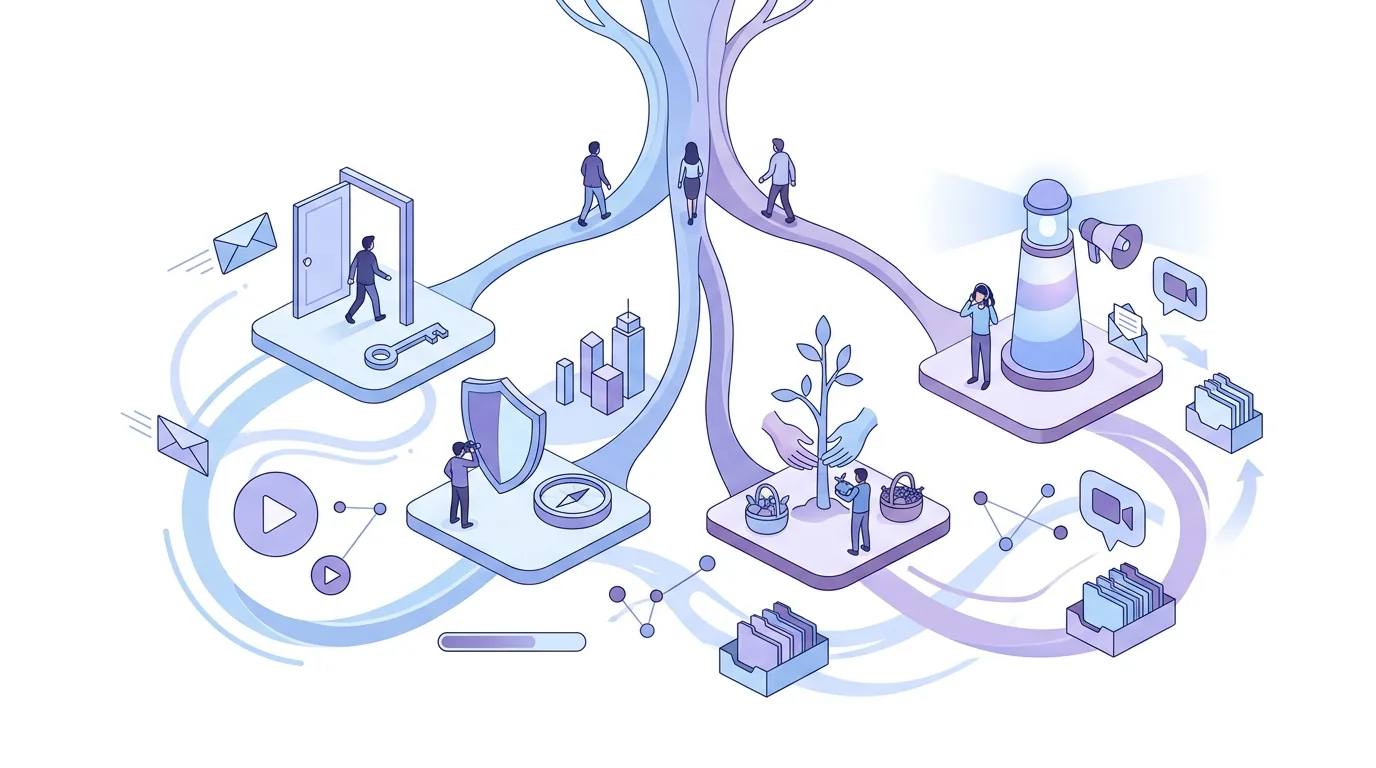
A typical B2B path starts as an SDR or BDR, moves to account executive, and then splits. One track goes deeper into selling: senior AE, enterprise AE, or strategic account roles with bigger deals and longer cycles. The other goes into management: team lead, sales manager, then head of sales. Account management and sales engineering are side doors. People enter them from an AE role, or directly from customer success or a technical job. Each step trades one skill for another. Moving from SDR to AE means you stop measuring meetings and start owning revenue. Moving from AE to manager means your number now depends on other people's deals. One mistake keeps coming up: promoting the best individual closer into management without checking whether they can coach. The skills don't overlap as much as the title change suggests.
What is a sales follow-up email?
A sales follow-up email is any message you send after a first contact that went unanswered, or after a call, a demo or a quote. It nudges the conversation to its next step. Almost every role in the table writes them. SDRs follow up on cold outreach, AEs follow up after demos and proposals, and account managers follow up before renewals. The technical detail people overlook is threading. A follow-up sent as a reply in the same conversation carries the In-Reply-To and References headers that point back to the earlier message. Mail clients use those headers to group the thread, so the recipient sees your first message right under the new one. A new email with a copied subject line doesn't carry those headers, and it can land as a separate conversation. Our collection of sales follow-up email templates has full examples by situation.
Sales follow-up email template
Use this sample as a reply in the original thread. Keep the subject line, add one new fact, and ask one question.
Hi [First name], one more thought on my note from [day]: [one new, specific fact — a change at their company, a relevant detail, an answer to a likely question]. If [problem] is on your list this quarter, would a short call on [day] or [day] work? If it's not a priority, just say so and I'll close the loop. — [Your name]
Here's what doesn't work: "just checking in" with nothing new, a fake "Re:" on a message that was never part of a thread, and following up after someone has asked you to stop. Under the CAN-SPAM Act, the FTC's compliance guide for business (checked November 2026) requires opt-out requests to be honored within 10 business days. In the EU, many member states require prior consent before advertising email is sent, and some apply that to business recipients too. Germany is one example, under § 7 UWG.
Sales follow-up email examples by role
- SDR after no reply: reply in thread, give one new reason the timing fits, offer two concrete time slots.
- AE after a demo: recap the two or three problems the buyer named, attach what was promised, propose the next meeting with the decision-maker.
- AE after a proposal: ask which part of the proposal is still open, and tie the question to the quote's expiry date if there is one.
- Account manager before renewal: summarize what the customer used, flag what changes at renewal, ask who needs to sign off.
- Any role after a "not now": confirm the date they named and send nothing until then.
Sales pitch structure
A pitch that works in email, on a call or in a video follows six parts: a trigger (why you're writing now), the problem, its impact on the buyer, the mechanism (how your product solves it), proof, and one ask. SDRs compress all six into a few lines. AEs stretch them across a full demo. Our sales pitch structure guide has examples for each channel.

Where EmailFlow OS fits for outbound sales roles
EmailFlow OS is built for the outbound end of the table: SDRs, BDRs and AEs who prospect themselves. It's an EmailFlow OS product, and the mechanism works like this. You record one video and upload it to EmailFlow OS. You connect your own Brevo account and your sending domain, then import your prospect list into EmailFlow OS. From that single recording, EmailFlow OS creates a personalized version for each recipient, not for each company. So two contacts at the same account each get their own version. Every message goes out from your own inbox, through your Brevo account and your domain, not from a shared platform sender. Your domain's SPF, DKIM and DMARC records and its sending reputation stay under your control. Whether a message reaches the inbox is still up to the receiving server. You can see how the product works on the EmailFlow OS home page. If you're checking your DNS before you start, read our guide to DKIM, DMARC and SPF for cold email senders.
Questions people ask
- What are the main types of sales jobs?
- The main types are sales development (SDR and BDR), account executive, account manager, sales engineer and sales management. They differ by stage: SDRs and BDRs make first contact and book meetings, AEs close deals, account managers renew and expand customers, sales engineers prove the product technically, and managers own team quota. Each can be inside or outside sales, B2B or B2C.
- What are the four types of salespeople?
- A common, unofficial split is hunter, farmer, consultant and closer. Hunters prefer first contact and suit SDR, BDR and new-business AE roles. Farmers prefer long relationships and suit account management. Consultants diagnose problems and suit complex B2B deals and sales engineering. Closers prefer negotiation. Most people combine several types, and a full-cycle AE needs at least three.
- What is the difference between an SDR and an account executive?
- An SDR owns the start of the sales cycle: researching, contacting and qualifying prospects, then booking a meeting. An account executive takes over from that meeting and owns discovery, demo, proposal, negotiation and signature. The SDR is measured on qualified meetings and the AE on closed revenue against a quota. Many AEs started as SDRs.
- Which sales jobs are entry level?
- SDR, BDR and inside sales representative are the usual entry points into B2B sales. They teach prospecting, qualification and objection handling without making you carry a revenue quota on day one. Retail sales is a common entry point into B2C. Roles like real estate or securities sales also require a license, so they need an extra step first.
- What is the difference between inside and outside sales?
- Inside sales reps work remotely through email, phone and video calls, and they often handle more conversations per day. Outside sales reps meet buyers in person, usually within a territory, so travel and in-person relationships take up more of their week. The stage of the cycle they own can be the same. Only the channel changes.
- Which sales roles need the most follow-up emails?
- Outbound roles, meaning SDRs, BDRs and AEs who prospect themselves, send the most follow-ups because most first contacts go unanswered. AEs also follow up after every demo and proposal. Account managers send fewer but more specific ones, usually tied to renewal dates. For every role, sending the follow-up as a reply in the original thread keeps the context visible.
