12 min read Alle Artikel auf Deutsch Tous les articles en français Todos os artigos em português
Email Reply Samples: Copy-Ready by Situation
The short answer
A professional email reply has four parts, in this order. Acknowledge the sender in one line. Give the answer, or say what you'll do. Name a next step with a date. Sign with your name. Use Reply so the In-Reply-To and References headers keep the message in the same thread. Below you'll find full samples for out-of-office messages, prospect replies to cold outreach, Dear Sir or Madam letters and sales follow-ups, plus the DNS records receiving servers check.
In this article
- How do you respond to an email professionally?
- Out-of-office and auto-reply samples
- How to reply when a prospect answers your cold email
- What are some professional email phrases?
- What are the common types of email and their uses?
- Dear Sir/Madam letter sample
- Follow up sales email sample
- Email blast or individual reply: which one?
- Where replies fit in B2B email lead generation
- Cold email deliverability: what receiving servers check
- Email deliverability checklist before you send
- How EmailFlow OS sends outreach that prospects reply to in your inbox
- Questions people ask
Email reply samples are complete replies you can copy and fill in. Each one has an acknowledgement line, the answer, a dated next step and your name. Pick the sample that matches the message you got, replace every [bracket], and send it with Reply rather than as a new email so it stays in the sender's thread. The samples below cover auto-replies, answers to prospects, formal letters to an unnamed recipient and sales follow-ups.
How do you respond to an email professionally?
Every reply sample below uses the same four parts. First, one line that shows you read the message. Second, the answer: the date, the decision, the document or the reason you can't help. Third, a next step with a day attached, like "I'll send the revised quote by Thursday", not "I'll get back to you soon". Fourth, a sign-off and your name. Keep the reply in the original thread. Hitting Reply keeps the "Re:" subject plus the In-Reply-To and References headers that mail clients use to group messages into one conversation. The IETF's internet message format standard defines these headers along with Message-ID. If you start a new email instead, the recipient's client can't link it to the earlier messages, and they have to dig for context.
Where replies go wrong: answering most of the questions but not all of them, burying the answer under pleasantries, or promising a next step with no date. Read the incoming message once more before you send and check that every question in it has an answer in yours.

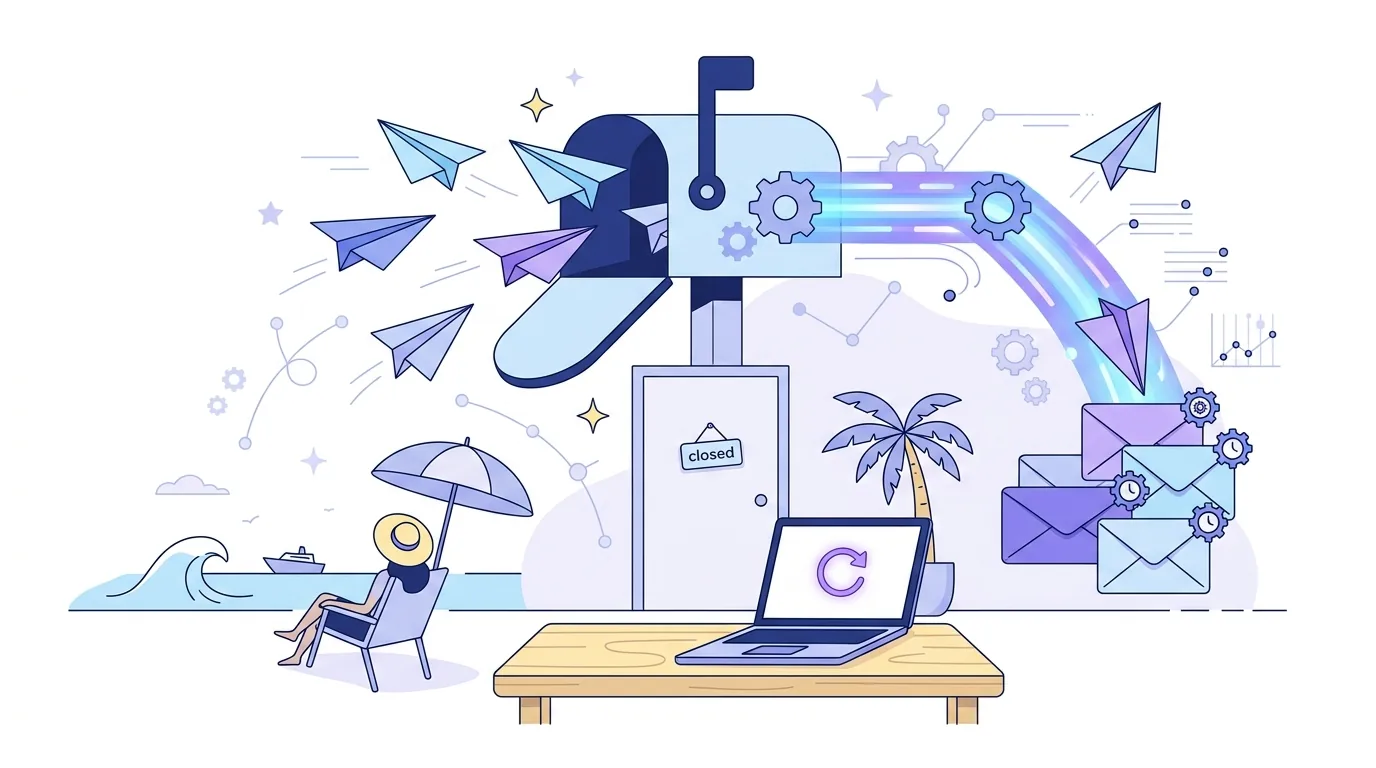
Out-of-office and auto-reply samples
- Standard out-of-office: Thank you for your message. I'm away from [start date] to [end date] and won't be checking email. For anything urgent, please contact [Name] at [address]. I'll reply when I'm back on [return date].
- Event or travel: Thank you for getting in touch. I'm at [event] in [city] until [date] and checking email only occasionally. If it can't wait, [Name] at [address] can help.
- After-hours acknowledgement: Thanks for your email. It arrived outside our working hours of [hours, time zone]. We'll reply on the next working day. If it's about [urgent topic], call [number].
An auto-reply needs three facts: when you're away, whether you're reading email, and who to contact instead. Leave out personal details like where you're travelling if the auto-reply goes to external senders. Auto-replies can also loop, because two mailboxes with out-of-office switched on can answer each other's auto-replies. The IETF's recommendation for automatic responses deals with this. Auto-responders should mark their own messages with the header Auto-Submitted: auto-replied and should not answer messages that already carry an Auto-Submitted value other than "no". Gmail and Outlook settings are covered in our guide to out of office email messages.
How to reply when a prospect answers your cold email
- Prospect is interested: Hi [Name], glad this is relevant. Would [day] at [time] or [day] at [time] [time zone] work for a short call? If neither works, send me a time that does and I'll fit it in. Best, [Your Name]
- Prospect asks for more information: Hi [Name], sure. Here's the one-page overview of [topic]: [link]. The part most relevant to [their situation] is [section]. Happy to go through it on a short call if that's easier. Best, [Your Name]
- Prospect replies to your video message with a question: Hi [Name], thanks for watching and for writing back. On your question about [point from the video]: [direct answer in two sentences]. If it helps, I can walk you through [specific part] on a short call on [day]. Best, [Your Name]
- Prospect says not now: Hi [Name], understood, thanks for telling me. Shall I check back in [month]? If something changes before then, just reply to this thread. Best, [Your Name]
- Prospect says wrong person: Hi [Name], thanks for letting me know. Who handles [topic] on your side? I'll contact them directly and mention that you pointed me their way, if that's alright with you. Best, [Your Name]
- Prospect asks to be removed: Hi [Name], done. I've removed you from our list and you won't hear from me again. Sorry for the interruption. [Your Name]
The removal reply has to be true when you send it. Mark the address as opted out in your sending tool before you type the confirmation, or a scheduled follow-up can still go out. For more ways to answer a refusal, see our not interested email replies, and for the complete set of reply types in an outreach thread, see the email response examples for B2B outreach.
What are some professional email phrases?
- Opening a reply: "Thanks for your email about [topic]." or "Thanks for the quick reply."
- Confirming: "I can confirm that…" or "That works for me."
- Buying time honestly: "I'm checking this with [team] and will reply by [day]."
- Declining: "I won't be able to take this on, but [Name] may help."
- Asking for something: "Could you send me [item] by [day]?"
- Correcting a misunderstanding: "To clarify, [correct fact]."
- Closing: "Let me know if anything's unclear." followed by "Best regards" or "Kind regards".
A phrase sounds professional because it's specific, not because it's formal. "Please find attached" adds nothing that "The contract is attached" doesn't already say. "Per my last email" usually comes across as irritation, so quote the line you mean instead.

What are the common types of email and their uses?
| Email type | What it's used for | Reply expected? |
|---|---|---|
| Request | Asking for information, a document or a decision | Yes, with the answer or a date |
| Confirmation | Locking in a date, price or detail | Only if something is wrong |
| Meeting invitation | Proposing a time and agenda | Accept, decline or counter-propose |
| Follow-up | Picking up an open thread | Yes, if a question is still open |
| Thank-you | Acknowledging help or a meeting | Usually not |
| Out-of-office | Saying you're unavailable and who to contact | No; the IETF's auto-response recommendation asks auto-responders not to answer it |
| Introduction | Connecting two people | Yes, from the person introduced |
| Cold outreach | First contact with a prospect who didn't ask | Optional for the recipient |
| Newsletter | Regular updates sent to subscribers | No |
| Transactional | Receipts, password resets, notifications | No; often sent from a no-reply address |
Dear Sir/Madam letter sample
Use "Dear Sir or Madam" only when you can't find a name. In B2B you usually can, from the company site or the role. Here's a complete sample for a general inbox:
Dear Sir or Madam, I am writing about invoice [number] dated [date], which shows [amount field] instead of the agreed [term]. Could you correct the invoice or confirm who in your accounts team handles this? I have attached the original order for reference. Yours faithfully, [Full Name], [Role], [Company], [Phone]
In British English, "Dear Sir or Madam" goes with "Yours faithfully", and a named greeting goes with "Yours sincerely". Once someone replies with a name, switch to "Dear Ms [Surname]" for the rest of the thread. More variants are in our Dear Sir or Madam alternatives and samples.
Follow up sales email sample
Hi [Name], following up on my note from [day] about [topic]. One thing I left out: [one new, specific fact relevant to their company]. Is this worth a short call, or should I close the loop? Either answer is fine. Best, [Your Name]
Send a sales follow-up as a reply in the same thread so the first message sits underneath it. Each follow-up should add one new fact, not just "bumping this up". Stop after the prospect replies, opts out or bounces. More variants by stage are in our sales follow up email template collection.
Email blast or individual reply: which one?
An email blast sends one identical message to a whole list at once, usually through a marketing platform with an unsubscribe footer. That works for newsletters and announcements to people who subscribed. It doesn't work for replies. A reply answers one person's specific message and belongs in their thread, from your own mailbox. Sending replies or individual follow-ups as a blast drops the thread headers and sends the same text to people who asked different things. How blasts work, and where they hit their limits, is in our guide to what an email blast is.

Where replies fit in B2B email lead generation
In B2B email lead generation, an outbound message only becomes a lead when someone writes back, so the reply is the step that counts. That has two practical consequences. Replies must reach a mailbox someone actually reads, not a shared no-reply address. They also need logging against the contact, so an "interested" reply gets a meeting proposal and an opt-out request gets removed before the next send. The steps before that point, from list building to first send, are in our B2B lead generation guide.
Cold email deliverability: what receiving servers check
Cold email deliverability is decided by the receiving server. It checks three DNS-based signals on your sending domain, each defined in an IETF standard. SPF lists the servers allowed to send for your domain. Its evaluation caps the number of DNS-querying mechanisms such as include, and a record that exceeds the cap returns a permerror. That's a common failure when every new sending tool adds another include to the same record. DKIM adds a cryptographic signature that the receiver checks against a public key published in your DNS. DMARC tells the receiver what to do when SPF or DKIM doesn't align with the visible From domain: none, quarantine or reject. It also says where to send reports. Your replies and your outreach usually go out from the same domain, so a domain damaged by careless cold sending affects your ordinary replies too. A new domain has no sending history, which is why senders warm it up gradually instead of starting at full volume. What else feeds into the decision is covered in cold email deliverability: what decides it.
Email deliverability checklist before you send
- SPF record published, listing every service that sends for your domain, including your email service provider, and staying within SPF's DNS lookup limit.
- DKIM signing switched on for the sending domain and the public key published in DNS.
- DMARC record published, starting with p=none so you get reports before you enforce anything.
- From address on your own domain, with replies going to a mailbox a person reads.
- List verified, with hard bounces and opt-outs removed before each send.
- Unsubscribe or opt-out route in every outreach message. Google's email sender guidelines require bulk senders to Gmail accounts to authenticate with SPF, DKIM and DMARC and to offer one-click unsubscribe.
- Volume raised gradually on a new or quiet domain.
- For EU recipients, check the legal basis for contacting each person. The EU's ePrivacy Directive governs unsolicited electronic marketing, and how member states apply it to B2B contacts differs from country to country.
Each item, with the checks to run, is in the email deliverability checklist for cold email.
How EmailFlow OS sends outreach that prospects reply to in your inbox
EmailFlow OS handles the outreach that comes before the reply. You record one video and upload it to EmailFlow OS, connect your own Brevo account and sending domain, and import your prospect list into EmailFlow OS. EmailFlow OS then personalises that single recording for each recipient, not just each company, and sends every version from your own inbox through your Brevo account and domain. There's no shared platform sender. Because the message comes from your address, a prospect's reply comes back to that same inbox. You answer it with the samples above, and the SPF, DKIM and DMARC records stay under your control. You can find how it works on the EmailFlow OS personalised video email page.
Questions people ask
- What is a good sample reply to a business email?
- A good reply has four parts: one line that shows you read the message, the answer, a dated next step and your name. Here's an example: "Hi Anna, thanks for the draft. I can confirm the scope section as written. I'll send comments on the timeline by Thursday. Best, Tom." Send it with Reply so the In-Reply-To and References threading headers stay intact.
- How long should an email reply be?
- Long enough to answer every question in the incoming message and name a next step, and no longer. For confirmations and acknowledgements that's often just a few sentences. A reply that needs several paragraphs may be better as a short call, followed by a written summary in the same thread so there's a record of what was agreed.
- How quickly should I reply to a business email?
- There's no fixed standard. Many teams set their own internal target, often by the next working day. If you can't answer fully in that time, send an acknowledgement with a date: "I'll reply by Thursday." A dated holding reply tells the sender something definite, while silence leaves them guessing whether the email arrived at all.
- Should I reply to an out-of-office message?
- No. An out-of-office is automatic, and the IETF recommendation for automatic responses asks auto-responders not to answer messages marked Auto-Submitted, which prevents reply loops. Note the return date or the backup contact it gives. Then write to that contact, or follow up in the original thread after the return date.
- Is "Dear Sir or Madam" still acceptable?
- Yes, for formal letters to an unnamed recipient, such as a complaints address or a general inbox. In B2B outreach it signals that you didn't look up who you're writing to, so use the person's name where you can find it. With "Dear Sir or Madam", British English closes with "Yours faithfully".
