13 min read Diesen Artikel auf Deutsch lesen Lire cet article en français Ler este artigo em português
Sales Lead Qualification: Steps, Frameworks
The short answer
Sales lead qualification means checking each lead against four things before a rep spends time on it: fit with your ideal customer profile, a real need, a person with authority or access to budget, and a timeline. You screen leads against firmographic criteria, ask framework questions such as BANT or MEDDIC on a call or by email, and record the answers in your CRM. Only leads that meet your written criteria go to sales.
In this article
- What is sales lead qualification?
- How do you qualify a sales lead, step by step?
- Example: one outbound lead, qualified field by field
- Which lead qualification framework should you use?
- What is an MQL and an SQL?
- What are the 7 types of leads in sales?
- What is the 5 minute rule for leads?
- Which tools track lead qualification?
- How does qualification connect to B2B lead generation?
- B2B lead generation
- B2B email lead generation
- Which sales follow-up emails move a lead through qualification?
- Sales follow up email: what it has to do
- Sales follow up email template and sales email follow up templates by stage
- Sales follow up email examples: what not to send
- Sales pitch structure for a qualified lead
- Where EmailFlow OS fits in outbound qualification
- What goes wrong in sales lead qualification?
- Questions people ask
What is sales lead qualification?
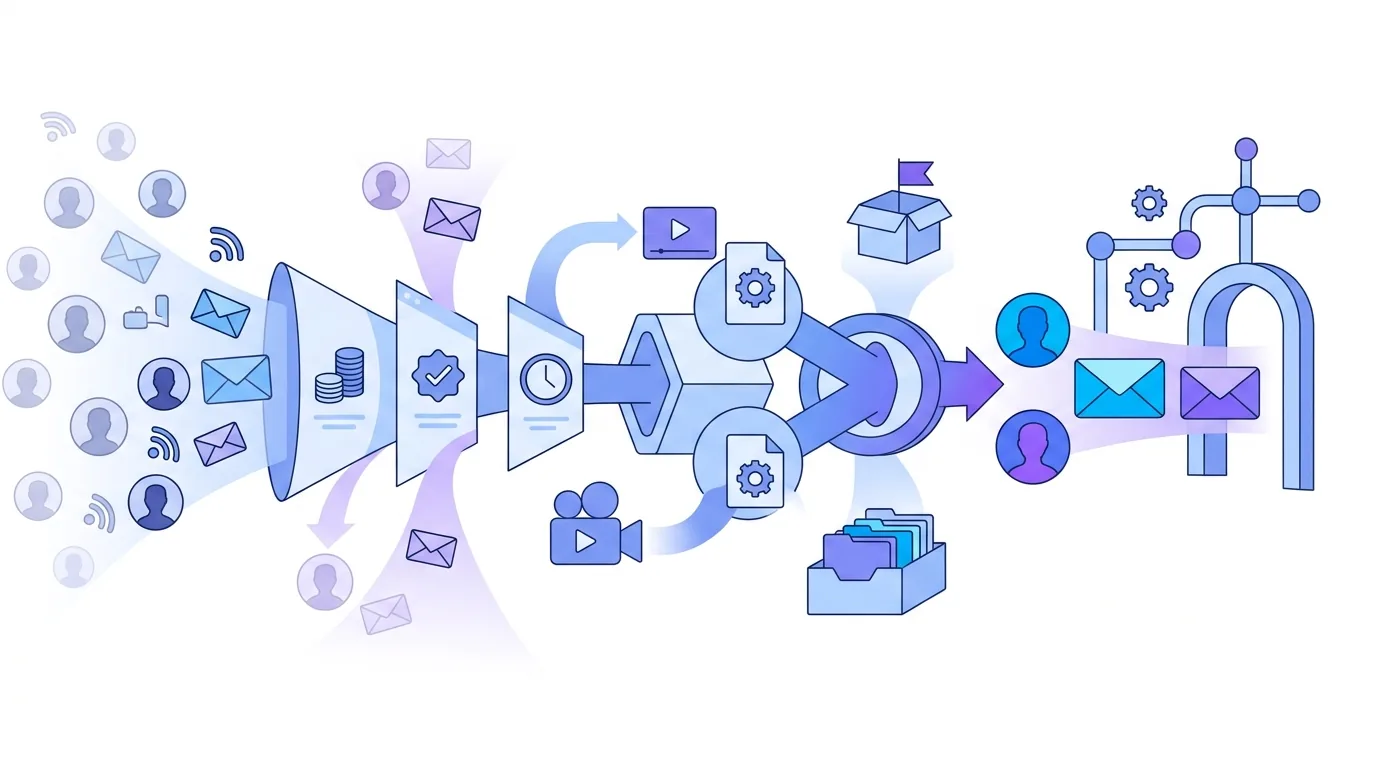
Sales lead qualification is the process of deciding whether a lead meets written criteria (fit with your ideal customer profile, a real need, authority and timing) before a salesperson spends time on it. Leads that meet the criteria go to an account executive with the answers attached. The rest go back to nurturing or get closed, with a reason recorded in the CRM.
The criteria nearly always fall into four groups: fit (industry, company size, region, tech stack), need (a problem your product solves), authority (the person decides, or can get you to whoever does) and timing (a reason to act soon rather than someday). Here's an example. A logistics software vendor defines its ideal customer profile as freight forwarders that run their own fleet. A lead from a small forwarder mentions failed delivery-time audits, so it fits and has a need. But if the contact is a dispatcher with no say over software, authority is still open. The next step is to ask who signs off, not to send a proposal. Qualification is a series of decisions like this one, each recorded so the next person doesn't have to ask again. We've collected the questions themselves in our guide to qualifying questions by sales stage.
How do you qualify a sales lead, step by step?
- Write the ideal customer profile down. List the firmographic properties a customer must have and the ones that rule a lead out. A profile that only lives in someone's head can't be applied the same way twice.
- Screen before you talk to anyone. Check each lead against the profile using data you already have, such as the company website, headcount and industry. Leads that fail a hard criterion stop here.
- Pick one framework and turn it into questions. Whether you use BANT, CHAMP or MEDDIC, each letter becomes one or two open questions a rep can ask.
- Collect the answers in conversation, on a discovery call or in an email reply. Don't ask about budget in the first message. Ask about the problem first.
- Record every answer in a CRM field, not in free-text notes. You can filter and report on a field. You can't do that with a note.
- Apply the handoff rule. A rule like 'need confirmed, decision-maker named, timeline agreed' tells an SDR when to pass the lead to an AE, with the answers attached.
- Re-qualify disqualified leads later. A 'no' on timing often means 'not yet', so set a date to check again instead of deleting the record.
Step 6 is where most processes break. If nobody writes the handoff rule down, every SDR ends up using their own. We cover how that handoff works in SDR in sales: role, handoff and follow-ups.
Example: one outbound lead, qualified field by field
Here's the logistics lead from above as it would sit in a CRM after two emails and one call, with a BANT-style field per criterion. The point of the layout: every status has a source, so the AE can see which answers came from the buyer and which from data.
| CRM field | Recorded answer | Where it came from | Status |
|---|---|---|---|
| Fit (ICP) | Freight forwarder, own fleet, in target region | Company website and list data, before first contact | Met |
| Need | Failed delivery-time audits, wants fewer manual checks | Dispatcher's reply to the first email | Met |
| Authority | Head of operations signs off software, dispatcher recommends | Answer to the authority follow-up email | Met, decision-maker named |
| Budget | Not set yet, depends on audit cost | Discovery call | Open |
| Timeline | Fix wanted before next audit round | Discovery call | Met |
| Handoff decision | Passed to AE as SQL, budget question flagged for the AE | Handoff rule: need, decision-maker, timeline | SQL |
Which lead qualification framework should you use?
Frameworks are sets of questions, not software. They differ in what they ask first and in how much a buyer must have worked out before a lead counts as qualified. BANT is usually traced back to IBM, MEDDIC to the enterprise software company PTC, and GPCTBA/C&I was published by HubSpot. The table compares the common ones on the same points.
| Framework | What the letters stand for | Suits | Where it stops |
|---|---|---|---|
| BANT | Budget, Authority, Need, Timeline | Transactional B2B deals with one buyer and a short cycle | Asking about budget early can stall buyers who haven't set one yet |
| ANUM | Authority, Need, Urgency, Money | Outbound, where reaching the right person is the first hurdle | Doesn't cover how the decision is made inside the account |
| CHAMP | Challenges, Authority, Money, Prioritization | Consultative selling that starts with the buyer's problem | Gives little structure for deals with large buying groups |
| MEDDIC | Metrics, Economic buyer, Decision criteria, Decision process, Identify pain, Champion | Enterprise deals with several stakeholders | Too heavy for small deals. Six fields per lead slows reps down |
| GPCTBA/C&I | Goals, Plans, Challenges, Timeline, Budget, Authority, Negative consequences and Positive implications | Inbound leads who have already researched the problem | The question list is long and can feel like an interrogation in a first email |
A rough rule: the more people who sign the contract, the more of MEDDIC you need. If one person buys, BANT or ANUM is usually enough. There's a broader comparison in sales methodologies: 10 frameworks compared.
What is an MQL and an SQL?
An MQL (marketing qualified lead) fits the profile and has shown interest that marketing counts as meaningful, such as downloading a guide or attending a webinar. Nobody in sales has confirmed need or timing yet. An SQL (sales qualified lead) has been checked against the qualification framework by a person, usually an SDR, and meets the handoff rule. The difference is who confirmed what. An MQL rests on behaviour and data. An SQL rests on answers the buyer gave. If an MQL goes to an AE without that conversation, the AE has to qualify it again, and that's a common reason sales teams stop trusting the leads marketing sends them.
What are the 7 types of leads in sales?
Lists vary, but these seven come up most often. Cold leads have had no prior contact. Warm leads have had some contact or know who you are. Hot leads show active interest and a near-term need. Information qualified leads (IQLs) gave their contact details in exchange for content. Marketing qualified leads fit the profile and have engaged in a meaningful way. Product qualified leads (PQLs) used a free trial or freemium product in a way that signals buying intent. Sales qualified leads have been confirmed by sales against the framework. The first three types describe how warm a lead is. The other four describe which team confirmed the lead and how.
What is the 5 minute rule for leads?
The 5 minute rule says you should contact an inbound lead within five minutes of a form submission or demo request, while the buyer still has your page open and the problem is on their mind. It only applies to inbound leads that asked to be contacted. It doesn't apply to cold outbound, where the prospect hasn't asked for anything. Meeting it depends on routing: the form has to create a CRM record, assign an owner and notify that owner right away. When it fails, the usual cause is a round-robin that assigns leads to reps who are off shift, or a form that only notifies a shared inbox nobody watches.
Which tools track lead qualification?
Qualification data belongs in the CRM, because that's where the handoff happens. B2B teams usually shortlist HubSpot, Salesforce, Pipedrive and Zoho CRM. All four store lead or contact records with custom fields and pipeline stages. That means you can turn each framework letter into a field and the handoff rule into a stage change. They differ in how much of the scoring and routing you build yourself and how much comes ready to configure, and in how much admin work the setup takes. Check each vendor's current documentation for the scoring and routing features on your plan. All four share one limit: a score built on opens and page views measures attention, not need. Our article on account scoring models and their mistakes explains why open tracking misleads.
How does qualification connect to B2B lead generation?
B2B lead generation
B2B lead generation produces the names and qualification sorts them. Inbound sources such as content, webinars and demo forms bring leads that show some interest but vary in fit. Outbound sources such as list building and cold outreach bring leads that fit well but haven't said they're interested. So the qualification work is different. Inbound leads get screened for fit first. Outbound leads get qualified for need and timing in conversation. We lay out the full process in B2B lead generation: 7 steps, tools and limits.
B2B email lead generation
In B2B email lead generation, qualification starts before the first send. Every address you email affects your domain's sender reputation. A list you haven't screened against the profile means more bounces and spam complaints, on top of conversations that go nowhere. Google's Email sender guidelines in Gmail Help ask bulk senders to keep the spam rate shown in Postmaster Tools low and to authenticate with SPF, DKIM and DMARC. In the EU, the GDPR also covers prospect data: its data minimisation principle limits what you store, and it requires you to inform people whose data you didn't collect from them directly. Germany's Unfair Competition Act (UWG) adds its own rules for advertising email. Screening a lead out before you email it costs less than handling a complaint afterwards.
Which sales follow-up emails move a lead through qualification?
Sales follow up email: what it has to do
A sales follow up email (some people say follow up sales email, it's the same thing) has one job: getting one missing qualification answer. If you still don't know who decides, the follow-up asks that and nothing else. Send it as a reply in the original thread. Mail clients use the In-Reply-To and References headers to group a message into a thread, so the buyer sees the earlier context without searching for it. Don't send a fresh 'just checking in' message with no new information and no question. It gives the buyer nothing to answer.
Sales follow up email template and sales email follow up templates by stage
- Need not yet confirmed: 'Hi Anna, you mentioned the delivery-time audit last week. Is fixing that on this year's plan, or is it parked for now?'
- Authority open: 'Thanks, Anna, that's helpful. When a tool like this gets approved, who besides you signs off on it?'
- Timing open: 'If the audit findings come in next quarter, when would a fix need to be live?'
- After a disqualifying answer: 'Understood, that isn't a priority this year. Is it all right if I check back in the spring?'
You'll find ten full versions with subject lines in our sales follow up email template collection.
Sales follow up email examples: what not to send
Here are three sales follow up email examples that fail, and why. 'Any update?' gives the buyer no question to answer. Putting 'Re: our meeting' on a message that isn't really a reply misleads the reader, and a false subject line can also break rules like the US CAN-SPAM Act, which bans deceptive subject headings. A follow-up that asks about budget, authority and timeline all at once reads like a form. Ask one question per email.
Sales pitch structure for a qualified lead
Pitch only after qualification, because a good pitch uses what the buyer told you. One sales pitch structure that works with qualification data has six parts. Start with the trigger (why now). Then comes the problem in the buyer's own words, and its impact, taken from the Metrics or Need answer. After that, the mechanism (how your product removes the problem), proof you can actually back up, and one ask. If you can't fill one of these parts, you're usually missing a qualification answer as well. That's a sign to go back to discovery, not to pitch harder. You'll find examples for email, calls and video in sales pitch structure, examples and follow-ups.
Where EmailFlow OS fits in outbound qualification
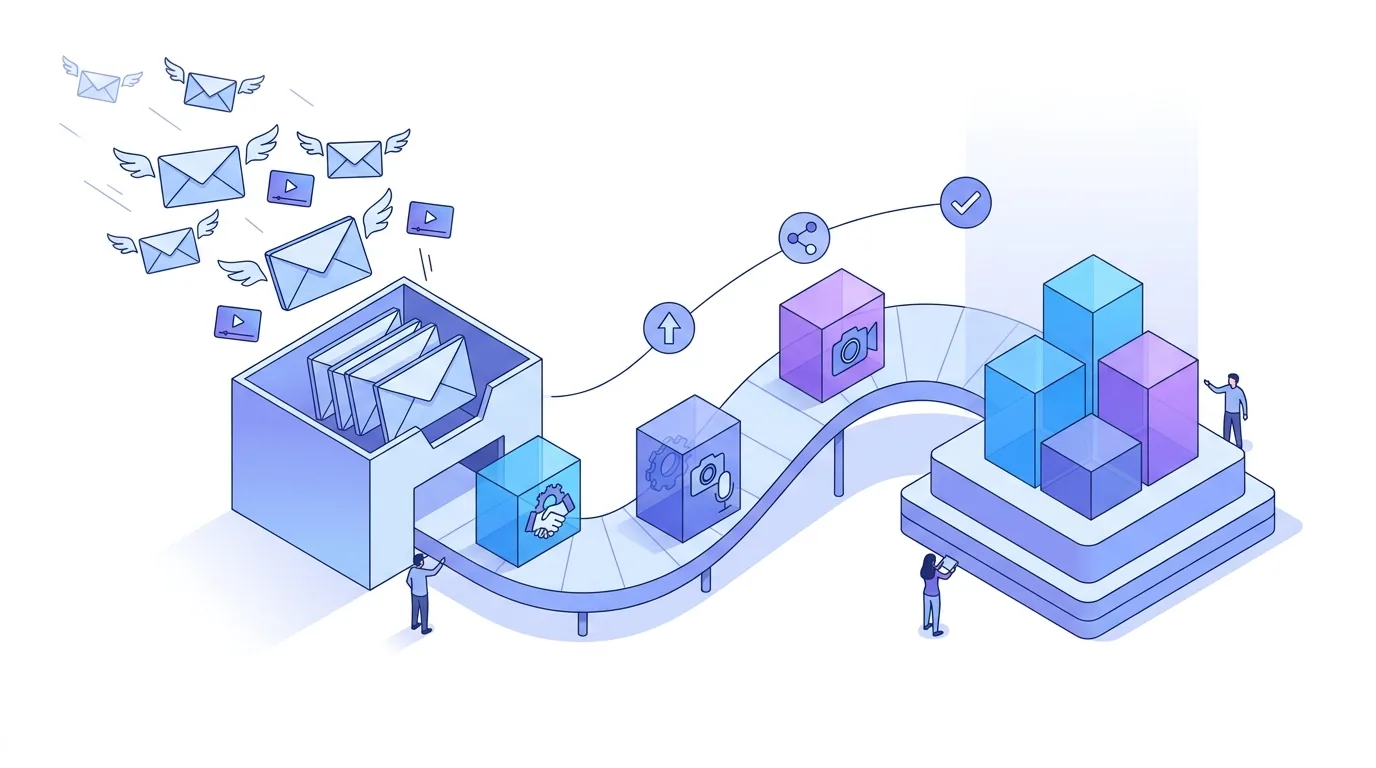
EmailFlow OS handles the outreach step that opens the qualification conversation with outbound leads. You record one video and upload it to EmailFlow OS. You connect your own Brevo account and sending domain, and you import the prospect list you've already screened against your profile into EmailFlow OS. EmailFlow OS then turns that one recording into a separate version for each recipient, not one per company. It sends each version from your own inbox through your Brevo account and your domain, not through a shared platform sender. Your SPF, DKIM and DMARC records, your sending reputation and your list stay under your control. The recipient's mail server decides how each message gets filed, not EmailFlow OS. The EmailFlow OS video outreach overview explains how it works.
What goes wrong in sales lead qualification?
- Leads get qualified on engagement alone. Image proxies and security scanners distort open tracking, so a 'hot' lead may just be a firewall that loaded the email.
- Nobody writes the handoff rule down, so AEs re-qualify every lead and stop trusting SDR notes.
- Teams copy a framework that doesn't match the deal. MEDDIC on a single-buyer deal slows reps down, and BANT on an enterprise deal misses the buying group.
- Disqualified leads get deleted instead of getting a date to check back, so a 'no' on timing is lost for good.
- Unscreened lists get emailed from the main domain, so bounces and complaints from poor-fit addresses count against that domain's reputation.
Questions people ask
- What is sales lead qualification?
- Sales lead qualification is the decision whether a lead meets written criteria before sales spends time on it. The four usual criteria are fit with the ideal customer profile, a confirmed need, authority or access to the decision-maker, and a timeline. Fit is checked from data; need, authority and timing are confirmed by the buyer's own answers and stored as CRM fields.
- How much does a qualified lead cost?
- There's no single figure. Divide your total spend by the number of leads that meet your handoff rule. Spend includes data or list costs, tool licences, SDR time per conversation, and the number of raw leads you need for each qualified one. A stricter definition gives you fewer qualified leads at a higher cost each, so only compare costs between teams that use the same definition.
- What is the difference between lead qualification and lead scoring?
- Lead scoring gives points for attributes and behaviour, such as job title or a visit to the pricing page, and ranks leads automatically. Lead qualification is the decision about whether a lead meets the handoff criteria, usually confirmed by asking the buyer directly. Scoring decides who you contact first. Qualification decides who goes to sales.
- Who qualifies leads, SDRs or AEs?
- In split teams, SDRs qualify and AEs close. The SDR confirms need, authority and timing, then passes an SQL to the AE with the answers attached. In small teams, one rep does both. Our guide to types of sales jobs compares the roles and covers the handoffs between SDR, BDR, AE and account manager.
- Can you qualify a lead by email alone?
- Partly. You can screen fit from data, and you can ask about need or authority one question per email in the same thread. Questions about the decision process and budget usually go better on a call, because the answers lead to follow-up questions. Email qualification fails when one message tries to ask everything at once.
