12 min read Diesen Artikel auf Deutsch lesen Lire cet article en français Ler este artigo em português
Account Executive: Role, Jobs, Outreach
The short answer
An account executive (AE) is the salesperson who owns a deal from qualified opportunity to signed contract. They run discovery, demos and proposals, negotiate and close against a quota, then hand the customer to an account manager or customer success. It's rarely a first job: most AEs move up from SDR or BDR roles. Their outbound email goes out from the company's own domain, so SPF, DKIM and DMARC decide whether it authenticates.
In this article
- What is an account executive?
- What does an account executive do?
- Account executive vs SDR vs account manager
- Is an account executive a high position or an entry-level job?
- Is account executive a hard job?
- Account executive jobs: what postings ask for and how pay is built
- Which tools does an account executive work in?
- Why an AE's outbound email depends on the company's own domain
- How EmailFlow OS works for an account executive's outreach
- Questions people ask
What is an account executive?
An account executive is the person who owns a client relationship or a sales opportunity and answers for its revenue. In B2B sales the AE is the closer: they take a qualified opportunity, run the sales cycle and get the contract signed. In an advertising agency the same title means the client's day-to-day contact.
The two reference definitions people quote most frame it more broadly. Wikipedia's entry (checked November 2026) describes the role in advertising, marketing, sales and finance as one that needs a close understanding of a client company's objectives and products. Investopedia (checked November 2026) describes the account executive as the manager mainly responsible for a corporate account, whether the client is an individual or a company. Neither definition separates the sales AE from the agency AE, and job ads use the title for both. In B2B sales, and in SaaS especially, someone else, usually an SDR or BDR, finds and qualifies the prospect before the AE takes over. In an agency, the account executive carries briefs to the creative team and handles timelines and approvals. When you read a job ad, look at what the role is measured on. A quota on new bookings means a sales AE. Campaign delivery and client retention mean an agency AE.

What does an account executive do?
In B2B sales, an AE's week follows the sales cycle. Each stage ends with something the buyer has to do, not just something the AE did. If you leave out the buyer's action, the pipeline fills with deals that look alive but aren't.
- Accept the handoff: read the SDR's notes on who the prospect is, what problem came up and who else is involved. If the notes are thin, the first call becomes a second qualification call.
- Run discovery: ask about the current situation, the problem, its cost and how the company buys. The exit condition is a confirmed problem and a named next meeting.
- Demo or present: show only what solves the problem discovery uncovered. A full product tour usually means discovery was skipped.
- Map the buying group: find the economic buyer, the users, IT or security reviewers and procurement. A deal with only one contact stalls when that person goes quiet.
- Propose and negotiate: write the proposal, defend the price and terms, and work through legal and security review.
- Close and hand over: get the signature, log it in the CRM and pass the account to an account manager or customer success with a written handover.
- Prospect your own pipeline: in many teams AEs also source part of their own pipeline, through referrals, existing contacts and their own outbound email.
Here's what a usable SDR-to-AE handoff note looks like in practice. It names the contact and their role, the trigger that started the conversation (say, a new head of operations who wants to replace a spreadsheet process), the problem in the prospect's own words, who else was mentioned (finance signs, IT reviews), and the agreed next step with a date. An AE who gets only a name and a meeting time has to rebuild all of that on the first call. After discovery, the AE's recap email should do the same job in reverse: restate the problem as the buyer described it, list who owns which next step, and ask for one thing, such as the security questionnaire or a slot with the finance contact.
Where the discovery call goes wrong is predictable. The AE starts pitching before the prospect has said what hurts, so every later stage rests on a guess. Our breakdown of discovery call questions, flow and follow-up covers that stage in detail.
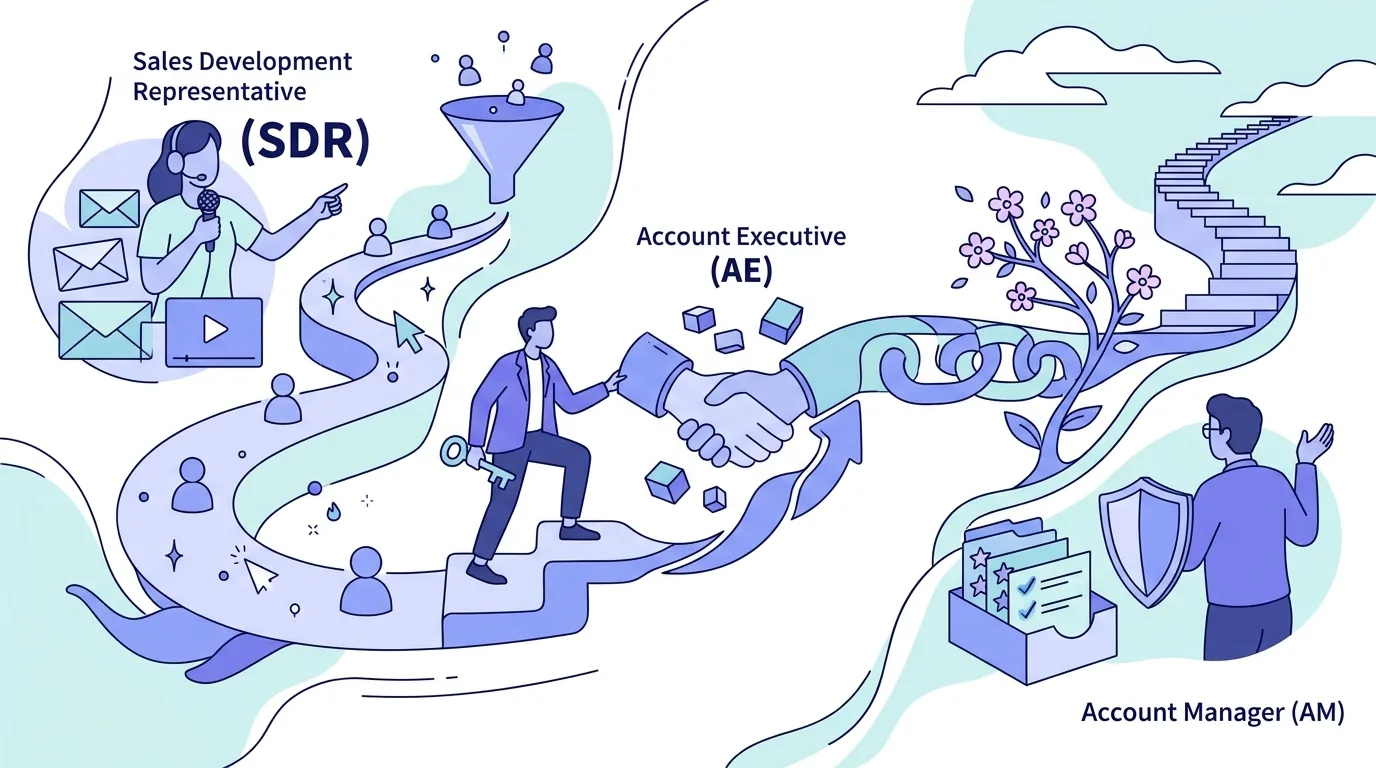
Account executive vs SDR vs account manager
These three roles split one customer's journey into three parts. Most of the confusion comes from small companies, where one person covers two of them. The table describes the usual split in B2B sales teams. If you want every sales role side by side, including sales engineers and managers, see our overview of types of sales jobs.
| SDR / BDR | Account executive | Account manager | |
|---|---|---|---|
| Owns | First contact and qualification | The opportunity, from qualified meeting to signature | The signed customer after the sale |
| Typically measured on | Meetings booked or opportunities accepted | New bookings against a quota | Retention, renewals and expansion |
| Main activities | Research, cold email, calls, booking meetings | Discovery, demos, proposals, negotiation, closing | Check-ins, renewals, upsell and cross-sell |
| Hands off to | The AE, with qualification notes | The account manager or customer success | Usually nobody; the account stays |
| What breaks the handoff | Meetings booked with people who can't buy | Promises made in the sale that nobody wrote down | Renewal surprises nobody saw coming |
Is an account executive a high position or an entry-level job?
It's a mid-level individual contributor role. It isn't a management position, and in most B2B companies it isn't an entry-level one either. The usual path runs through an SDR or BDR role first. Companies want proof that someone can open conversations before trusting them to close. Inside the AE title there's a ladder, usually split by deal size or customer segment: SMB AE, mid-market AE, enterprise AE, and in some companies a strategic or named-accounts AE above that. Enterprise AEs handle fewer, larger deals with longer cycles and bigger buying groups. Past that, people either stay individual contributors on larger accounts or move into sales management. Entry-level AE jobs do exist, mostly in small companies and in transactional sales with short cycles, and in agencies, where the title can be a junior client-service role. If a posting says "account executive" and asks for no experience, check whether a quota is attached. That tells you which kind of role it is.
Is account executive a hard job?
It's demanding in a specific way. The result is measured every quarter against a number, and a large part of it depends on things the AE doesn't control. The pressure comes from a few repeatable causes:
- Thin pipeline: if SDRs or marketing don't supply enough qualified opportunities, the AE can't close what doesn't exist, so many AEs prospect on top of their deals.
- Long cycles: in enterprise deals the outcome of today's work may only show up quarters later, which makes a single bad quarter hard to read.
- Single-threaded deals: one contact changes jobs or goes silent and the deal dies, because nobody else in the buying group knows the AE.
- Forecast discipline: managers expect the AE to say which deals will close and when. Deals stuck in a stage with no buyer action make that forecast wrong.
- Variable pay: when part of the pay is commission, income moves with closed deals, not with hours worked.
What makes it easier is prioritisation. An AE who decides early which accounts deserve time, and drops the rest, spends fewer hours chasing deals that were never going to close. A scoring model is one way to make that decision explicit. Our article on account scoring models, tools and mistakes explains how fit, intent and engagement get combined, and why opens mislead.

Account executive jobs: what postings ask for and how pay is built
Account executive jobs are among the most common sales postings on job boards. The search results for this term (checked November 2026) are mostly city listings on Indeed and similar sites. One Austin listing in those results describes the job as building executive relationships, developing territory plans, coordinating virtual account teams, doing discovery and value-based selling, and demonstrating CRM solutions. That's a fair summary of a mid-market or enterprise AE role. When you compare postings, check these points:
- Segment: SMB, mid-market or enterprise. This sets deal size, cycle length and how many deals you carry.
- Pipeline source: whether SDRs book your meetings, inbound leads come to you, or you're expected to source everything yourself.
- Territory: a region, an industry vertical or a list of named accounts.
- Quota and attainment: the target and how many of the current team actually hit it. Ask in the interview, because postings rarely say.
- Pay structure: base salary plus commission, often stated as on-target earnings (OTE), meaning total pay if you hit your quota exactly. Ask how the base-to-variable split works and whether commission is capped.
- Tools: which CRM and which email and sequencing tools the team uses, and whether outbound email goes from your own mailbox.
Pay ranges in postings vary with segment, region and industry. Compare the OTE and the split between base and variable, not just the headline figure.
Which tools does an account executive work in?
Most AE tool stacks combine three categories. The products below are common examples in each category, compared on the same points. Check plan details on each vendor's own documentation, because features and limits differ by plan.
| Category | Common examples | What it's for | Where it stops |
|---|---|---|---|
| CRM | Salesforce Sales Cloud, HubSpot Sales Hub, Pipedrive | Record of accounts, contacts, opportunities, stages and forecast | Stores and reports; it doesn't send outreach or change how a mailbox's sender reputation looks to receivers |
| Sales engagement / sequencing | Outreach, Salesloft, Apollo.io | Multi-step sequences of email, call and task steps per prospect, with activity logged back to the CRM | Sends through connected mailboxes; deliverability still depends on the sending domain's DNS records and list quality |
| Meetings and conversation capture | Zoom, Microsoft Teams, Gong | Running calls and demos; Gong records and transcribes them for review | Captures what was said; doesn't decide which deals deserve time |

Why an AE's outbound email depends on the company's own domain
When an AE emails a prospect, the message goes out under the company's domain. The receiving server checks three DNS records for it. SPF lists the servers allowed to send for the domain. DKIM signs the message with a key whose public half is published in DNS. DMARC tells the receiver what to do when neither check passes for a domain that aligns with the visible From address. If a sequencing tool sends through servers missing from the SPF record, or signs with a domain that doesn't match the From domain, DMARC can fail even though the message looks normal to the AE. A second problem is that reputation is shared across the domain. One AE sending to an unverified list affects how receivers treat every other mailbox on it. That's why many teams send outbound from a separate subdomain or domain with its own records. Our guide to DKIM, DMARC and SPF for cold email senders walks through the records and shows how to read the results in a message header.
A quick check any AE can run: send a message from the sequencing tool to a personal Gmail address, open it, choose Show original, and read the Authentication-Results line. You want to see spf=pass, dkim=pass with a header.d value that matches your From domain, and dmarc=pass. If dkim=pass shows the tool's domain instead of yours, the signature doesn't align and DMARC won't pass on DKIM. A DMARC record itself is a TXT entry at _dmarc.yourdomain, starting with v=DMARC1; p=none while you collect reports. Our walkthrough of DMARC setup, record tags and reports explains the tags and when to move off p=none.
How EmailFlow OS works for an account executive's outreach
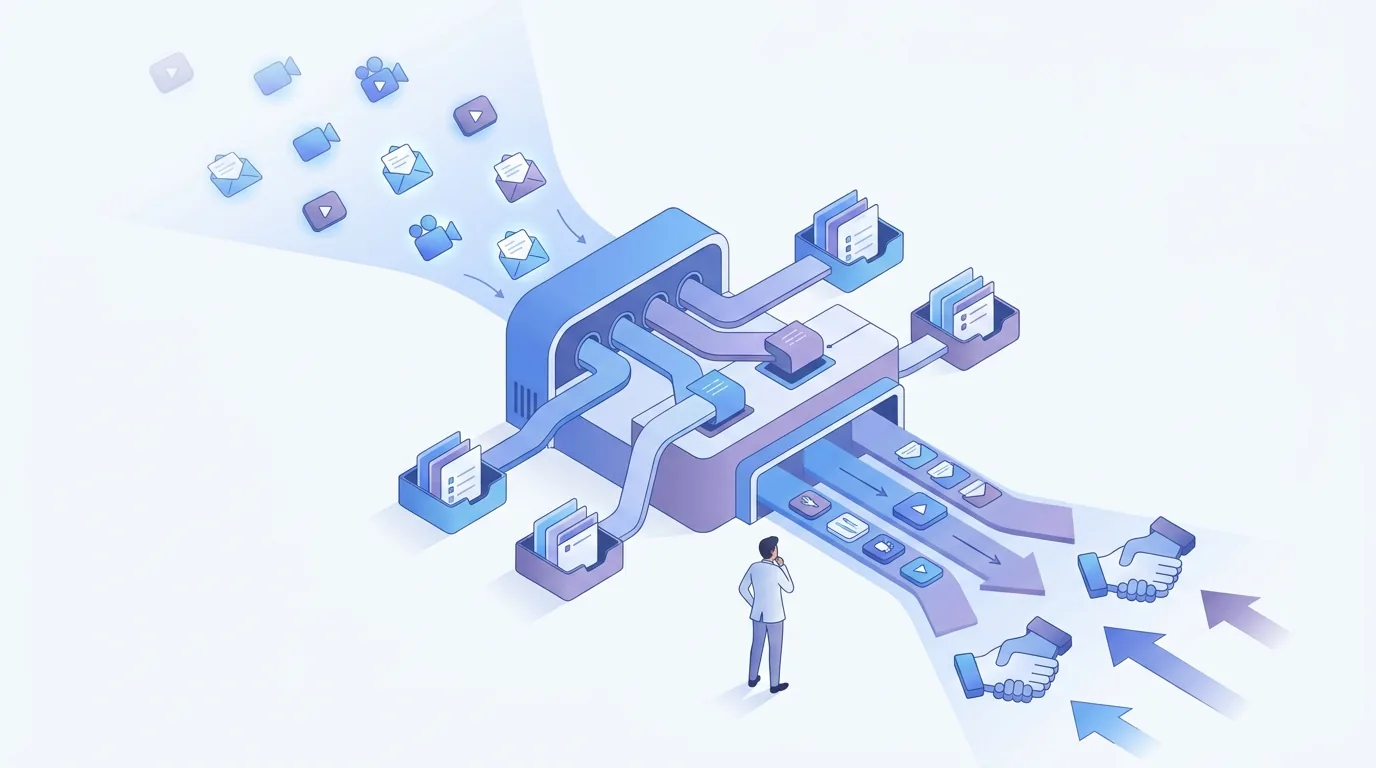
EmailFlow OS is a separate option from the tool categories above. It covers one specific job: personalised video email for B2B cold outreach. The AE records one video and uploads it to EmailFlow OS, connects their own Brevo account and sending domain, and imports their prospect list into EmailFlow OS. From that single recording, EmailFlow OS makes a separate personalised version for each recipient, per person rather than per company. Each version goes out from the AE's own inbox, through their own Brevo account and on their own sending domain, never through a shared platform sender. The DNS records, the Brevo account and the domain's reputation stay under the customer's control, so the SPF, DKIM and DMARC setup described above still applies and is still the customer's to maintain. Whether a message reaches the inbox is decided by the receiving server. The steps are described on the EmailFlow OS home page, and the mechanism behind per-recipient versions is covered in our article on the personalised video message for cold email.
Questions people ask
- What is an account executive in simple terms?
- An account executive (AE) is the salesperson who turns a qualified opportunity into a signed contract. In B2B sales the AE sits between the SDR or BDR, who finds and qualifies prospects, and the account manager, who looks after the customer after signature. In advertising agencies the same title means the client's day-to-day contact for briefs, timelines and approvals.
- What is the difference between an account executive and an account manager?
- An account executive wins new business and is measured on new bookings against a quota. An account manager takes over an existing customer after the sale and is measured on retention, renewals and expansion. Put simply, the AE's work ends at the signature and the account manager's begins there. In smaller companies one person sometimes does both.
- Is an account executive a senior position?
- It's mid-level: an individual contributor role above SDR or BDR and below sales management. Within the title there's a ladder by segment, from SMB AE to mid-market and enterprise AE, sometimes with strategic or named-accounts AEs on top. Agency AE roles are the exception, where the title can be a junior client-service job.
- What does OTE mean in an account executive job posting?
- OTE means on-target earnings: base salary plus the variable commission you'd earn by hitting your quota exactly. Two postings with the same OTE can differ a lot in risk. A higher base share means steadier income, and a higher variable share means pay depends more on closed deals. Ask whether commission is capped above quota.
- Do account executives do their own prospecting?
- Often, yes, at least in part. In teams with SDRs, the SDRs supply most meetings, but AEs still source deals through referrals, existing contacts and their own outbound email, especially when the pipeline runs thin. In small companies without SDRs, the AE does the whole cycle, from first email to signature.
