8 min read Diesen Artikel auf Deutsch lesen Lire cet article en français Ler este artigo em português
Another Word for Looking Forward in Emails
The short answer
Formal options are "I look forward to", "anticipate" and "await your reply". Neutral ones are "expect" and "hope to". Casual ones are "can't wait" and "excited to". After "look forward to", use a noun or an -ing verb, never a bare verb. In a cold email, a concrete question usually does the job better than any of these. When you follow up, reply in the same thread to the same recipient. Forward only when you're adding someone new.
In this article
- Another word for looking forward: options by tone
- How do you say "looking forward" in a professional way?
- What's a fancy word for "looking forward to"?
- Why is it "looking forward to hearing", not "to hear"?
- What to write instead of "looking forward to hearing from you" in a cold email
- To follow up on an email, do you reply or forward?
- Where EmailFlow OS fits in
- Questions people ask
Another word for looking forward: options by tone
If you want another word for looking forward, pick it by tone and by what you actually expect to happen. The Merriam-Webster thesaurus entry for "looking forward to" lists expecting, anticipating, awaiting, hoping (for) and waiting (for) as synonyms. They don't mean quite the same thing. "Expect" says you think it will happen. "Hope" says you'd like it to. "Anticipate" sits in between and can also mean getting ready for something. "Can't wait" adds an eagerness that a business email usually doesn't need.
| Phrase | Tone | Example sentence | Where it fits |
|---|---|---|---|
| I look forward to | Formal | I look forward to your comments on the draft. | Client and partner emails, letters |
| I'm looking forward to | Warm, neutral | I'm looking forward to Thursday's call. | Colleagues, existing contacts |
| Anticipate | Formal | We anticipate your decision by the end of the quarter. | Project updates, plans with a date |
| Await | Formal, slightly stiff | I await your confirmation. | Contracts, approvals, official replies |
| Expect | Neutral, firm | I expect the samples next week. | Deliveries, agreed deadlines |
| Hope to | Polite, soft | I hope to hear your view on this. | Requests where the reader may say no |
| Keen to / eager to | Friendly; keen leans British | Keen to see how the pilot goes. | Internal notes, warm relationships |
| Can't wait / excited to | Casual | Can't wait to see the new office. | Friends, close colleagues, never cold email |
Here's what goes wrong: "await" with no time frame can sound cold or impatient, and "expect" aimed at a stranger sounds like you're demanding something. Keep both for situations where the other side has already agreed to act.

How do you say "looking forward" in a professional way?
The simple present, "I look forward to", reads as more formal than the continuous "I'm looking forward to". That's why it's the standard choice in letters and client emails. For a more formal register, use "I anticipate" or "I await", or, for a team, "We look forward to working with you". For something friendlier that's still businesslike, use the contraction: "I'm looking forward to meeting you next week".
What makes a professional closing work is usually the detail, not the verb. "I look forward to hearing from you" says nothing the reader can act on. "I look forward to your feedback on the pricing section by Friday" names the thing and the deadline. If the reader can't tell what you're waiting for, any synonym is just as vague as the original. The closing line also sits right above your sign-off, so the two should match in register. A stiff "I await your reply" followed by "Cheers" looks careless.
How to pair the closing line with a sign-off is covered in our guide to email closings and sign-offs.
What's a fancy word for "looking forward to"?
The most elevated single-word options are "anticipate" and "await". Phrases like "eagerly await" and "look forward with interest to" also work. Each one changes the sentence structure:
- Anticipate takes a direct object with no "to": "We anticipate your reply", not "We anticipate to your reply".
- Await also takes a direct object: "I await your decision". "Await for" is wrong. "Wait for" is the version that needs "for".
- Eagerly await shows enthusiasm while staying formal. It suits invitations and launches, but not a cold first message to a stranger.
- Envisage and envision mean imagining a future state. "We envisage a rollout in spring" works, but they don't express pleasure about something coming, so they can't replace "looking forward to seeing you".
Fancy wording raises the register, not the clarity. In a short sales email, "anticipate" can come across as legal language. Use it when the rest of the message is just as formal.

Why is it "looking forward to hearing", not "to hear"?
In "look forward to", the word "to" is a preposition, not part of an infinitive. A preposition takes a noun or a gerund. So it's "I look forward to hearing from you" and "I look forward to the meeting", never "I look forward to hear from you". The same rule covers "be used to" and "object to". You can test it by putting a noun in the gap: if "I look forward to the call" works, the -ing form is the right one.
Two neighbours get mixed up with it. "Forward-looking" is an adjective meaning proactive or farsighted. The Merriam-Webster thesaurus lists prescient, farsighted and visionary for it, as in "a forward-looking strategy". It has nothing to do with anticipation. "Going forward" means "from now on". To avoid it, write "from now on", "in future", "from here on" or "starting next month". The last one is the most useful because it names when the change begins.
What to write instead of "looking forward to hearing from you" in a cold email
In a cold email, "looking forward to hearing from you" takes for granted a relationship you don't have yet. It also leaves the next step to the reader. A closing question works better because it has a clear answer: "Is this on your list for this quarter, or should I check back later?" or "Would a short call next week be worth it, or is someone else the right person?" Each one gives the reader a yes, a no or a referral to choose from.
Swapping one stock phrase for another won't change how a message is filtered. Spam filters score the whole message, not one courteous phrase. SpamAssassin, for example, adds up the points of every rule that fires and compares the total with a configurable threshold, the required_score setting. A polite closing line rarely fires a rule at all. The weight sits elsewhere: whether your domain passes SPF, DKIM and DMARC, what your links point to, how the message is formatted, and the domain's sending history. Google's email sender guidelines require bulk senders to Gmail accounts to authenticate with all three. Our article on spam trigger words and how filters score them explains why changing single words rarely matters by itself.

To follow up on an email, do you reply or forward?
To follow up with the same person, reply. Don't forward. A reply keeps the original subject with "Re:" in front and sets the In-Reply-To and References headers, which point to the Message-ID of the earlier message. The internet message format standard defines those headers, and mail clients use them to group the messages into one thread, so your earlier message sits right under the follow-up. Forwarding creates a message with "Fwd:" in the subject. It's meant for passing the content on to someone else, and to the original recipient it looks like you're circulating the email rather than continuing the conversation.
- Reply: following up with the same recipient, nudging after no answer, adding a new fact on the same topic.
- Forward: bringing in a colleague or a different contact who wasn't on the first message, with a short note explaining why.
- Neither: if the topic has really changed, start a new message with a new subject instead of stretching an old thread.
Faking a thread by typing "Re:" into a new message doesn't set the In-Reply-To or References header, so clients that thread by those headers won't group it, and readers often notice. Timing and threading for sequences are covered in cold email follow-up timing, threads and limits.
Where EmailFlow OS fits in
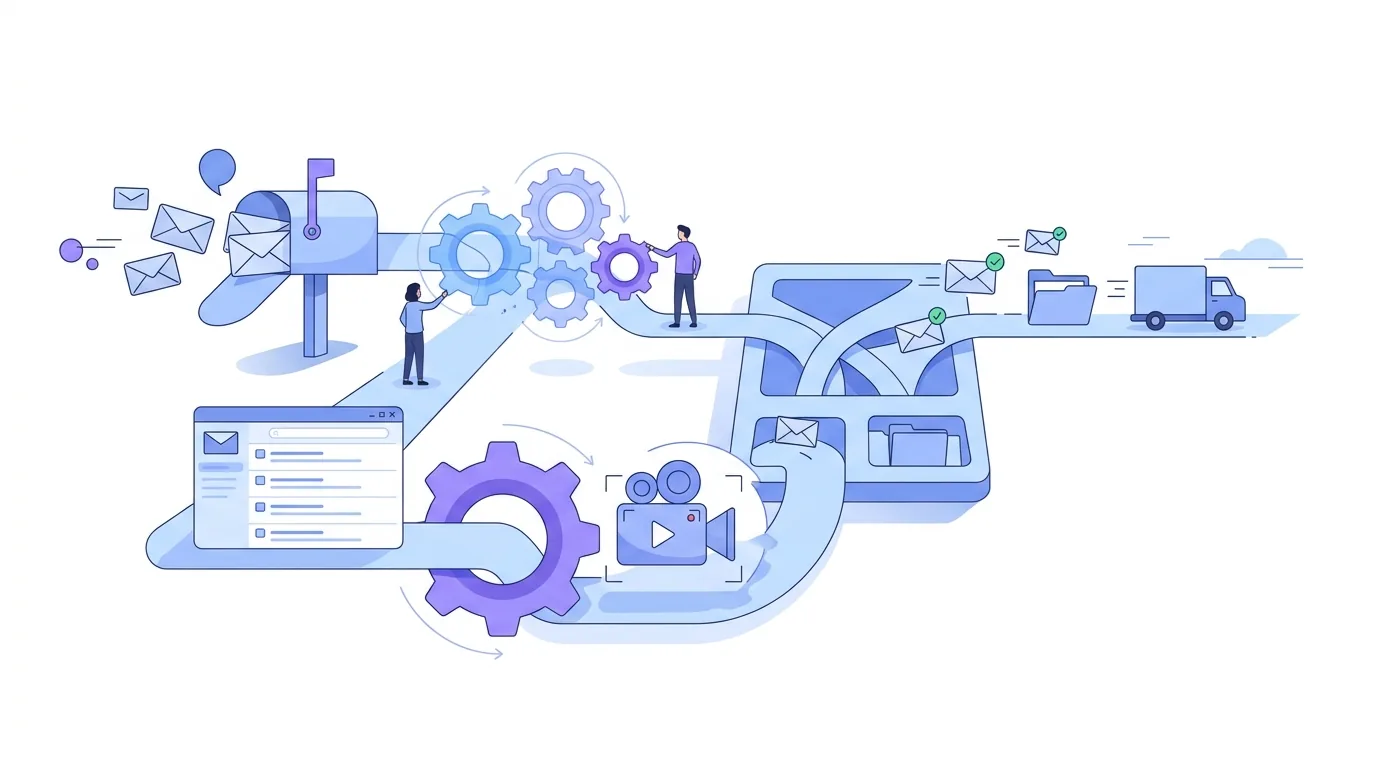
In a video email, the closing line has less to do because the video already makes the ask. A short question under the video is usually all the text needs. With EmailFlow OS, you record one video and upload it. You connect your own Brevo account and sending domain, and you import your prospect list into EmailFlow OS. EmailFlow OS then makes a personalised version of that recording for each recipient, not each company. Each version goes out from your own inbox through your Brevo account and your domain, not through a shared platform sender. The DNS records and sending reputation stay under your control. You can see how this works on the page for personalised AI video email from EmailFlow OS.
What EmailFlow OS doesn't do is write your closing line, or decide whether a receiving server puts the message in the inbox. The receiving server makes that call, based on your authentication, your list and how you send.
Questions people ask
- Is "I look forward to hearing from you" too formal?
- It's standard in letters and formal client emails, so it's not wrong. It is generic, though. Compared with "I'm looking forward to it", it's more formal. Compared with a concrete question like "Does Tuesday morning work?", it's weaker, because it doesn't tell the reader what to do next. For cold outreach, the question is usually the better choice.
- Is "looking forward to speaking with you" correct?
- Yes. "To" is a preposition here, so the -ing form "speaking" is correct. "Looking forward to speak with you" is the common mistake. "Speaking with" and "speaking to" are both fine. "With" sounds a bit more like a two-way conversation, which suits sales calls and meetings.
- What is the opposite of looking forward to?
- Common opposites are "dread", "be apprehensive about" and "not relish". "Dread" is the strongest and means fear of something coming. "Not relish" is mild and fairly British. Note that "apprehension" can also mean anticipation in some thesaurus lists, so check the context before using it as an opposite.
- Can I end a cold email with "looking forward" alone?
- "Looking forward" on its own is a clipped, casual form that leaves out what you're looking forward to. Between colleagues it's fine. In a first-contact email it can read as rushed and presumptuous. A complete sentence or a closing question gives a stranger more context than a two-word sign-off.
